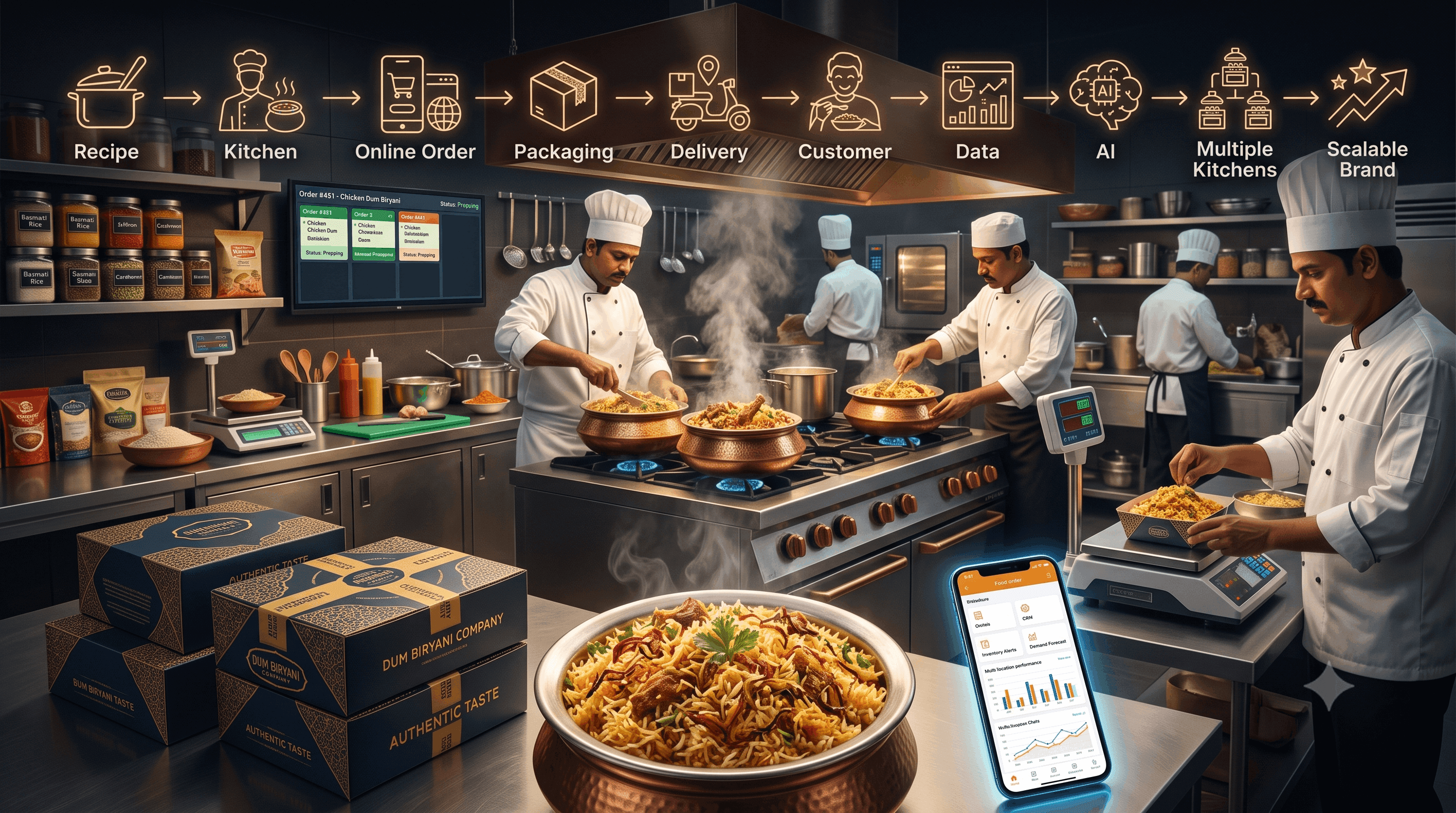
Rahul
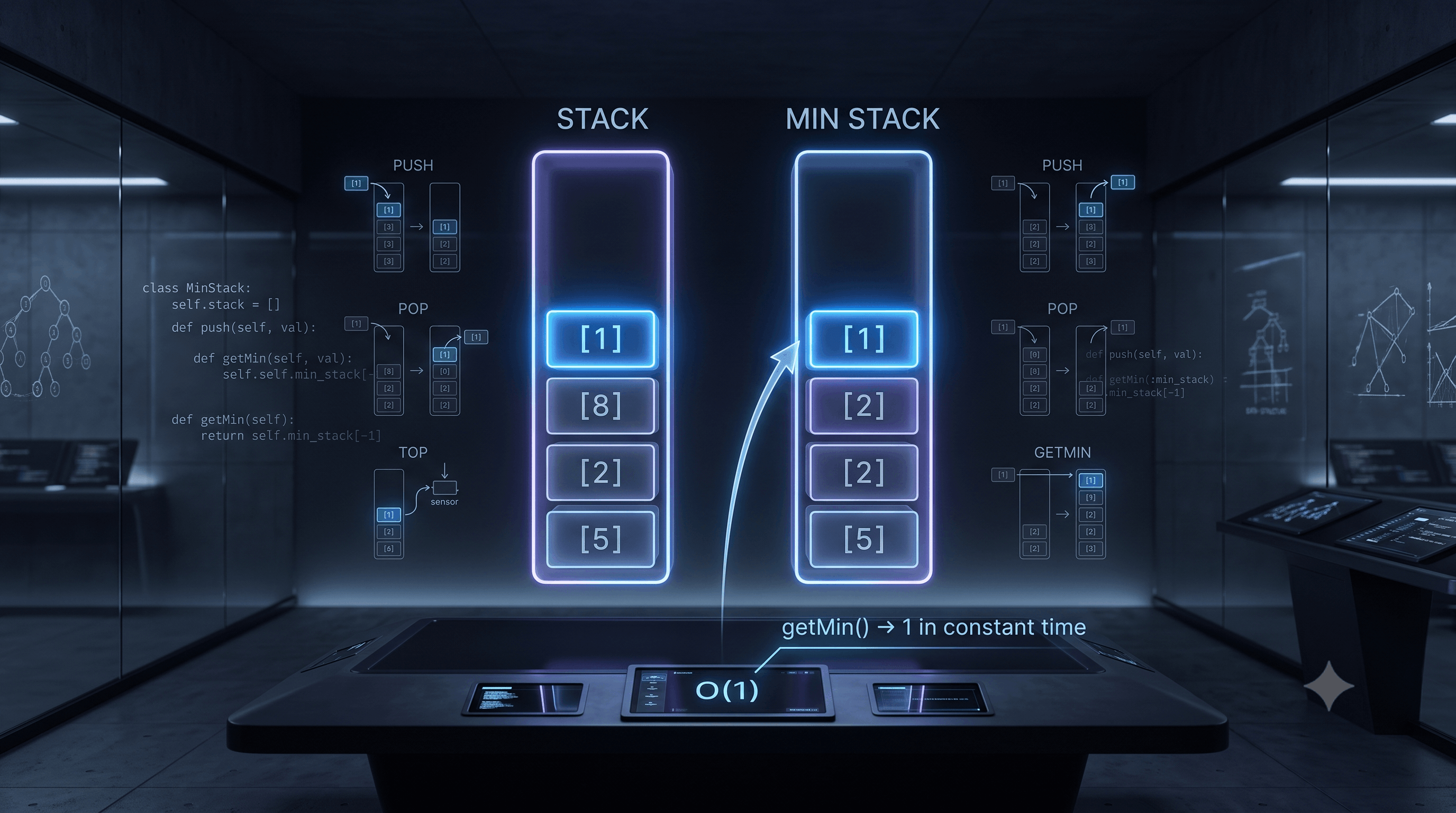 LeetCode #155: Min Stack — Design a Stack with O(1) Minimum Retrieval
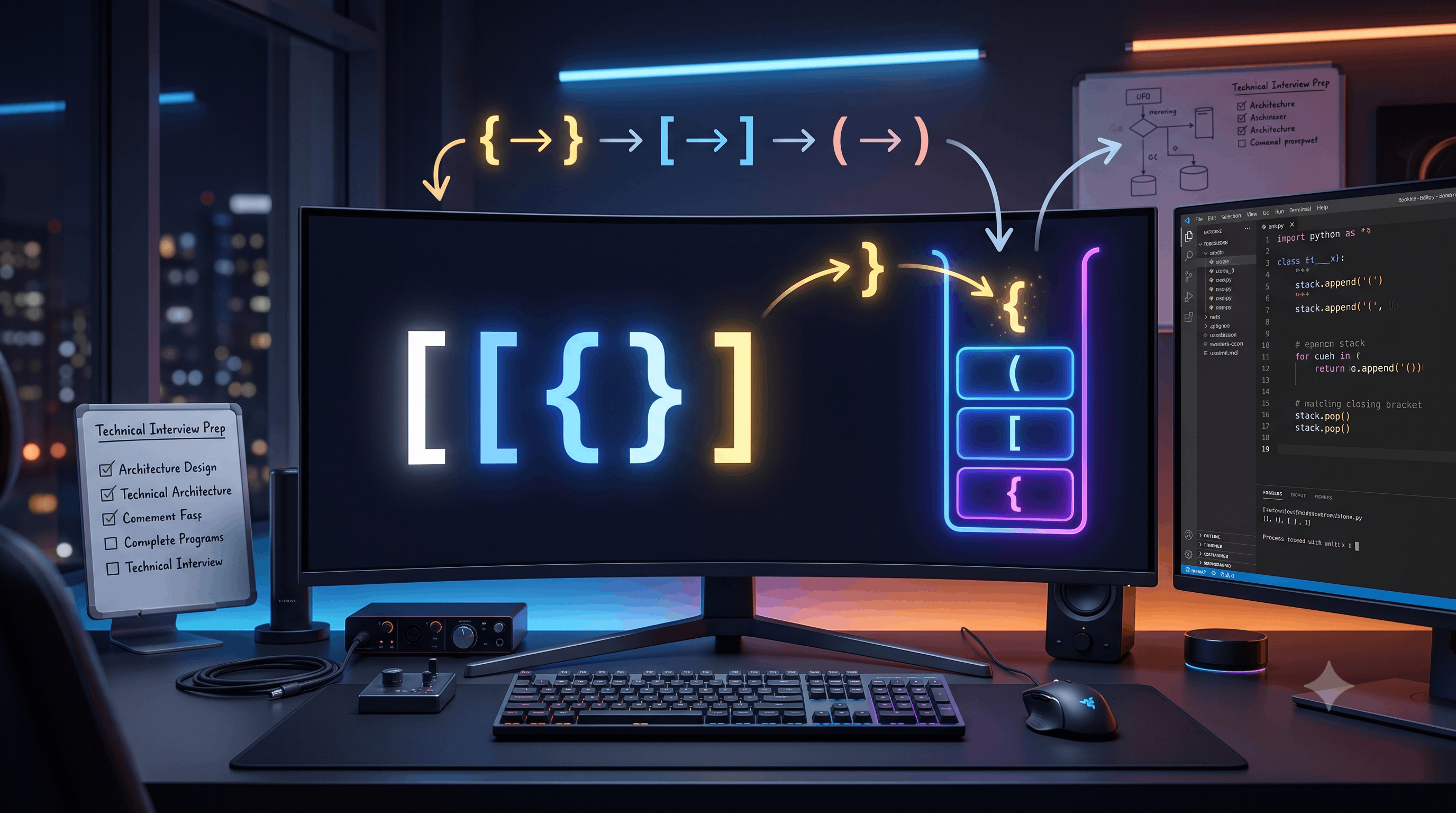 LeetCode #20: Valid Parentheses — Master the Stack Pattern
 LeetCode #15: 3Sum — Master Sorting, Two Pointers and Duplicate Handling
 Instruction vs Context in AI Prompts: How to Tell AI What to Do and What Information to Use
 Rust Structs and Enums: Building Powerful Data Models
 Dissecting the High-Level System Architecture of Booking.com
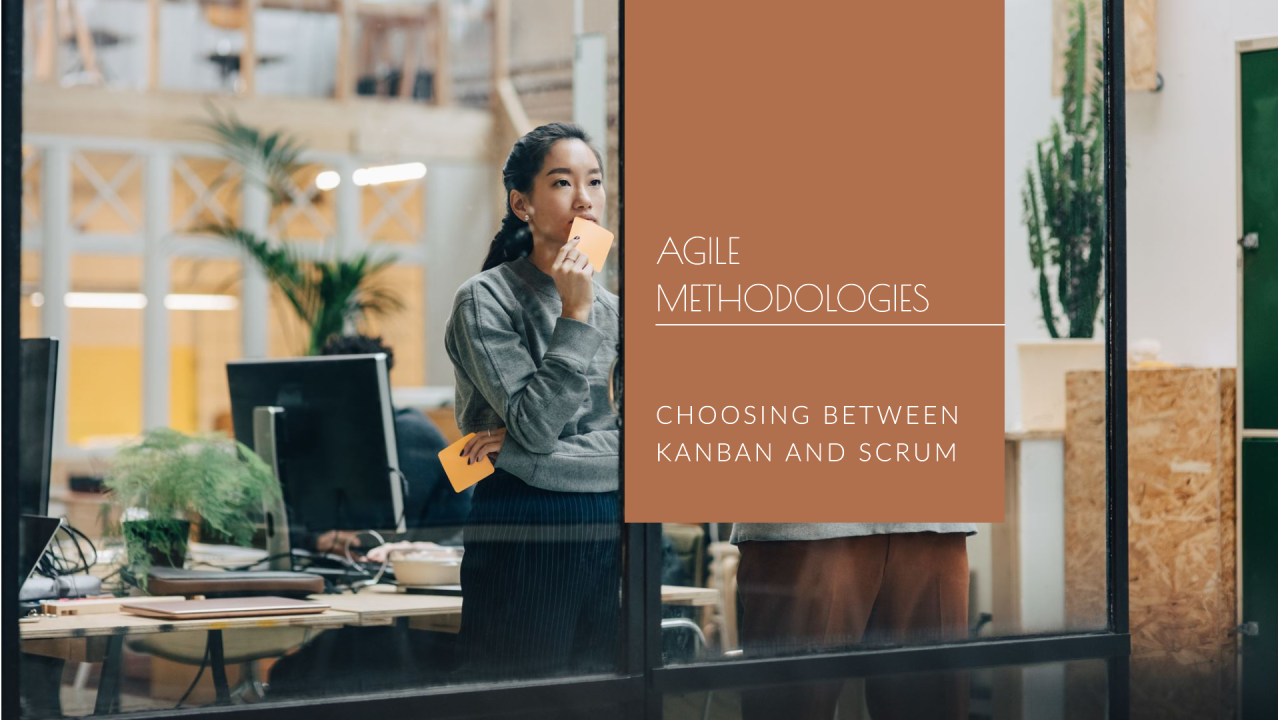 Kanban vs. Scrum: Which Agile Methodology to Choose?
 The Scaling Journey of LinkedIn: From Startup to Professional Powerhouse
 Mastering Code Review: A Guide for Reviewers and PR Creators
 ChatGPT: Unveiling the Power of AI in Conversational Experiences with Kairos Coders

Kairos Coders are here to help
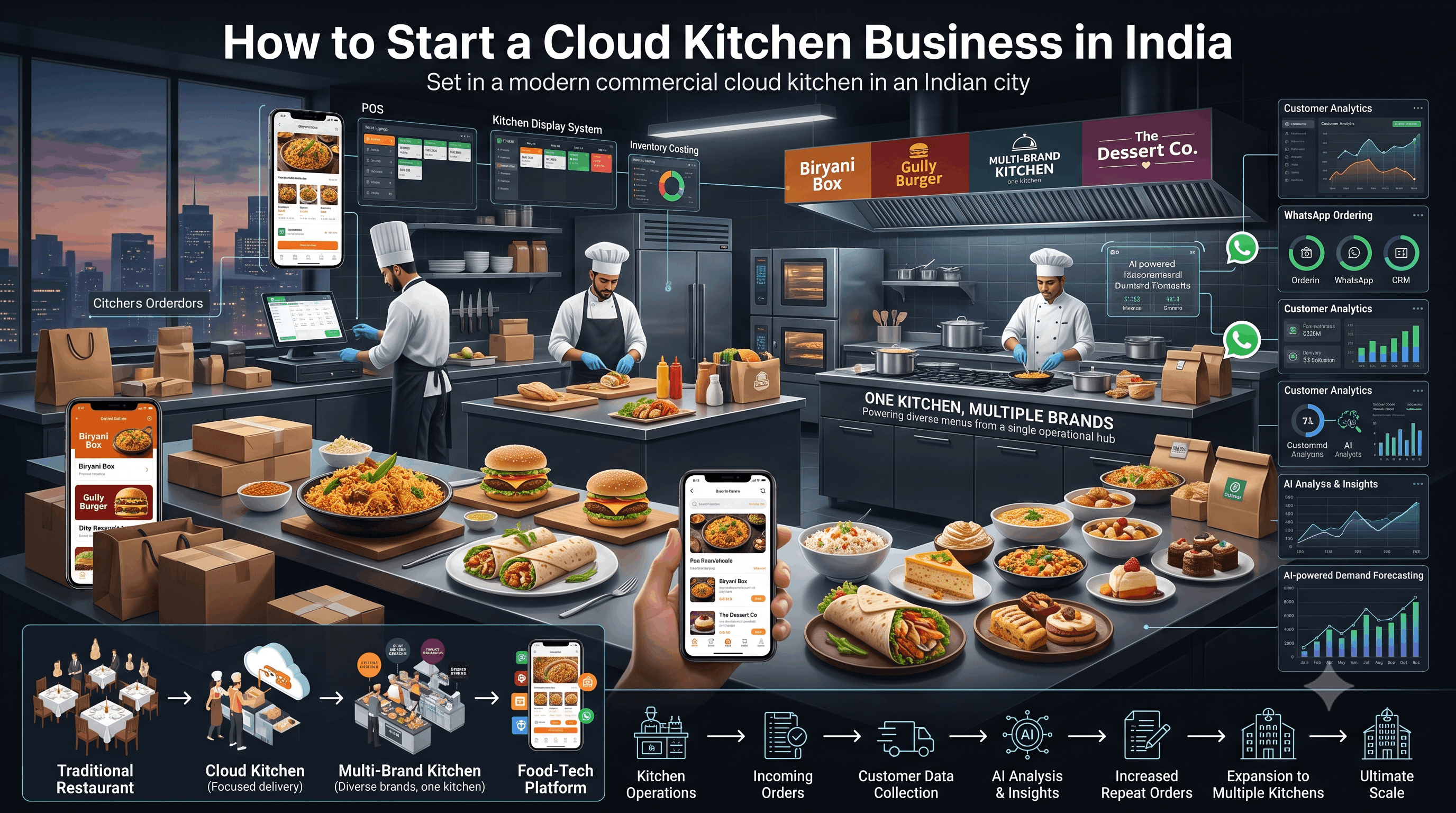
The restaurant business used to require one important thing:
A dining room.
Tables. Chairs. Waiters. Décor. Parking.
Then cloud kitchens changed the equation.
A customer doesn't necessarily care whether your restaurant has 50 tables.
They care about:
Taste → Price → Packaging → Delivery Speed → Reviews → Consistency
And that creates an interesting opportunity for entrepreneurs.
India has already produced large food-tech businesses built around delivery-first restaurant models. Rebel Foods, the company behind brands such as Faasos and Behrouz Biryani, is one of the most useful real-world case studies. Its platform has also expanded into a multi-brand restaurant ecosystem through EatSure.
The lesson isn't simply:
"Start a cloud kitchen."
It's:
Build a restaurant without making the restaurant itself the centre of the business.
A cloud kitchen is essentially a food business designed primarily for:
Online orders → Kitchen → Delivery
There may be:
Instead of spending heavily on customer seating, more capital can go toward:
Kitchen → Food → Packaging → Technology → Marketing
| Traditional Restaurant | Cloud Kitchen |
|---|---|
| Dining space | Kitchen-focused |
| High interior cost | Lower front-of-house cost |
| Waiters | Minimal service staff |
| Walk-in customers | Online customers |
| Table turnover | Order throughput |
| Décor important | Packaging/brand important |
| Location visibility | Delivery radius |
| Large footprint | Smaller footprint |
But there is an important catch.
A cloud kitchen doesn't eliminate expenses.
It moves them.
Instead of paying heavily for dining space, you may spend more on:
Rebel Foods is probably one of the most important Indian examples to study.
The company started with Faasos and eventually evolved into a much larger internet-first restaurant company operating multiple brands.
Its current website describes Rebel Foods as the world's largest internet restaurant company, with 45+ brands and 4,000+ restaurants across 80+ cities, while noting that the network includes franchise and partner locations.
That's an extraordinary transformation.
It started with:
Food
and became:
Food + Technology + Brands + Data + Distribution
Imagine opening one restaurant.
You have:
One kitchen
One brand
One menu
One customer segment
But what if that same kitchen could produce food for multiple brands?
That's where the model becomes interesting.
For example:
                  ONE KITCHEN
                      │
        ┌─────────────┼─────────────┐
        ↓             ↓             ↓
     BRAND A       BRAND B       BRAND C
        │             │             │
        └─────────────┼─────────────┘
                      ↓
                 SAME KITCHEN
                      ↓
                   DELIVERY
The kitchen infrastructure can potentially be utilized across multiple concepts.
This is one of the biggest ideas behind modern cloud kitchens.
Imagine a 400 sq. ft. kitchen.
Instead of selling only:
Biryani
you could potentially operate:
Biryani Brand
Rice Bowl Brand
Kebab Brand
Dessert Brand
But there's a critical requirement:
The concepts must share enough ingredients, equipment and operational capacity to make the economics work.
Otherwise you simply create unnecessary complexity.
Rebel Foods also operates EatSure, its food delivery platform.
EatSure's positioning emphasizes multiple food brands, quality standards and transparency around ingredients and preparation.
This demonstrates an important strategic shift.
A company doesn't necessarily have to depend entirely on a third-party marketplace.
It can eventually try to build:
Brand
Kitchen
Ordering Platform
Customer Relationship
Delivery Ecosystem
That is a much deeper technology play.
There is no universal number.
A tiny takeaway kitchen and a multi-brand commercial kitchen can have completely different budgets.
For a small independent operation, an illustrative model might look like:
| Expense | Example |
|---|---|
| Security deposit | ₹75,000 |
| Kitchen setup | ₹1,50,000 |
| Gas/electrical work | ₹50,000 |
| Commercial equipment | ₹1,25,000 |
| Refrigerator/freezer | ₹60,000 |
| Utensils/prep equipment | ₹40,000 |
| POS/tablet/printer | ₹20,000 |
| Branding | ₹25,000 |
| Packaging | ₹25,000 |
| Initial inventory | ₹50,000 |
| Licenses/misc. | ₹30,000 |
| Working capital | ₹1,00,000 |
| Illustrative total | ₹7,50,000 |
You could spend less with a very small operation.
You could also spend several times more for:
Treat this as a planning example, not a quotation.
Imagine two businesses.
Monthly rent:
₹1,50,000
Dining area:
1,500 sq. ft.
Staff:
8–12 people
Monthly rent:
₹50,000
Kitchen:
400 sq. ft.
Staff:
4–6 people
The second business can potentially reach profitability with lower fixed costs.
But only if it generates sufficient order volume.
For a restaurant:
Location visibility matters.
For a cloud kitchen:
Delivery accessibility matters.
You need to understand:
A kitchen in the wrong place can destroy the business even if the food is excellent.
Don't start with:
"We'll sell everything."
That's a recipe for operational chaos.
Instead choose a focused proposition.
Examples:
The best cuisine isn't necessarily the most popular.
It's the one where you can build:
Demand + Differentiation + Margin + Repeat Orders
Suppose your cloud kitchen has:
60 dishes
That sounds impressive.
But it also means:
Instead:
Start with:
10–20 highly engineered products.
Then expand based on actual demand.
This is one of the most important cloud-kitchen concepts.
Imagine you buy:
Chicken
You can use it for:
One ingredient.
Multiple products.
This can improve inventory utilization.
For example:
| Ingredient | Burger | Wrap | Bowl | Rice |
|---|---|---|---|---|
| Chicken | ✓ | ✓ | ✓ | ✓ |
| Onion | ✓ | ✓ | ✓ | ✓ |
| Lettuce | ✓ | ✓ | ✓ | |
| Rice | ✓ | ✓ | ||
| Sauce | ✓ | ✓ | ✓ | ✓ |
Now you can identify ingredients with high utilization.
This is where technology becomes extremely useful.
Suppose:
Selling price = ₹249
Ingredients:
₹70
Packaging:
₹20
Total direct cost:
₹90
Contribution before other expenses:
₹159
But remember:
Delivery commissions, discounts, advertising and overhead can significantly reduce what actually reaches the business.
Never confuse:
Food margin
with:
Net profit.
One of the biggest differences between a normal restaurant and a delivery-first business is the acquisition channel.
You may receive an order through:
Swiggy
or
Zomato
But the platform ecosystem can involve:
Therefore your pricing must be designed around the actual channel economics.
Suppose:
Dine-in price = ₹200
That doesn't automatically mean:
Online price = ₹200
You need to account for:
Your channel-specific unit economics matter.
Third-party platforms are excellent for discovery.
But your long-term asset is:
Customer relationship.
Imagine a customer orders:
20 times
but you have no direct relationship with them.
The marketplace owns much of the customer interaction.
Now imagine:
20 orders
and the customer is also part of your:
CRM
Now you can potentially send:
That customer becomes a business asset.
Your system could store:
CUSTOMER

Name: Aman

Orders: 27

Favorite:
Chicken Biryani

Average Order:
₹482

Last Order:
11 days ago

Preferred Time:
8–9 PM

Location:
2.8 km

Lifetime Value:
₹13,014
Now marketing can become much more intelligent.
Imagine:
"Hi Aman 👋 Your usual Chicken Biryani is just one message away. Reorder?"
Customer:
YES
System:
Order confirmed.
That's a simple example of conversational commerce.
You don't necessarily need a native mobile app.
Instead of constantly offering:
20% OFF
create:
₹100 spent
→ 10 points
500 points
→ ₹100 reward
Higher frequency customers receive:
The goal is:
Increase frequency without destroying margins.
When customers never visit your physical kitchen, the package becomes their interaction with your brand.
Your packaging should communicate:
Logo
Brand personality
Food safety
Reheating instructions where needed
Contact information
QR code
Social media
And ideally:
A memorable experience.
Imagine opening a food package and seeing:
"You just made our kitchen happy. ❤️"
Then:
Scan → reorder
This tiny detail can improve brand recall.
A cloud kitchen doesn't have a storefront that customers can visually judge.
Instead they see:
4.6 ⭐
2,000 reviews
Food photographs
Delivery time
This becomes your digital storefront.
Therefore:
Every order is a marketing event.
Imagine receiving:
2,000 reviews.
Nobody can manually read all of them.
AI can classify:
Positive: 82%
Positive: 91%
Positive: 64%
Positive: 71%
Negative: 18%
Now you know where the problem is.
Suppose:
Paneer Wrap
Orders: 500
Rating: 4.7
Contribution: ₹90
Excellent.
But:
Mexican Rice Bowl
Orders: 38
Rating: 3.9
Contribution: ₹40
The system can recommend:
Remove or reformulate Mexican Rice Bowl.
That's data-driven menu management.
Suppose your kitchen historically receives:
Friday 7 PM
→ 90 orders
Saturday 7 PM
→ 130 orders
Monday 7 PM
→ 55 orders
The system can forecast:
Saturday demand = 125–145 orders
Then prepare:
This reduces:
Stockouts + Delays + Waste
Imagine:
Potential increase:
Potential increase:
AI can combine:
Weather + historical orders + weekday + promotions
to predict demand.
Imagine your kitchen dashboard at 6 PM:
TONIGHT'S FORECAST

Biryani       87
Wraps         61
Burgers       44
Rice Bowls    32

Expected Orders
6 PM–10 PM: 224

Chicken Required
18.4 kg

Rice Required
14.2 kg

Packaging
250 sets
Now your kitchen isn't guessing.
It's preparing based on data.
Instead of printed tickets:
ORDER #1842

2 × Chicken Biryani
1 × Paneer Wrap
1 × Coke

STATUS:
🔥 PREPARING
Then:
Preparing
→ Ready
→ Picked Up
This improves kitchen coordination.
Suppose your kitchen receives:
30 orders/hour
but can only comfortably produce:
20 orders/hour
You have a bottleneck.
Maybe:
Technology can reveal the bottleneck.
Think about it like software.
Ingredients
Cooking
Food
Recipe + temperature + portion
Customer
That means restaurant operations can be treated almost like a manufacturing system.
For every product:
PRODUCT: CHICKEN BIRYANI

1. Prepare rice
2. Prepare chicken
3. Portion chicken
4. Add rice
5. Add garnish
6. Seal container
7. Quality check
8. Dispatch
This is essential if you want multiple kitchens.
Customer orders:
Chicken Biryani
from:
Delhi Kitchen
or:
Chandigarh Kitchen
or:
Mumbai Kitchen
They should receive a reasonably consistent product.
That requires:
Recipe
Ingredient specification
Portion
Process
Quality control
As you grow:
Kitchen 1
Kitchen 2
Kitchen 3
may all purchase independently.
That's inefficient.
A larger company can centralize:
Technology can track purchasing across all locations.
Imagine:
REBEL-STYLE FOOD OS

12 KITCHENS

TODAY
Orders: 3,842
Revenue: ₹18.7L

BEST KITCHEN
Delhi #03

LOWEST RATING
Mumbai #02

WASTAGE
2.8%

TOP BRAND
Biryani

TOP PRODUCT
Chicken Biryani

AI ALERT
Delhi #04 may
stock out of chicken
by 9 PM
That's where the technology becomes powerful.
Suppose you operate:
Biryani
Wraps
Desserts
If all three brands share:
you potentially increase utilization.
But again:
More brands ≠ automatically more profit.
Poorly designed multi-brand operations create enormous complexity.
A new entrepreneur should usually prove:
One cuisine
One brand
One kitchen
One delivery area
Then optimize.
Only after finding product-market fit should you consider:
Second brand
You don't necessarily need the most expensive commercial street.
You need:
Dense demand + affordable rent + delivery accessibility
For example:
TARGET RADIUS

0–2 km
★★★★★

2–4 km
★★★★

4–6 km
★★

6+ km
★
The ideal radius depends on cuisine, delivery economics and local competition.
Don't immediately spend ₹2 lakh on advertising.
Find your first customers through:
Then ask:
Would you order again?
That's more important than:
Did you click the advertisement?
Suppose:
100 people order once.
Interesting.
But:
60 people order again.
Now you may have something.
If:
40 customers order five times
that's even stronger evidence.
The goal isn't simply:
Acquire customers.
It's:
Create a reason for customers to return.
Cloud kitchens can experiment with:
20 meals/month.
30 meals/month.
High-protein meals.
Weekly family meals.
Subscriptions can create predictable demand.
Imagine:
₹4,999/month
for:
20 meals
Average:
₹250/meal.
If the customer would otherwise order sporadically at ₹300–₹400, the subscription creates a value proposition.
But you need to calculate:
before launching.
Suppose:
Average order value = ₹450
Orders:
100/day
Daily revenue:
₹45,000
At 30 days:
₹13,50,000
Now consider:
Your actual profit could be dramatically lower.
Revenue is not profit.
Suppose monthly fixed expenses:
₹4,00,000
Average contribution per order:
₹150
Break-even:
₹4,00,000 ÷ ₹150
≈ 2,667 orders/month
≈ 89 orders/day
That's your approximate operating break-even in this simplified model.
Buying customers instead of building customers.
Suppose you spend:
₹300
to acquire a customer.
Customer places:
₹500 order
You may feel successful.
But if that customer never comes back, the economics may be terrible.
Now imagine:
Customer acquisition:
₹300
Lifetime contribution:
₹2,500
Much healthier.
This is why Customer Lifetime Value (LTV) matters.
Customer Acquisition Cost.
How much does it cost to get one customer?
Customer Lifetime Value.
How much contribution does that customer generate over their relationship with you?
Your goal is:
LTV > CAC
with sufficient margin to cover overhead and risk.
KAIROS CLOUD KITCHEN OS

TODAY

Orders              428
Revenue             ₹1.94L
Avg Order           ₹453

Food Cost           31%
Packaging            6%
Marketing            8%

Repeat Customers    42%

Top Product
Chicken Biryani

Low Product
Veg Rice Bowl

Wastage             2.4%

AI FORECAST
Tomorrow:
+17% demand
That's the kind of software layer Kairos Coders could build for restaurant businesses.
Rebel Foods is an extraordinary example because it demonstrates that a food company can become a technology-enabled multi-brand restaurant platform.
The company describes its model around internet-first restaurants, multiple brands and technology infrastructure.
The lesson:
Don't think of your kitchen as a restaurant. Think of it as a food production and distribution node.
That's a much more scalable way of thinking.
EatSure demonstrates another layer:
Discovery
Ordering
Multiple Food Brands
Customer Experience
A restaurant company can potentially move closer to owning the entire customer journey.
That's a powerful idea for entrepreneurs.
Creates operational chaos.
Creates unnecessary complexity.
Destroys margins.
Creates inconsistent food.
Damages the customer experience.
Makes you dependent on marketplaces.
Creates wastage.
Damages digital reputation.
Can multiply losses.
Start:
One Kitchen
↓
One Brand
↓
10 Products
↓
100 Customers
↓
Repeat Orders
↓
Positive Unit Economics
↓
Technology
↓
Second Kitchen
↓
Second Brand
↓
Central Procurement
↓
Multi-Brand Food Platform
That's a much safer progression than:
"Let's open five kitchens."
The biggest lesson from Rebel Foods isn't about burgers, biryani or wraps.
It's about architecture.
A traditional restaurant thinks:
Kitchen → Customer
A modern food-tech company can think:
Kitchen → Brand → Technology → Marketplace → Customer → Data → Retention → New Orders
That's a completely different business.
The kitchen makes the food.
Technology makes the system scalable.
And the most valuable asset eventually becomes:
the customer relationship + operating data + repeat demand.
A cloud kitchen can become a serious software problem:
POS
→ Kitchen Display
→ Inventory
→ Recipe Management
→ Procurement
→ Delivery
→ CRM
→ Loyalty
→ Analytics
→ AI Forecasting
→ Multi-Brand Management
→ Multi-Location Dashboard
Imagine building a "Shopify for restaurants"—not merely software that records orders, but an operating system that helps a food entrepreneur decide:
What should I cook?
How much should I buy?
Which product should I promote?
Which customer should I bring back?
Which kitchen is losing money?
Where should I open my next kitchen?
That's where food business meets technology.
Pixels to Perfection Design that Impresses