
Rahul
 LeetCode #155: Min Stack — Design a Stack with O(1) Minimum Retrieval
 LeetCode #20: Valid Parentheses — Master the Stack Pattern
 LeetCode #15: 3Sum — Master Sorting, Two Pointers and Duplicate Handling
 Instruction vs Context in AI Prompts: How to Tell AI What to Do and What Information to Use
 Rust Structs and Enums: Building Powerful Data Models
 Dissecting the High-Level System Architecture of Booking.com
 Kanban vs. Scrum: Which Agile Methodology to Choose?
 The Scaling Journey of LinkedIn: From Startup to Professional Powerhouse
 Mastering Code Review: A Guide for Reviewers and PR Creators
 ChatGPT: Unveiling the Power of AI in Conversational Experiences with Kairos Coders

Kairos Coders are here to help
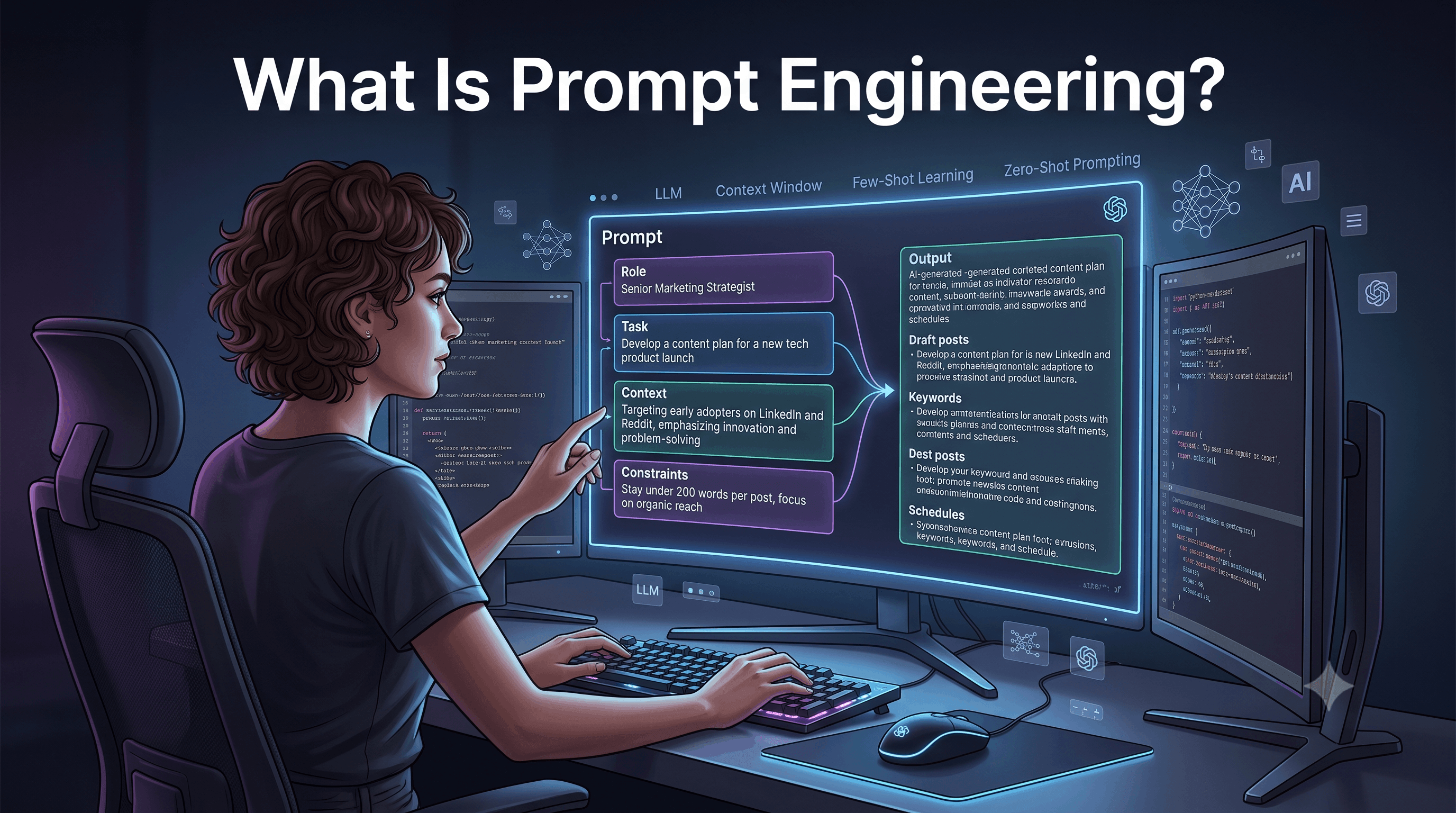
Artificial intelligence has changed the way we write, code, research, learn, create content, analyze data, and solve problems. But there is one skill that often determines how useful an AI system actually becomes:
Prompt Engineering.
You can ask an AI model the same question in two different ways and receive completely different results.
For example:
"Write about Python."
This is a very broad instruction.
Compare it with:
"Act as a senior Python developer. Explain Python decorators to a beginner using a simple real-world analogy, followed by a practical code example and three common mistakes. Keep the explanation under 800 words."
The second prompt gives the AI much more useful information: its role, task, audience, topic, format, constraints, and expected depth.
That is the basic idea behind prompt engineering.
In this article, we will understand what prompt engineering is, why it matters, how AI models interpret prompts, and how you can start writing better prompts.
Prompt engineering is the process of designing, structuring, and refining instructions given to an AI model to produce a desired output.
A prompt can be a simple question:
"What is recursion?"
Or it can be a detailed instruction:
"Explain recursion to a beginner who knows basic programming but has never studied recursive functions. Use a real-world analogy, then provide a Python example and explain the code line by line."
Both are prompts.
The difference is how much guidance they provide.
Prompt engineering is therefore not simply about "asking AI questions."
It is about learning how to communicate with AI systems effectively.
Modern AI models such as large language models can perform many different tasks:
However, the quality of the result depends heavily on how the task is presented.
Consider these two prompts.
Write a blog about JavaScript.
Write an SEO-friendly beginner-level blog article about JavaScript. Explain what JavaScript is, where it is used, how it works in a browser, and why developers use it. Include simple code examples and a conclusion. Use clear headings and keep the article around 1,500 words.
The second prompt establishes expectations.
This leads to a fundamental principle:
Better instructions generally give the AI a better chance of producing useful results.
An AI model does not understand your prompt exactly like a human does.
Large language models process text as tokens and use patterns learned during training to predict appropriate continuations and generate responses.
For practical prompt engineering, you don't need to understand every mathematical detail of transformers.
Instead, think of an AI model as a highly capable language system that needs sufficient context to determine:
What should I do?
What information should I use?
Who is the response for?
What should the final answer look like?
The clearer these elements are, the easier it is for the model to follow your intended direction.
A useful prompt often contains several components.
Tell the AI what perspective or expertise it should use.
Example:
"Act as a senior software architect."
Or:
"Act as an experienced SEO content writer."
Roles can help establish the type of response you expect.
Clearly explain what you want the AI to do.
For example:
"Explain how REST APIs work."
The task is the central action.
Other examples include:
Context gives the AI additional information required to perform the task correctly.
For example:
"I am a beginner who understands basic JavaScript but has never worked with Node.js."
Now the AI knows something about the user's knowledge level.
Without context, the AI might produce an explanation that is either too simple or too advanced.
Constraints define boundaries.
For example:
"Keep the explanation under 1,000 words."
Other constraints could include:
Constraints are particularly useful when you need predictable outputs.
Tell the model how the answer should be structured.
For example:
"Return the answer as a table with three columns: Concept, Explanation, Example."
Or:
"Return valid JSON containing the fields
title,description, andkeywords."
This can be extremely useful when integrating AI into software applications.
A useful beginner-friendly formula is:
Role + Task + Context + Constraints + Output Format
For example:
Role: Act as a senior Python developer.
Task: Explain Python decorators.
Context: The reader understands functions but has never used decorators.
Constraints: Use simple language and one real-world analogy.
Output: Explanation followed by a Python example and three practice questions.
Combined:
"Act as a senior Python developer. Explain Python decorators to a beginner who understands functions but has never used decorators. Use simple language and one real-world analogy. Include a practical Python example and three practice questions."
This is already a significantly stronger prompt.
Let's look at a practical example.
Create a workout plan.
The AI doesn't know:
A better prompt might be:
"Create a beginner-friendly 4-day workout plan for someone who wants to build strength and improve overall fitness. The person has access to dumbbells and resistance bands, can train for 45 minutes per day, and prefers a simple upper-body/lower-body split. Include exercises, sets, repetitions, rest periods, and progression guidelines."
Notice how much additional information was provided.
The AI now has a clearer target.
One of the biggest mistakes beginners make is expecting their first prompt to be perfect.
Prompt engineering is usually iterative.
You might start with:
"Explain Docker."
The response may be too technical.
You can then refine the prompt:
"Explain Docker to a beginner who understands basic programming but has never used containers. Avoid Kubernetes and advanced DevOps concepts. Use a real-world analogy and provide a simple Docker example."
If the result is still not ideal, refine it again.
For example:
"The explanation is still too technical. Rewrite it for someone who has never worked with servers. Start with the problem Docker solves before explaining how Docker works."
This process of prompt → output → evaluation → refinement is an important part of prompt engineering.
A model can only work with the information available to it within the current interaction and any additional context supplied by the application.
Suppose you ask:
"Fix this code."
And provide:
def calculate_total(items):
    total = 0
    for item in items
        total += item
    return total
The AI can identify the missing colon.
But imagine instead asking:
"Fix this code. It is part of a Django application where
itemsis a list of dictionaries containing apricefield."
Now the model has additional context.
It may recognize that the actual implementation requires something like:
def calculate_total(items):
    total = 0

    for item in items:
        total += item["price"]

    return total
The lesson is simple:
When the AI needs information to make a good decision, provide that information.
Compare:
"Make my website better."
with:
"Review the homepage of my SaaS website and suggest improvements to the hero section. Focus specifically on headline clarity, call-to-action placement, trust signals, and conversion friction. Provide five actionable recommendations."
The second prompt is much easier to execute.
A useful rule is:
Don't make the AI guess what you mean when you can specify it.
Sometimes describing the desired output isn't enough.
Examples can be extremely powerful.
Suppose you want an AI model to classify customer messages.
You could provide examples:
Message: "I want my money back."
Category: Refund

Message: "My payment failed."
Category: Payment Issue

Message: "Where is my order?"
Category: Order Tracking

Message: "I was charged twice."
Category:
The model can infer the pattern and produce:
Category: Duplicate ChargeThis technique is commonly known as few-shot prompting.
We will explore it in detail later in this series.
Zero-shot prompting means asking the model to perform a task without providing examples.
Example:
"Classify this review as Positive, Negative, or Neutral:
'The product arrived quickly but the packaging was damaged.'"
No examples are provided.
The model must infer the task from the instruction itself.
Few-shot prompting provides examples before asking the model to perform the task.
For example:
Review: "Absolutely loved it!"
Sentiment: Positive

Review: "Terrible experience."
Sentiment: Negative

Review: "It works, but nothing special."
Sentiment: Neutral

Review: "The product is excellent and delivery was fast."
Sentiment:
The expected response is:
PositiveFew-shot prompting can help establish the exact behavior and format you want.
Prompt engineering becomes even more important when building AI-powered applications.
Imagine you are building a customer-support chatbot.
A simple implementation might send:
Answer the customer's question.A production system may need something much more structured:
You are a customer-support assistant for an e-commerce company.

Your responsibilities:
1. Answer questions about orders and products.
2. Never invent order information.
3. If required information is unavailable, clearly state that it is unavailable.
4. Be polite and concise.
5. Do not expose internal system information.

Customer message:
{{customer_message}}

Relevant order information:
{{order_context}}
This is much closer to real-world prompt engineering.
The prompt becomes part of the application's behavior.
These concepts are related but not identical.
"What is an API?"
"Act as a senior software engineer teaching a beginner. Explain what an API is using a restaurant analogy. Then explain the same concept technically using HTTP requests and responses. Include a simple JavaScript example. Avoid advanced authentication concepts."
The second approach deliberately controls the response.
That is the essence of prompt engineering.
Bad:
"Write something about AI."
Better:
"Write a beginner-friendly 1,500-word article explaining how generative AI works, including LLMs, tokens, training, inference, and practical applications."
For example:
"Write a detailed explanation in exactly 50 words."
The model has conflicting goals: detailed explanation and extremely short length.
Make priorities clear.
More information isn't automatically better.
A prompt containing hundreds of irrelevant instructions can make the actual task harder to identify.
Good prompt engineering is about relevant context, not simply more context.
A technical explanation for a software engineer is different from one for a school student.
Specify the audience when it matters.
If you need JSON, ask for JSON.
If you need a table, ask for a table.
If you need bullet points, specify bullet points.
Don't make the output format an assumption.
Prompt engineering involves experimentation.
Treat prompts like code.
Write them.
Test them.
Evaluate the output.
Improve them.
Repeat.
For developers, prompt engineering can be viewed as another form of programming.
Traditional programming tells a computer exactly what operations to perform.
Prompt engineering communicates desired behavior to a probabilistic language model using natural language, examples, constraints, context, and structured instructions.
The two approaches are different, but they share an important principle:
Precision matters.
A vague program can produce incorrect behavior.
A vague prompt can produce an unreliable response.
Before sending an important prompt, ask yourself:
If you can answer these questions, your prompt will usually be much stronger.
Here is a simple template you can use for many tasks:
Role:
You are a [role/expert].

Objective:
Your task is to [describe the task].

Context:
Here is the relevant context:
[context]

Requirements:
- [requirement 1]
- [requirement 2]
- [requirement 3]

Constraints:
- [constraint 1]
- [constraint 2]

Output Format:
Return the response as [desired format].

Input:
[input]
You don't need to use every section for every prompt.
Use the components that actually help the task.
Prompt engineering is evolving rapidly.
As AI systems become more capable, prompt engineering is expanding beyond simple text instructions.
Modern AI applications increasingly involve:
This means prompt engineering is becoming less about finding a "magic sentence" and more about designing reliable interactions between humans, applications, and AI models.
Prompt engineering is one of the foundational skills for working effectively with modern AI.
The goal isn't to discover a secret prompt that works forever.
The real goal is to learn how to communicate:
What you want + why you want it + relevant context + constraints + expected output.
Start simple.
Be specific.
Provide useful context.
Give examples when necessary.
Define the desired output.
Then evaluate the response and refine your prompt.
As we move through this series, we will go from basic prompting techniques to advanced concepts such as chain-of-thought alternatives, few-shot prompting, ReAct, prompt chaining, RAG, tool calling, AI agents, prompt security, evaluation, and production-grade prompt engineering.
Prompt engineering is not about talking to AI better.
It is about learning to design AI behavior more effectively.
Pixels to Perfection Design that Impresses