Rahul
 LeetCode #155: Min Stack — Design a Stack with O(1) Minimum Retrieval
 LeetCode #20: Valid Parentheses — Master the Stack Pattern
 LeetCode #15: 3Sum — Master Sorting, Two Pointers and Duplicate Handling
 Instruction vs Context in AI Prompts: How to Tell AI What to Do and What Information to Use
 Rust Structs and Enums: Building Powerful Data Models
 Dissecting the High-Level System Architecture of Booking.com
 Kanban vs. Scrum: Which Agile Methodology to Choose?
 The Scaling Journey of LinkedIn: From Startup to Professional Powerhouse
 Mastering Code Review: A Guide for Reviewers and PR Creators
 ChatGPT: Unveiling the Power of AI in Conversational Experiences with Kairos Coders

Kairos Coders are here to help
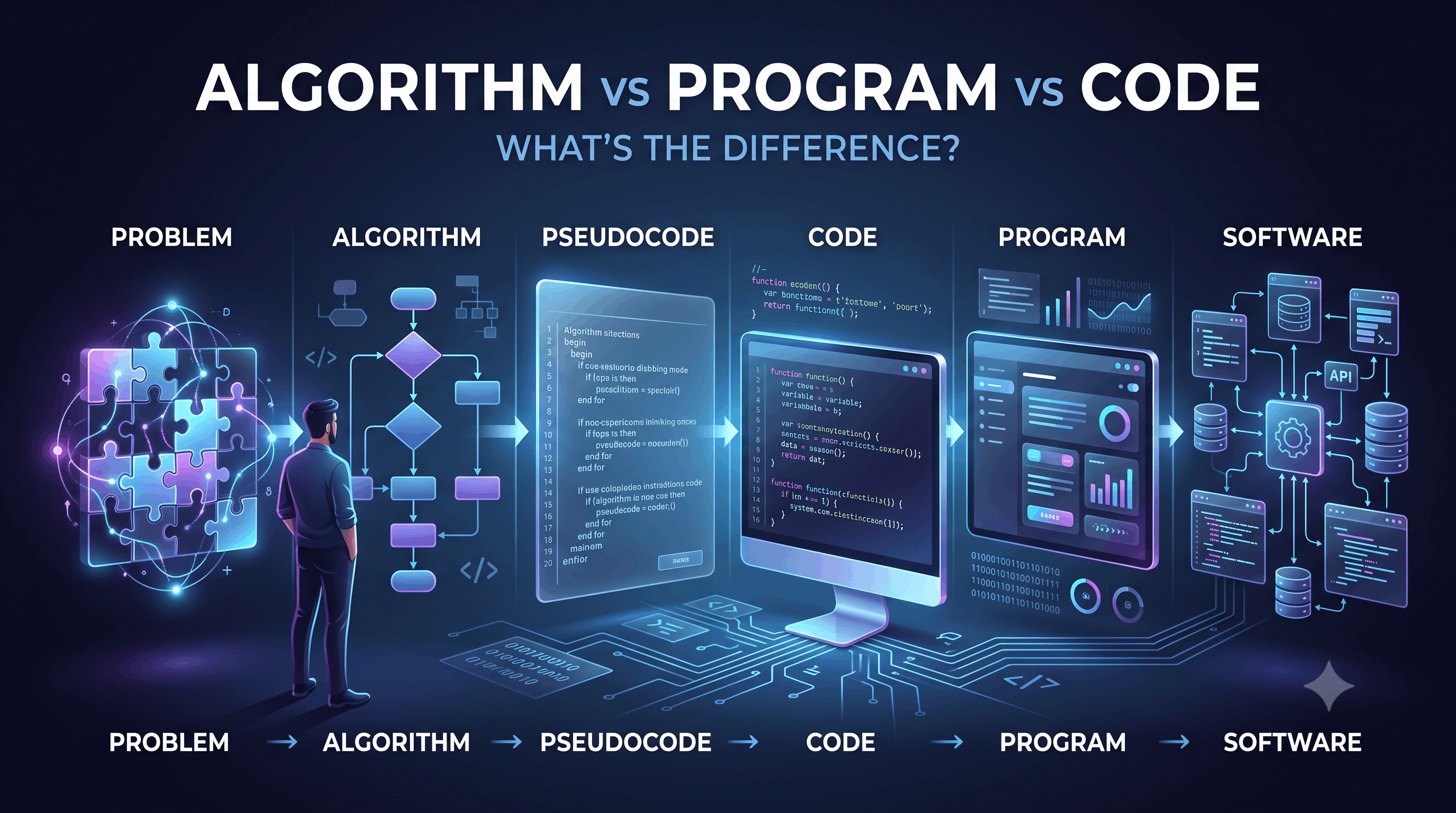
When you're learning programming, you will constantly hear words like algorithm, program, code, pseudocode, and software.
They are related, but they are not the same thing.
A beginner might think:
Algorithm = Code = Program
But that's not quite right.
Understanding the difference is important because professional software development usually follows a journey like this:
Real-World Problem
       ↓
   Algorithm
       ↓
   Pseudocode
       ↓
     Code
       ↓
    Program
       ↓
    Software
In the previous article, we learned what an algorithm is. Now let's understand how an algorithm becomes actual working software.
Before going deeper, here's the simplest explanation:
| Concept | Meaning |
|---|---|
| Problem | Something that needs to be solved |
| Algorithm | Step-by-step logic for solving it |
| Pseudocode | Human-readable representation of that logic |
| Code | Instructions written in a programming language |
| Program | A complete set of code that performs a task |
| Software | A broader application/system made from programs, data, configuration, and other components |
Think of building a house.
Problem
   ↓
What kind of house do we need?

Algorithm
   ↓
Plan how to build it

Pseudocode
   ↓
Describe the construction steps

Code
   ↓
Write those instructions in a specific programming language

Program
   ↓
Complete working implementation

Software
   ↓
The larger system users interact with
Let's break everything down.
Everything starts with a problem.
For example:
Find the largest number in a list.
Suppose we have:
[12, 45, 7, 89, 23]We need to determine:
89The problem tells us what we want to achieve.
It doesn't tell us how to achieve it.
That's where the algorithm comes in.
An algorithm is a step-by-step procedure for solving a problem.
For our largest-number problem:
1. Take the first number.
2. Assume it is the largest.
3. Compare it with the next number.
4. If the next number is larger, update the largest number.
5. Continue until all numbers have been checked.
6. Return the largest number.
Notice that we haven't written any programming language.
We are only describing the logic.
That's an algorithm.
Pseudocode is a structured way of expressing an algorithm using language that resembles programming logic but isn't tied to a specific programming language.
Our algorithm could become:
START

numbers = [12, 45, 7, 89, 23]

largest = first number

FOR each number:
    IF number > largest:
        largest = number

PRINT largest

END
This is not valid Python.
It is not valid JavaScript.
It is not valid Java.
But a programmer can easily understand what needs to happen.
That's the purpose of pseudocode.
Code is the actual set of instructions written using a programming language.
For example, the pseudocode can be converted into Python.
numbers = [12, 45, 7, 89, 23]

largest = numbers[0]

for number in numbers:
    if number > largest:
        largest = number

print(largest)
Now we have actual executable instructions.
The programming language provides the syntax and rules that the computer understands through its compiler or interpreter/runtime.
The same algorithm can be implemented using different programming languages.
numbers = [12, 45, 7, 89, 23]

largest = numbers[0]

for number in numbers:
    if number > largest:
        largest = number

print(largest)const numbers = [12, 45, 7, 89, 23];
let largest = numbers[0];
for (const number of numbers) {
if (number > largest) {
largest = number;
}
}
console.log(largest);int[] numbers = {12, 45, 7, 89, 23};
int largest = numbers[0];
for (int number : numbers) {
if (number > largest) {
largest = number;
}
}
System.out.println(largest);$numbers = [12, 45, 7, 89, 23];
$largest = $numbers[0];
foreach ($numbers as $number) {
if ($number > $largest) {
$largest = $number;
}
}
echo $largest;The syntax changes.
The underlying logic remains essentially the same.
This demonstrates an important programming principle:
Algorithms are generally independent of programming languages.
A program is a complete set of instructions written to perform a particular task or set of tasks.
A few lines of code can be a tiny program.
But real applications usually contain much more.
For example, a calculator program might contain code for:
Addition
Subtraction
Multiplication
Division
Input handling
Error handling
User interface
History
Settings
Together, these components form a program or application.
So:
Code is the individual instructions; a program is an organized implementation that performs a useful task.
The boundary isn't always perfectly rigid in everyday usage, but this distinction is useful for learning.
Software is a broader concept.
A modern application can contain:
Source Code
+
Algorithms
+
Data
+
Configuration
+
Dependencies
+
Database
+
APIs
+
Assets
+
Infrastructure
For example, consider an e-commerce platform.
It may contain:
Frontend
Backend
Database
Authentication
Payment System
Search
Recommendation Engine
Inventory System
Order Management
Notifications
Analytics
All of these components work together to create a complete software system.
Therefore:
Algorithm
   ↓
Code
   ↓
Program
   ↓
Application
   ↓
Software System
These layers aren't strict formal definitions in every context, but they provide a useful mental model.
Let's compare programming with cooking.
Suppose you want to make a pizza.
You want to make a pizza.
The process might be:
1. Prepare dough.
2. Add sauce.
3. Add cheese.
4. Add toppings.
5. Bake.
6. Serve.START
prepare dough
add sauce
add cheese
add toppings
bake pizza
serve pizza
ENDNow imagine translating those instructions into a language that a hypothetical automated kitchen machine understands.
prepare(dough)
add(sauce)
add(cheese)
add(toppings)
bake(temperature, time)
serve()The complete kitchen automation system combines those instructions with controls, sensors, error handling, and user input.
The entire pizza-ordering and kitchen-management system could include:
Customer App
+
Restaurant Dashboard
+
Kitchen System
+
Payment System
+
Delivery System
+
Database
That's the difference between an individual instruction, a solution strategy, a program, and a larger software system.
This is one of the most important distinctions for beginners.
Focuses on:
What steps should we follow to solve the problem?
Focuses on:
How do we express those steps in a programming language?
For example:
1. Read a number.
2. Check whether it is divisible by 2.
3. If yes, print "Even".
4. Otherwise, print "Odd".number = 17
if number % 2 == 0:
print("Even")
else:
print("Odd")The algorithm doesn't care whether you use Python, JavaScript, Java, C++, or PHP.
The code does.
An algorithm is a solution strategy.
A program is an implementation of that strategy.
For example:
Problem:
Find a number in a sorted array.
Possible algorithm:
Binary SearchPossible implementation:
Python program
Java program
JavaScript program
C++ program
The algorithm is the idea.
The program is the implementation.
Suppose the problem is:
Find an element in a sorted array.
The algorithm could be:
Binary SearchYou can implement it in Python:
def binary_search(arr, target):
    left = 0
    right = len(arr) - 1

    while left <= right:
        mid = (left + right) // 2

        if arr[mid] == target:
            return mid

        if arr[mid] < target:
            left = mid + 1
        else:
            right = mid - 1

    return -1
Or JavaScript:
function binarySearch(arr, target) {
    let left = 0;
    let right = arr.length - 1;

    while (left <= right) {
        const mid = Math.floor((left + right) / 2);

        if (arr[mid] === target) {
            return mid;
        }

        if (arr[mid] < target) {
            left = mid + 1;
        } else {
            right = mid - 1;
        }
    }

    return -1;
}
Same algorithm.
Different implementations.
Absolutely.
This is one of the most important ideas in algorithm design.
Suppose you need to find an element in a list.
You could use:
Linear Searchor:
Binary SearchBoth can produce the same answer.
But their performance can be dramatically different.
For a sorted collection:
Linear Search
O(n)
while:
Binary Search
O(log n)
This is why knowing multiple algorithms matters.
Programming isn't simply:
"Can I make it work?"
It is also:
"Can I make it work efficiently?"
Consider this:
numbers = [1, 2, 3, 4, 5]

print(5 in numbers)
This works.
But if you're processing billions of records, the underlying data structure and search strategy become extremely important.
A developer needs to think about:
This is where algorithmic thinking becomes important in real software engineering.
Another common confusion is between pseudocode and actual code.
| Pseudocode | Code |
| Human-oriented | Machine-oriented |
| Language-independent | Language-specific |
| Focuses on logic | Focuses on implementation |
| Doesn't need strict syntax | Must follow language syntax |
| Useful during planning | Used to build software |
Example:
IF age >= 18
    PRINT "Adult"
ELSE
PRINT "Minor"if (age >= 18) {
console.log("Adult");
} else {
console.log("Minor");
}if age >= 18:
print("Adult")
else:
print("Minor")The logic is the same.
The syntax is different.
Let's look at the entire journey using a practical example.
A school wants to calculate the average marks of students.
Student:
Rahul

Marks:
80, 75, 90, 85
We need:
Average = 82.5We need to calculate:
sum of marks / number of subjects1. Take all marks.
2. Calculate their sum.
3. Count the number of subjects.
4. Divide the sum by the number of subjects.
5. Return the average.START
marks = [80, 75, 90, 85]
sum = 0
FOR each mark:
sum = sum + mark
average = sum / number of marks
PRINT average
ENDPython:
marks = [80, 75, 90, 85]

total = sum(marks)
average = total / len(marks)

print(average)
Output:
82.5A real school management system might then add:
Student Login
Teacher Dashboard
Marks Entry
Grade Calculation
Attendance
Reports
Notifications
Database
Authentication
Now we have something much larger than a simple algorithm.
The complete platform could contain:
Web Application
       +
Mobile Application
       +
Backend API
       +
Database
       +
Authentication
       +
Cloud Infrastructure
       +
Analytics
That becomes a complete software system.
Understanding these concepts helps you approach software development systematically.
Instead of immediately opening your code editor and writing random code, you can think:
What is the problem?
       ↓
What should the solution do?
       ↓
What algorithm can solve it?
       ↓
Can I express it in pseudocode?
       ↓
What data structures do I need?
       ↓
Which programming language should I use?
       ↓
How should I implement it?
       ↓
How efficient is the solution?
This is much closer to how professional software engineering works.
One of the most useful habits you can develop is:
Think before you code.
Suppose you're asked:
Find the first duplicate number in an array.
Don't immediately start writing loops.
First ask:
What is the input?
What is the expected output?
Are duplicates guaranteed?
Does order matter?
How large can the input be?
Can I use extra memory?
What is the simplest solution?
Can it be optimized?
Then design the algorithm.
Then write the code.
This approach becomes increasingly valuable as problems become harder.
Whenever you encounter a programming problem, remember:
                 PROBLEM
                    ↓
            What do we need?
                    ↓
                ALGORITHM
                    ↓
           How will we solve it?
                    ↓
               PSEUDOCODE
                    ↓
           Can we express the logic?
                    ↓
                  CODE
                    ↓
          Implement in a language
                    ↓
                PROGRAM
                    ↓
          Complete working solution
                    ↓
                SOFTWARE
                    ↓
           Larger usable system
This is a powerful mental model for beginners.
Code is an implementation.
An algorithm is the underlying solution procedure.
Beginners often think:
"Which Python syntax should I use?"
before asking:
"What is the best way to solve this problem?"
The second question should come first.
Memorizing a Binary Search implementation isn't enough.
You should understand:
Then you can implement it in any language.
A solution that works on 10 elements may fail on 10 million.
Always ask:
"How does this solution behave as the input grows?"
Less code doesn't automatically mean better code.
Good software should be:
A common interview question is:
"What's the difference between an algorithm and a program?"
A strong answer would be:
An algorithm is a language-independent sequence of steps designed to solve a problem, while a program is the implementation of those steps using a programming language, together with the necessary logic and supporting code to perform a task.
Another question:
"What's the difference between pseudocode and code?"
Answer:
Pseudocode describes programming logic in a human-readable, language-independent form, while code expresses that logic using the syntax and rules of a specific programming language.
These distinctions become especially important in technical interviews.
| Term | Primary Purpose | Language Dependent? |
| Problem | Defines what needs to be solved | No |
| Algorithm | Defines how to solve it | Usually no |
| Pseudocode | Describes the algorithm | No |
| Code | Implements the solution | Yes |
| Program | Performs a specific task | Usually yes |
| Software | Complete usable system/application | Usually yes |
The most important idea from this article is:
Algorithm ≠ Code
Code ≠ Program
Program ≠ Entire Software System
They are connected layers.
A programmer may start with a problem:
"Find the shortest route between two cities."Then design:
Shortest-path algorithmThen express it using:
PseudocodeThen implement it using:
Python / JavaScript / Java / C++ / etc.Then integrate it into:
A programAnd finally into:
A complete software productUnderstanding this progression will make the rest of your algorithm journey much easier.
Pixels to Perfection Design that Impresses