Rahul
 LeetCode #155: Min Stack — Design a Stack with O(1) Minimum Retrieval
 LeetCode #20: Valid Parentheses — Master the Stack Pattern
 LeetCode #15: 3Sum — Master Sorting, Two Pointers and Duplicate Handling
 Instruction vs Context in AI Prompts: How to Tell AI What to Do and What Information to Use
 Rust Structs and Enums: Building Powerful Data Models
 Dissecting the High-Level System Architecture of Booking.com
 Kanban vs. Scrum: Which Agile Methodology to Choose?
 The Scaling Journey of LinkedIn: From Startup to Professional Powerhouse
 Mastering Code Review: A Guide for Reviewers and PR Creators
 ChatGPT: Unveiling the Power of AI in Conversational Experiences with Kairos Coders

Kairos Coders are here to help
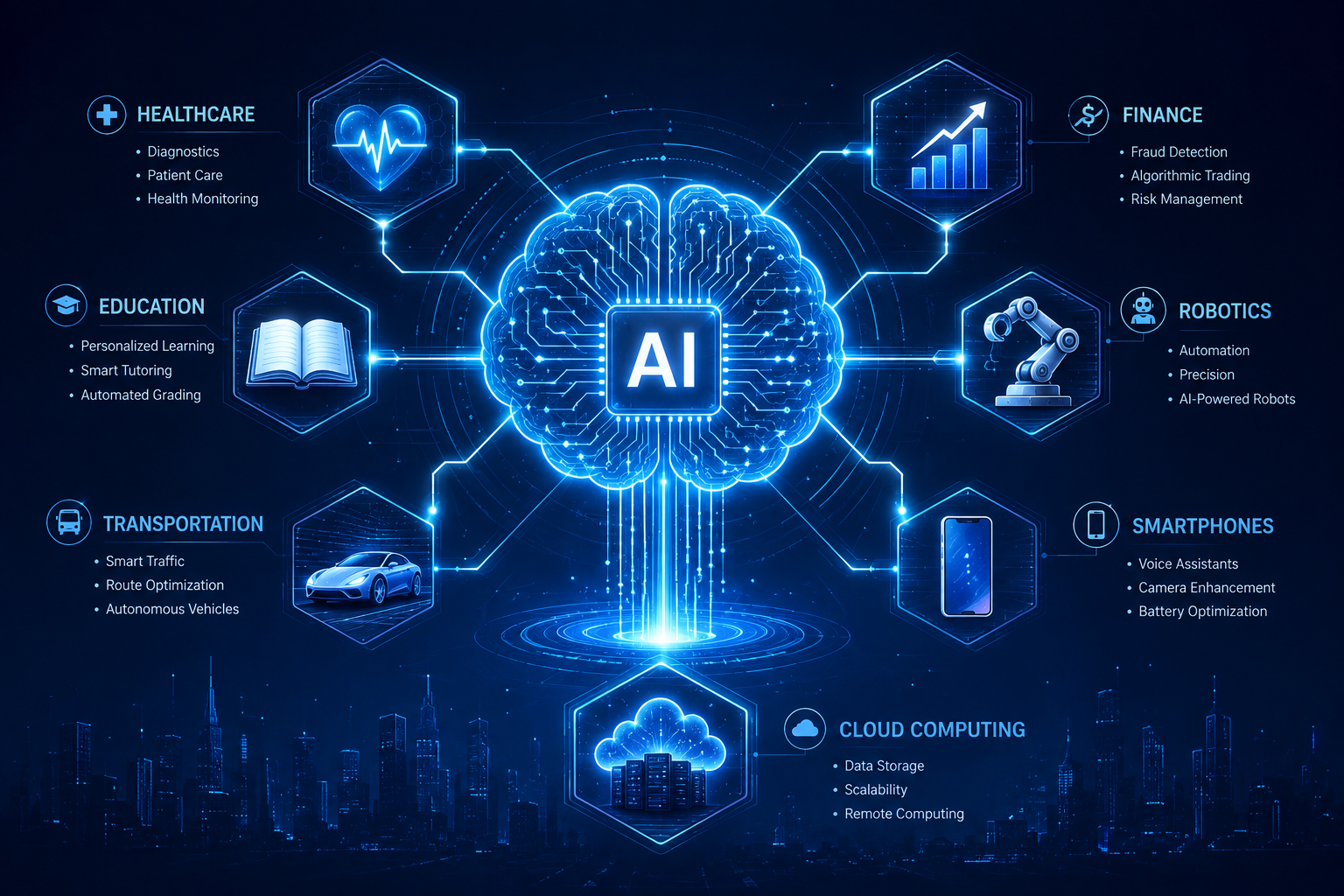
Artificial Intelligence (AI) is no longer a futuristic concept reserved for science fiction movies. It has quietly become a part of everyday life, helping us navigate cities, recommend movies, answer questions, detect fraud, translate languages, and even generate images and videos.
Whether you're using a smartphone, shopping online, streaming your favorite series, or asking a chatbot a question, chances are you're interacting with AI.
But what exactly is Artificial Intelligence? How does it work? Why is everyone talking about it? And how might it shape our future?
This guide explains AI in simple language while covering the concepts every beginner should understand.
Artificial Intelligence (AI) is the field of computer science focused on creating systems that can perform tasks that typically require human intelligence.
These tasks include:
Rather than following only fixed instructions, many AI systems improve their performance by analyzing data and identifying patterns.
Artificial Intelligence is the ability of a machine or computer program to perform tasks that normally require human intelligence.
Imagine teaching a child to recognize dogs.
Instead of memorizing one picture, the child sees hundreds of dogs of different breeds, colors, and sizes. Eventually, the child learns the common characteristics of dogs and can identify one they've never seen before.
AI learns in a similar way.
Instead of observing the world directly, it is trained on large amounts of data. By analyzing examples, it discovers patterns that help it make predictions or decisions.
Modern society generates enormous amounts of data every second. Humans cannot manually analyze all of it quickly enough.
AI helps by:
Organizations across industries use AI to reduce costs, improve efficiency, and create new products and services.
| Year | Milestone |
|---|---|
| 1950 | Alan Turing proposes the famous Turing Test. |
| 1956 | The term "Artificial Intelligence" is introduced at the Dartmouth Conference. |
| 1960s–1970s | Early AI research expands but faces technical limitations. |
| 1980s | Expert systems gain popularity in businesses. |
| 1997 | IBM Deep Blue defeats world chess champion Garry Kasparov. |
| 2012 | Deep learning achieves major breakthroughs in image recognition. |
| 2017 | The Transformer architecture revolutionizes AI research. |
| 2022 | Generative AI becomes mainstream with advanced conversational models. |
| Today | AI powers healthcare, education, finance, transportation, entertainment, software development, and countless everyday applications. |
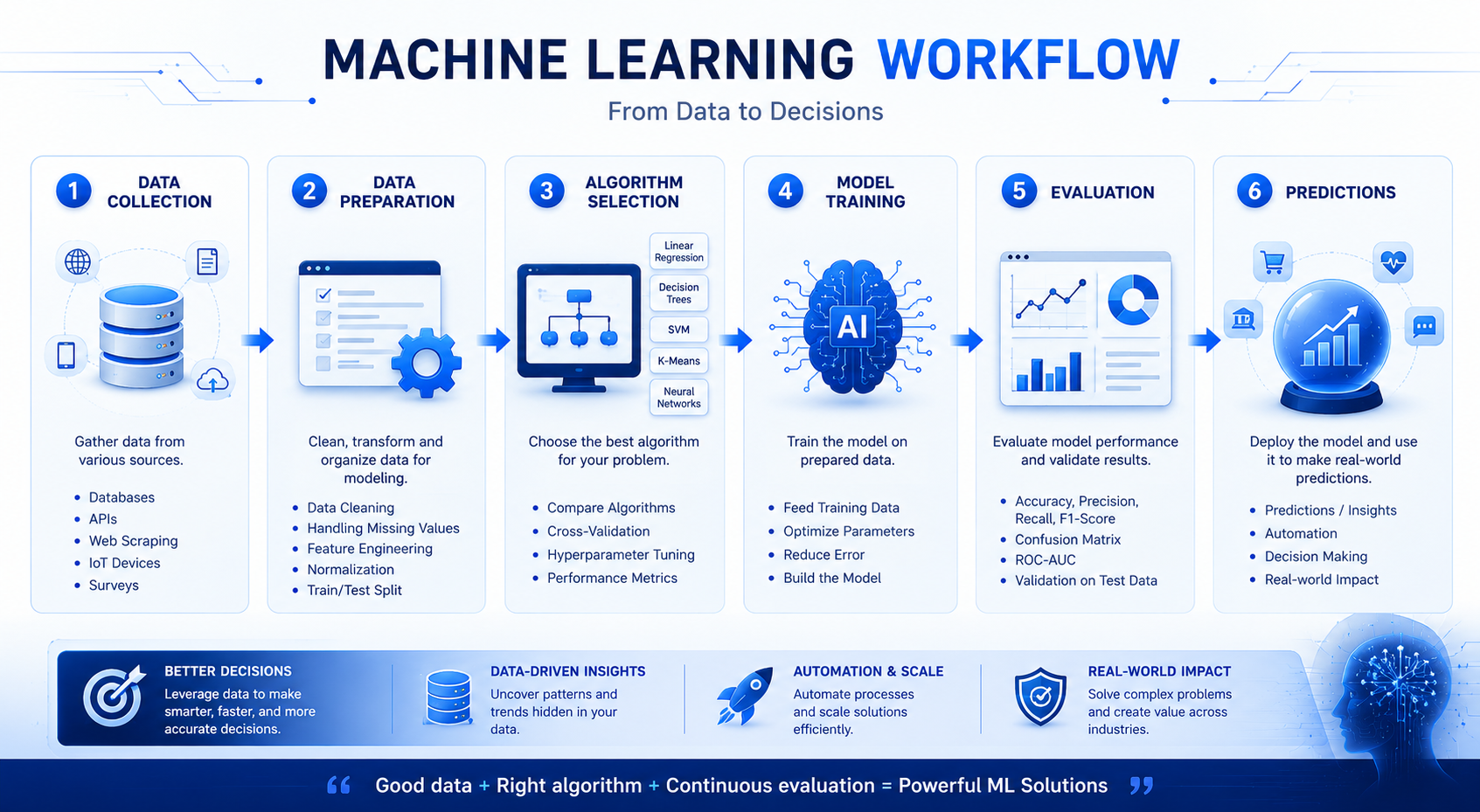
Although AI systems vary, many follow a similar process.
Everything starts with data.
Examples include:
The quality of the data greatly influences the quality of the AI system.
Algorithms analyze the data to identify relationships and patterns.
For example:
A spam filter studies thousands of emails to learn what characteristics are common in spam messages.
The learned knowledge is stored in a mathematical model.
This model allows the AI to make predictions on new, unseen information.
After training, the model receives new data and generates an output.
Examples include:
Many AI systems continue improving by learning from additional data, user feedback, or periodic retraining.
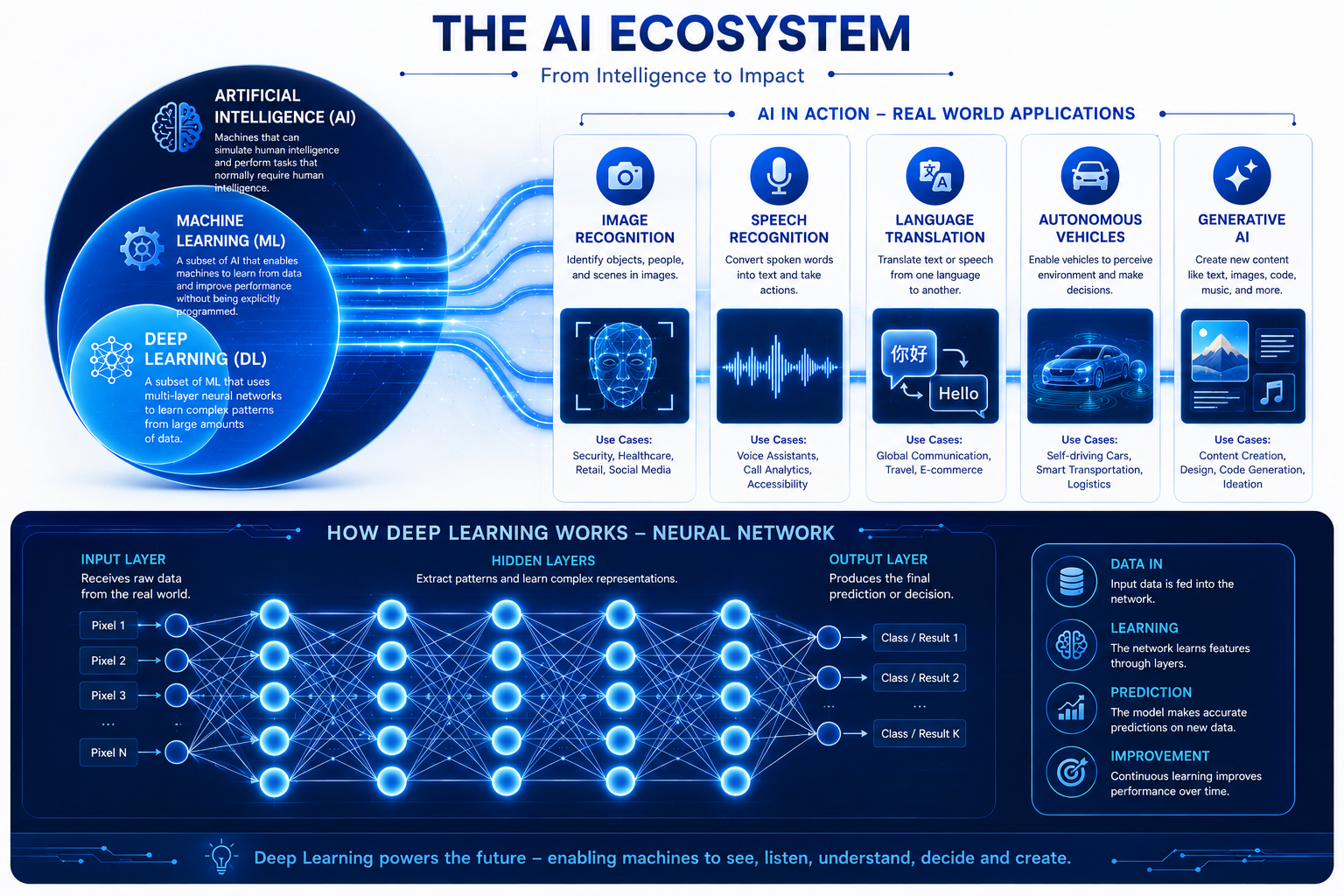
Artificial Intelligence is built from several interconnected technologies.
Allows computers to learn patterns from data instead of relying solely on explicit programming.
Uses multi-layered neural networks to solve complex tasks such as speech recognition and image analysis.
Enables computers to understand, interpret, and generate human language.
Allows machines to interpret images and videos.
Combines AI with mechanical systems to perform physical tasks.
AI can be categorized in different ways.
Designed to perform specific tasks.
Examples:
Most AI systems in use today fall into this category.
A theoretical form of AI capable of understanding and performing any intellectual task a human can do.
AGI has not yet been achieved.
A hypothetical stage where AI surpasses human intelligence across nearly all domains.
This remains a topic of research and debate rather than current reality.
AI helps understand search intent and rank relevant results.
Recommendation systems suggest movies, TV shows, and music based on your preferences.
AI analyzes traffic patterns to recommend faster routes.
Retailers use AI for:
AI assists with:
AI powers:
AI automates repetitive work, allowing people to focus on higher-value tasks.
AI analyzes large datasets faster than humans.
When trained well, AI can reduce errors in many applications.
Unlike humans, AI systems can operate continuously without fatigue.
AI tailors recommendations, learning experiences, and customer interactions to individual users.
Despite its benefits, AI also presents important challenges.
AI systems can inherit biases from the data they are trained on, leading to unfair outcomes.
AI often relies on large amounts of data, making responsible data handling essential.
Generative AI can produce convincing but incorrect or fabricated content, so outputs should be verified.
AI is changing how work is done. While some routine tasks become automated, new roles and skills are also emerging.
AI can be used for beneficial purposes but may also be misused, making cybersecurity and responsible governance increasingly important.
Reality: AI identifies patterns and generates outputs based on data and algorithms. It does not possess human consciousness or emotions.
Reality: AI is more likely to automate specific tasks than entire professions. Many jobs will evolve, requiring people to work alongside AI.
Reality: AI systems can make mistakes, especially when given incomplete, biased, or ambiguous information.
Reality: Affordable AI tools allow startups, educators, students, freelancers, and small businesses to benefit from AI.
AI is expected to continue transforming many industries.
Potential developments include:
As AI becomes more integrated into daily life, responsible development, transparency, and human oversight will remain essential.
No. Artificial Intelligence is the broader field. Machine Learning is one approach used to build AI systems.
No. You can begin by understanding AI concepts before learning programming languages such as Python.
Yes. ChatGPT is an example of a generative AI application built using large language models (LLMs).
Current AI systems do not think or reason in the same way humans do. They analyze data, recognize patterns, and generate outputs based on training.
Healthcare, finance, education, manufacturing, agriculture, transportation, retail, entertainment, software development, customer support, and many others.
Artificial Intelligence is one of the most significant technological advancements of our time. From recommending your next favorite movie to assisting doctors in diagnosing diseases, AI is reshaping how people live and work.
Understanding its foundations is the first step toward using AI effectively and responsibly. Whether you're a student, developer, entrepreneur, or simply curious about technology, learning AI concepts today will help you navigate a future where intelligent systems play an increasingly important role.
Pixels to Perfection Design that Impresses