Rahul
 LeetCode #155: Min Stack — Design a Stack with O(1) Minimum Retrieval
 LeetCode #20: Valid Parentheses — Master the Stack Pattern
 LeetCode #15: 3Sum — Master Sorting, Two Pointers and Duplicate Handling
 Instruction vs Context in AI Prompts: How to Tell AI What to Do and What Information to Use
 Rust Structs and Enums: Building Powerful Data Models
 Dissecting the High-Level System Architecture of Booking.com
 Kanban vs. Scrum: Which Agile Methodology to Choose?
 The Scaling Journey of LinkedIn: From Startup to Professional Powerhouse
 Mastering Code Review: A Guide for Reviewers and PR Creators
 ChatGPT: Unveiling the Power of AI in Conversational Experiences with Kairos Coders

Kairos Coders are here to help
Machine Learning (ML) is one of the most important technologies behind today's Artificial Intelligence revolution. Every time Netflix recommends a movie, Google predicts your search, your bank detects fraudulent transactions, or your email filters spam, Machine Learning is likely at work.
Unlike traditional computer programs that rely solely on predefined instructions, Machine Learning enables computers to learn patterns from data and improve their performance without being explicitly programmed for every scenario.
In this guide, you'll learn what Machine Learning is, how it works, its major types, common algorithms, real-world applications, benefits, challenges, and why it has become one of the fastest-growing fields in technology.
Machine Learning (ML) is a branch of Artificial Intelligence (AI) that allows computers to learn from data instead of relying entirely on manually written rules.
Instead of programming every possible situation, developers provide examples (data), and the algorithm identifies patterns that help it make predictions or decisions.
Machine Learning is the process of teaching computers to learn from data and improve their performance through experience without being explicitly programmed for every task.
Think of it this way:
Traditional programming tells the computer how to solve a problem.
Machine Learning lets the computer discover how to solve the problem by analyzing data.
Imagine teaching a child to recognize apples.
You would write hundreds of rules:
Eventually, the rules become impossible to maintain.
Instead, you show the child thousands of pictures labeled:
✅ Apple
❌ Not Apple
Over time, the child naturally learns the patterns.
Machine Learning follows a similar approach.
Today's world produces enormous amounts of data every second.
Examples include:
No human can manually analyze all of this information efficiently.
Machine Learning helps by:
| Traditional Programming | Machine Learning |
|---|---|
| Programmer writes rules | Algorithm learns rules |
| Works well for fixed tasks | Excels in complex pattern recognition |
| Difficult to scale | Improves with more data |
| Limited adaptability | Can adapt through retraining |
| Rule-based | Data-driven |
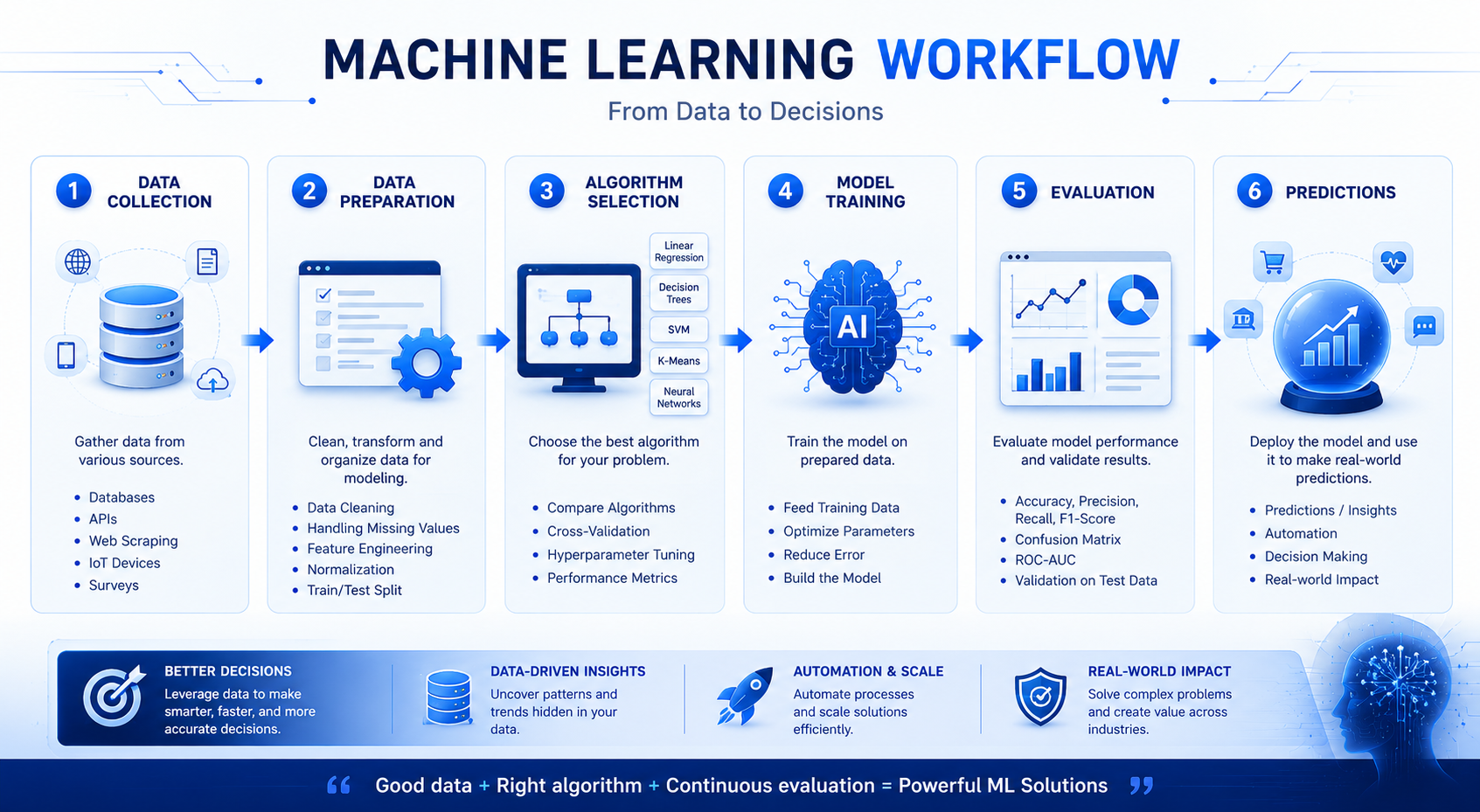
Most Machine Learning systems follow six major steps.
Everything begins with data.
Examples include:
The better the data, the better the model.
Raw data is rarely perfect.
Data scientists clean it by:
This process is known as data preprocessing.
Different problems require different algorithms.
Examples:
The choice depends on the problem being solved.
During training, the algorithm analyzes the data and adjusts its internal parameters to reduce errors.
This is where the "learning" happens.
After training, the model is tested using data it has never seen before.
This helps determine whether it can generalize to new situations instead of simply memorizing the training data.
Once validated, the model is deployed to make predictions on real-world data.
Examples include:
Machine Learning is commonly divided into four categories.
The algorithm learns using labeled data.
Each training example includes:
Example:
| Label | |
|---|---|
| Win $1,000 now! | Spam |
| Meeting at 2 PM | Not Spam |
The algorithm learns the relationship between inputs and outputs.
Here, the data has no labels.
The algorithm searches for hidden structures and patterns.
Examples include:
Think of it as organizing a box of mixed puzzle pieces without knowing the final picture.
The algorithm learns by interacting with an environment.
It receives:
Over time, it learns strategies that maximize rewards.
Examples:
A combination of supervised and unsupervised learning.
The model trains using:
This approach is useful when labeling data is expensive or time-consuming.
Used for predicting continuous values.
Examples:
Despite its name, it is primarily used for classification.
Examples:
Models decisions using a tree-like structure.
Advantages:
Builds many decision trees and combines their predictions.
Benefits:
Finds the optimal boundary that separates different classes of data.
Often used in:
Inspired by the human brain.
They power many modern AI applications, including:
We'll explore Neural Networks in detail in a later article.
Machine Learning is transforming nearly every industry.
As more quality data becomes available, models can often become more accurate through retraining.
Machine Learning can uncover patterns that would be difficult to encode with traditional rules.
It reduces manual effort in repetitive decision-making tasks.
The same model can process millions of predictions quickly once deployed.
It enables personalized recommendations, search results, and user experiences.
Poor-quality data often leads to poor model performance.
Models can learn biases present in historical data, making careful dataset design and evaluation essential.
A model may memorize the training data instead of learning general patterns, causing poor performance on new data.
Some complex models can be difficult to explain, making it harder to understand why they made a particular prediction.
Many Machine Learning applications rely on large datasets, requiring responsible data collection and governance.
| Machine Learning | Deep Learning |
|---|---|
| Subset of AI | Subset of Machine Learning |
| Often works with structured data | Excels with images, audio, and text |
| Requires more manual feature engineering | Learns features automatically from data |
| Can perform well with smaller datasets | Typically benefits from large datasets |
| Usually faster to train | Often requires greater computational resources |
Deep Learning is a specialized area within Machine Learning and will be covered in the next article.
Machine Learning is one branch of Artificial Intelligence, not the entire field.
No. Developers still design systems, prepare data, choose algorithms, evaluate models, and maintain applications.
Not necessarily. High-quality, relevant data is generally more valuable than simply having a larger quantity of data.
The concepts can be understood without advanced mathematics. Building models professionally typically requires knowledge of programming, statistics, and data analysis.
Python is widely used because of its rich ecosystem of libraries such as NumPy, pandas, scikit-learn, TensorFlow, and PyTorch.
Machine Learning is generally considered a subset of Artificial Intelligence, so discussions of ML are usually within the broader AI field.
Yes. ChatGPT is built using Machine Learning techniques, particularly Deep Learning with large language models.
Machine Learning has transformed how computers solve problems. Instead of following rigid instructions, modern systems can identify patterns, make predictions, and improve through experience.
As data continues to grow and computational resources become more powerful, Machine Learning will remain a driving force behind innovations in AI. Understanding its principles provides a strong foundation for exploring more advanced topics such as Deep Learning, Neural Networks, and Large Language Models.
Pixels to Perfection Design that Impresses