Rahul
 LeetCode #155: Min Stack — Design a Stack with O(1) Minimum Retrieval
 LeetCode #20: Valid Parentheses — Master the Stack Pattern
 LeetCode #15: 3Sum — Master Sorting, Two Pointers and Duplicate Handling
 Instruction vs Context in AI Prompts: How to Tell AI What to Do and What Information to Use
 Rust Structs and Enums: Building Powerful Data Models
 Dissecting the High-Level System Architecture of Booking.com
 Kanban vs. Scrum: Which Agile Methodology to Choose?
 The Scaling Journey of LinkedIn: From Startup to Professional Powerhouse
 Mastering Code Review: A Guide for Reviewers and PR Creators
 ChatGPT: Unveiling the Power of AI in Conversational Experiences with Kairos Coders
Kairos Coders are here to help
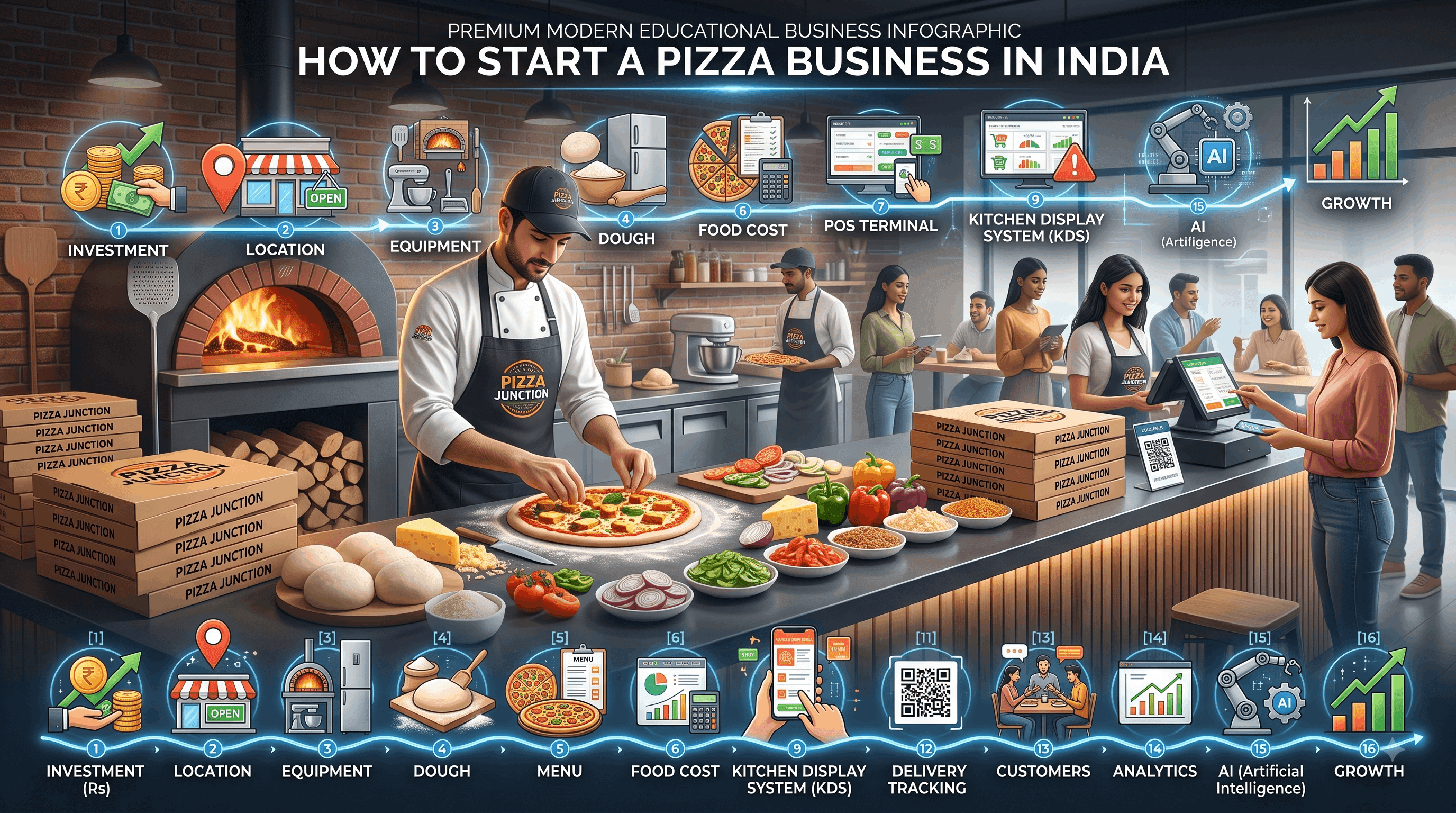
Pizza has become one of India's most popular fast-food categories.
From local pizza shops to large international chains, customers can now find everything from a ₹99 personal pizza to premium pizzas costing several hundred rupees.
That makes pizza an interesting business opportunity.
But opening a pizza shop isn't simply about buying an oven and selling pizza.
You need to understand:
And if you study large pizza chains such as Domino's, one thing becomes obvious:
The real business isn't just pizza. It's the system behind the pizza.
This article explains how to build that system for an independent pizza business in India.
Pizza has several attractive characteristics as a food business.
Pizza can be ordered for:
One base can produce many products:
You can sell:
Pizza + Beverage
Pizza + Garlic Bread
Pizza + Fries
Pizza + Dessert
This increases average order value.
Unlike many restaurant dishes, pizza can be designed specifically for takeaway and delivery.
That makes it suitable for a hybrid:
Dine-in + Takeaway + Delivery
business model.
There isn't just one way to start.
A small kitchen with limited seating.
Focus:
This can keep investment and operational complexity relatively low.
Add:
Now you're selling a broader dining experience.
No dine-in area.
Customers order through:
The major focus becomes:
Food quality + packaging + delivery economics + digital marketing
You operate under an established brand.
Advantages may include:
But franchises also involve:
The economics need to be evaluated carefully before signing anything.
Investment depends on the format.
A small independent pizza outlet could have an illustrative setup like:
| Expense | Approx. Budget |
|---|---|
| Security deposit/advance | ₹75,000 |
| Interior/setup | ₹1,00,000 |
| Pizza oven | ₹1,00,000 |
| Refrigerator/freezer | ₹50,000 |
| Prep tables & kitchen equipment | ₹50,000 |
| Mixer/dough equipment | ₹30,000 |
| POS system | ₹20,000 |
| Furniture | ₹50,000 |
| Signboard/branding | ₹25,000 |
| Initial inventory | ₹50,000 |
| Licenses/miscellaneous | ₹25,000 |
| Working capital | ₹1,00,000 |
| Illustrative Total | ₹6,75,000 |
These are example figures, not fixed market prices.
A small takeaway or cloud kitchen may cost less.
A large dine-in restaurant with premium interiors can cost substantially more.
A pizza business can work in many locations, but your target audience determines the best one.
Potential locations include:
A student-focused pizza outlet might prioritize:
Affordable pricing + delivery radius + high footfall
A premium pizza restaurant may prioritize:
Affluent customers + parking + ambience + dining experience
Don't choose your location before understanding your customer.
Ask:
Who is going to buy my pizza?
Possible segments include:
Price-sensitive.
Interested in:
Higher order value.
Interested in:
Interested in:
Potentially interested in:
Your menu and pricing should match the segment.
Pizza isn't just about toppings.
Consistency begins with:
Dough
You need to standardize:
Why?
Because customers expect the same pizza every time.
If Monday's pizza tastes different from Friday's pizza, you don't have a scalable business.
You have a recipe.
A scalable brand needs a standardized process.
Suppose your regular pizza uses:
180g dough
80g sauce
100g cheese
60g vegetables
If your staff randomly adds ingredients, your food cost will change every day.
Instead:
Recipe → Standard Portion → Standard Cost → Standard Price
This is one of the most important concepts in restaurant operations.
Don't start with 40 pizzas.
You could begin with:
A focused menu makes purchasing, preparation and inventory management easier.
Suppose a pizza sells for:
₹299
And the ingredients cost:
Total direct cost:
₹145
Contribution:
₹299 − ₹145 = ₹154
But ₹154 isn't your net profit.
You still have:
This is why proper recipe costing is essential.
Cheese is often one of the most important ingredients in pizza economics.
A small change in portion size can significantly affect food cost.
For example:
If one pizza uses:
100g cheese
and another accidentally uses:
130g
that's a 30% increase in cheese consumption.
Multiply that across:
100 pizzas/day
and the financial impact becomes significant.
This is why portion control matters.
A pizza kitchen may maintain inventory such as:
Some ingredients are perishable.
You need to track:
Opening Stock
Purchases
−
Consumption
−
Wastage
=
Closing Stock
This can be done manually at a small scale.
But technology becomes extremely valuable as volume grows.
A modern pizza outlet should ideally connect billing with inventory.
For example:
Customer orders:
Large Paneer Pizza
The POS records the sale.
Your inventory system can estimate consumption of:
Now you can compare:
Expected consumption
vs.
Actual consumption
If the numbers don't match, something needs investigation.
It could be:
This is where technology directly protects profit.
Delivery can dramatically increase your market.
Suppose your shop has:
20 seats
You can only serve a limited number of dine-in customers at once.
But delivery allows you to reach customers beyond the seating capacity.
Your business can operate through:
Dine-in
Takeaway
Delivery
However, each channel has different economics.
Imagine an order worth:
₹600
You may have:
Your actual contribution can be much lower than ₹600.
Therefore, don't measure delivery success only by:
"How many orders did we get?"
Measure:
How much money did each delivery order contribute?
Third-party delivery platforms can help acquire customers.
But a long-term business can also develop its own channels.
For example:
Customer → Website → Order → Payment → Kitchen → Delivery
Or:
Customer → WhatsApp → Order → POS → Kitchen
This can reduce dependence on third-party platforms over time, subject to your own delivery and operating costs.
Customers sit down.
They scan:
QR Code
The digital menu opens.
They select:
Pizza + Garlic Bread + Beverage
Order goes to the kitchen.
Staff prepares it.
Customer pays digitally.
This reduces manual order-taking and can make table service faster.
As order volume increases, handwritten tickets can become difficult to manage.
A Kitchen Display System can show:
ORDER #1042

2 × Large Paneer Pizza
1 × Garlic Bread
2 × Cold Drink

STATUS:
Preparing
Then staff can update:
Preparing → Ready → Completed
Now front-of-house and kitchen staff have the same information.
Customers don't just evaluate:
Taste
They evaluate:
Taste + Temperature + Packaging + Speed
If a customer orders pizza and receives it much later than expected, the experience suffers.
That's why large pizza chains invest heavily in standardized operations.
You don't necessarily need the same infrastructure.
But you should learn from the principle:
Standardize the process to improve consistency.
Suppose a customer orders pizza twice every month.
Instead of treating each transaction independently, create a relationship.
Examples:
₹1,000 spent → ₹100 reward
or:
5 orders → Free side
or:
Members get special combo pricing
The exact program depends on your margins.
The goal is:
More repeat purchases.
A customer database can potentially tell you:
Now imagine:
"Customers who regularly order Paneer Pizza haven't ordered for 30 days."
You could create a targeted offer.
Instead of sending the same discount to everyone, you send relevant offers to specific customer segments.
AI can become useful once you have enough data.
Predict expected orders by:
Estimate required:
Suggest:
"You ordered Paneer Pizza last time. Try our Tandoori Paneer Pizza."
Generate:
Ask:
"Why did our food cost increase this month?"
The system can analyze:
This is where AI becomes a business tool rather than a marketing gimmick.
A mature pizza business could eventually look like:
                     CUSTOMER
                        │
       ┌────────────────┼────────────────┐
       ↓                ↓                ↓
    DINE-IN           WEBSITE         WHATSAPP
       │                │                │
       └────────────────┼────────────────┘
                        ↓
                       POS
                        ↓
              ┌─────────┴─────────┐
              ↓                   ↓
          INVENTORY             CRM
              ↓                   ↓
              └─────────┬─────────┘
                        ↓
                  KITCHEN DISPLAY
                        ↓
                     KITCHEN
                        ↓
                   ORDER READY
                        ↓
              ┌─────────┴─────────┐
              ↓                   ↓
          TAKEAWAY             DELIVERY
                        ↓
                    ANALYTICS
                        ↓
                       AI
This is how a simple food outlet can gradually become a technology-enabled operation.
Pizza is perfect for visual marketing.
Create content around:
You can also work with:
Your first objective isn't necessarily national fame.
It's:
Become known in your delivery radius.
This is a dangerous strategy.
If your only advantage is:
"Our pizza is cheaper."
Someone else can become cheaper tomorrow.
Instead compete through:
A ₹299 pizza that customers love can be more valuable than a ₹199 pizza customers don't want again.
Suppose your monthly fixed expenses are:
₹1,50,000
And your average contribution per order after direct costs is:
₹150
Then:
₹1,50,000 ÷ ₹150 = 1,000 orders/month
For 30 days:
1,000 ÷ 30 ≈ 34 orders/day
So under this simplified assumption, you'd need approximately:
34 orders per day to cover fixed expenses.
Actual break-even depends on your complete cost structure and channel mix.
Imagine:
100 orders/day
Average order:
₹300
Daily revenue:
₹30,000
Monthly revenue:
₹9,00,000
Now imagine your contribution after direct costs averages:
₹140/order
Then:
100 × ₹140 = ₹14,000/day
Monthly contribution:
₹4,20,000
If fixed operating costs are:
₹2,00,000/month
Illustrative operating profit:
₹2,20,000/month
Again, this is only a simplified example.
Real-world profitability depends on food costs, rent, staffing, taxes, commissions, wastage, discounts, utilities, maintenance and other expenses.
The purpose is to understand the business model, not promise a specific income.
Complexity creates operational problems.
Every pizza should be consistent.
You need to know the cost of every product.
Small portion deviations can destroy margins.
Delivery presentation matters.
Customers may never become loyal to your brand.
Revenue doesn't equal profit.
You can't manage a growing kitchen using guesswork.
Prove one store before opening five.
Suppose your first outlet becomes successful.
Don't immediately open three more.
First document:
Recipes
Portion sizes
Supplier specifications
Kitchen layout
Cooking times
Cleaning procedures
Opening checklist
Closing checklist
Inventory process
Staff training
Customer service
Refund/cancellation procedures
Now you have a repeatable system.
That's what makes expansion possible.
The journey could look like:
Small Pizza Shop
↓
Profitable Store
↓
Standardized Recipes
↓
Digital POS
↓
Online Ordering
↓
Second Location
↓
Central Purchasing
↓
Multiple Stores
↓
Private Label
↓
Franchise
Technology can connect all of these locations.
A central dashboard could show:
STORE 01     ₹7.2L
STORE 02     ₹8.5L
STORE 03     ₹6.8L
STORE 04     ₹9.1L

TOTAL        ₹31.6L/month
Then management can compare:
Now you're not just running restaurants.
You're operating a restaurant network.
You don't have to copy Domino's.
But you can learn from the underlying principles of large quick-service restaurant chains:
Standardization
Speed
Consistency
Supply chain
Technology
Branding
Delivery
Customer data
The lesson isn't:
"Build a giant pizza chain immediately."
It's:
Build a system that can eventually support scale.
A pizza business can start with a small kitchen and one oven.
But the businesses that survive and scale understand something important:
Pizza is the product. The system is the business.
Your product needs to taste good.
Your costs need to be controlled.
Your recipes need to be standardized.
Your customers need a reason to return.
Your delivery needs to make economic sense.
And your technology should help you understand what's happening inside the business.
Start with one outlet.
Get the numbers right.
Build repeat customers.
Standardize operations.
Then scale.
The future of food businesses isn't necessarily about replacing chefs and restaurant staff with technology.
It's about giving them better information.
POS tells you what sold.
Inventory tells you what you have.
Analytics tells you what is happening.
CRM tells you who your customers are.
AI can help you understand what might happen next.
That's the technology layer behind a modern pizza business.
And that's how a simple pizza shop can evolve into a scalable food-tech operation.
Pixels to Perfection Design that Impresses