Rahul
 LeetCode #155: Min Stack — Design a Stack with O(1) Minimum Retrieval
 LeetCode #20: Valid Parentheses — Master the Stack Pattern
 LeetCode #15: 3Sum — Master Sorting, Two Pointers and Duplicate Handling
 Instruction vs Context in AI Prompts: How to Tell AI What to Do and What Information to Use
 Rust Structs and Enums: Building Powerful Data Models
 Dissecting the High-Level System Architecture of Booking.com
 Kanban vs. Scrum: Which Agile Methodology to Choose?
 The Scaling Journey of LinkedIn: From Startup to Professional Powerhouse
 Mastering Code Review: A Guide for Reviewers and PR Creators
 ChatGPT: Unveiling the Power of AI in Conversational Experiences with Kairos Coders

Kairos Coders are here to help
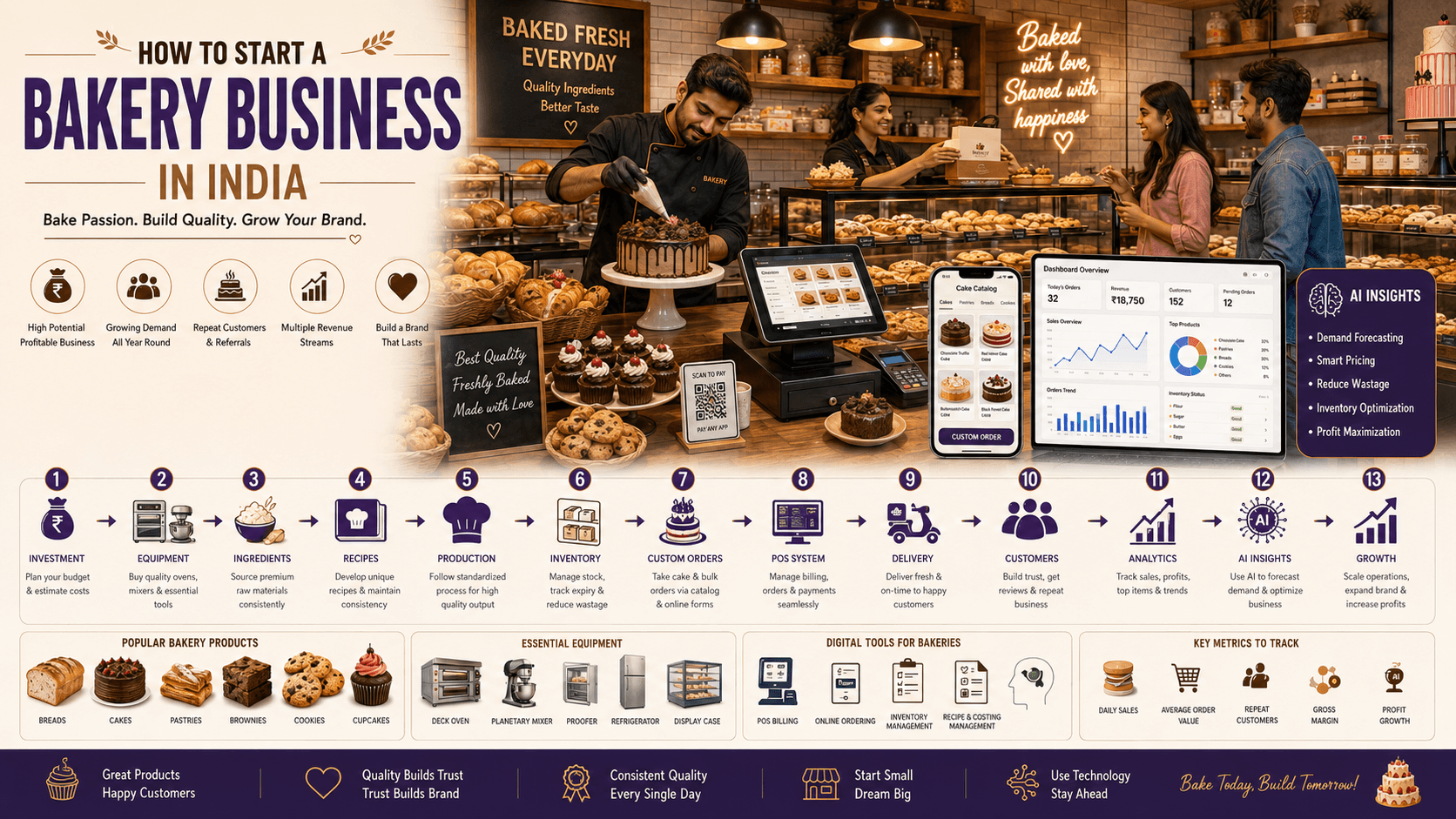
The biggest challenge is that bakery products are often perishable.
If you produce too much, you create wastage.
If you produce too little, you lose sales.
That makes a bakery particularly interesting from a technology and data perspective.
In this guide, we'll explore how to start a bakery business in India and how technology can help turn a traditional bakery into a smarter, scalable business.
A bakery can have multiple revenue streams.
You can sell:
You can also generate additional revenue through:
This gives a bakery more opportunities than a business focused on just one product.
Before investing money, decide what type of bakery you want.
You operate from home and accept orders online.
Possible products:
Advantages:
The main challenge is production capacity and applicable local food-business requirements.
A physical neighborhood store.
You can sell:
This gives you both:
Walk-in customers + pre-orders
Combine:
Bakery + Café
Customers can purchase:
Now the business can also earn from seating and beverage sales.
Instead of focusing on walk-in customers, you manufacture products and supply:
This becomes more of a B2B bakery business.
Investment varies considerably depending on the business model.
An illustrative small bakery setup could look like:
| Expense | Approx. Budget |
|---|---|
| Security deposit/advance | ₹75,000 |
| Interior/setup | ₹1,00,000 |
| Commercial oven | ₹1,50,000 |
| Mixer | ₹50,000 |
| Refrigerator/freezer | ₹50,000 |
| Display counter | ₹75,000 |
| Baking trays & tools | ₹25,000 |
| POS system | ₹20,000 |
| Furniture | ₹40,000 |
| Signage/branding | ₹25,000 |
| Initial ingredients | ₹40,000 |
| Licenses/miscellaneous | ₹25,000 |
| Working capital | ₹1,00,000 |
| Illustrative Total | ₹7,75,000 |
These are illustrative figures.
Actual investment depends on:
A home bakery can require much less capital.
A large premium bakery can require significantly more.
Don't start by making everything.
Choose a small core menu.
For example:
Then expand based on demand.
A bakery near a residential neighborhood might sell more:
A bakery near a college might sell more:
A premium neighborhood might support:
Your location should influence your menu.
If you operate a walk-in bakery, look for:
But remember:
Visibility is not the same as profitability.
A premium location with extremely high rent can destroy your margins.
Calculate:
Expected Sales − Rent − Staff − Ingredients − Other Costs
before signing a long lease.
Suppose you sell a cake for:
₹1,000
Your ingredients cost:
₹350
Then:
Gross contribution = ₹650
But that doesn't mean you earned ₹650.
You still need to account for:
This is why every recipe should have a standard cost.
Suppose one chocolate cake requires:
Total:
₹480
If you sell it for:
₹1,000
your direct contribution is:
₹520
Now you can compare the product against other cakes.
This is much better than simply guessing:
"₹1,000 sounds like a good price."
A recipe might cost ₹480 in ingredients and packaging.
But someone still needs to:
As the business grows, labor becomes a significant cost.
Therefore, your pricing should consider the complete production economics, not only raw materials.
A bakery can lose money through unsold products.
Imagine you produce:
100 pastries
but sell only:
70
Now you have:
30 unsold products
Depending on the product and food-safety requirements, some inventory may not be saleable the next day.
That's lost money.
This is why production planning is critical.
Instead of asking:
"How much should we bake today?"
use your sales data.
Suppose historical data shows:
Monday → 50 pastries
Tuesday → 55
Wednesday → 52
Thursday → 60
Friday → 75
Saturday → 110
Sunday → 130
Now you can plan production accordingly.
This is a simple example of demand forecasting.
Imagine your POS records every sale.
After several months, you have data.
You can analyze:
Your system can eventually recommend:
Produce 120 pastries on Saturday.
instead of relying entirely on intuition.
A bakery POS can track:
What was sold?
What ingredients remain?
Which products are popular?
Who purchases regularly?
Which cakes are scheduled?
Cash, UPI, card, online payment, etc.
This creates a digital record of the business.
Custom cakes are different from regular bakery sales.
A customer may request:
Birthday Cake
Date:
Saturday
Flavor:
Chocolate
Weight:
2 kg
Design:
Superhero theme
Message:
Happy Birthday!
Advance:
₹500
Remaining:
₹1,500
This information should not live only in a notebook or WhatsApp chat.
A simple order-management system can track:
Customer → Design → Date → Payment → Production → Delivery
This dramatically reduces missed orders.
A bakery could eventually have:
Customer
   ↓
Website / WhatsApp
   ↓
Cake Selection
   ↓
Customization
   ↓
Date & Time
   ↓
Payment
   ↓
Order Management
   ↓
Kitchen
   ↓
Quality Check
   ↓
Delivery / Pickup
Now your bakery has a mini e-commerce system.
Customers often discover bakeries through:
WhatsApp can be used for:
For example:
Your chocolate birthday cake is ready for pickup at 5:00 PM.
That's much better than making the customer call repeatedly.
Instead of sending dozens of images manually, create a digital catalog containing:
For cakes:
0.5 kg
1 kg
1.5 kg
2 kg
etc.
Customers can browse before contacting the bakery.
As your business grows, you can accept orders through:
Website
QR Menu
Delivery platforms
Social media
Ideally, all orders should eventually flow into one centralized order system.
Otherwise you might have:
and no single view of the business.
A bakery can build strong repeat behavior.
Customers may return for:
A loyalty program can reward repeat customers.
For example:
Spend ₹2,000 → ₹200 reward
or:
5 purchases → Free brownie
The exact reward should be based on your margins.
With customer permission, you could record important dates such as:
Birthday
Anniversary
Then send a timely reminder:
Planning a birthday cake this week? Here are our latest designs.
This is more useful than sending random advertisements every day.
The objective is relevance, not spam.
AI becomes particularly interesting for bakeries because demand can fluctuate significantly.
Predict how many products you may need.
Estimate required:
Identify products with consistently high unsold quantities.
Recommend products based on previous purchases.
Generate:
Ask:
"Which products generated the highest contribution this month?"
AI can analyze the underlying sales data and summarize it.
Bakeries often experience demand spikes around:
A bakery that understands these patterns can prepare:
Inventory
Staff
Packaging
Marketing
Production capacity
in advance.
Instead of offering the exact same menu all year, introduce limited products.
For example:
Christmas
→ Plum cake
→ Christmas gift box
Valentine's Day
→ Heart-shaped cakes
→ Dessert boxes
Diwali
→ Dessert hampers
Limited-time products can create urgency and give existing customers a reason to purchase again.
A physical bakery serves customers near the shop.
Online ordering can expand your reach.
Possible channels include:
For custom cakes, pre-orders can be particularly valuable because they allow you to plan production.
Customers see the packaging before they eat the product.
Good packaging can communicate:
Quality
Brand
Care
Premium positioning
Your packaging can include:
A well-designed cake box can turn into a marketing tool.
Bakery products are highly visual.
Create content around:
Short videos can show the transformation:
Ingredients → Baking → Decoration → Final Product
This type of content naturally demonstrates the product.
A technology-enabled bakery could look like:
                     CUSTOMER
                        │
        ┌───────────────┼───────────────┐
        ↓               ↓               ↓
     WALK-IN         WEBSITE         WHATSAPP
        │               │               │
        └───────────────┼───────────────┘
                        ↓
                       POS
                        ↓
          ┌─────────────┴─────────────┐
          ↓                           ↓
      INVENTORY                    ORDERS
          ↓                           ↓
          └─────────────┬─────────────┘
                        ↓
                   PRODUCTION
                        ↓
                    PACKAGING
                        ↓
                  PICKUP / DELIVERY
                        ↓
                    ANALYTICS
                        ↓
                       AI
This is the difference between simply selling bakery products and building a digital bakery operation.
Don't automate everything.
Start with the biggest bottleneck.
Implement POS.
Implement inventory management.
Implement order management.
Implement CRM and loyalty.
Implement production analytics.
Implement centralized online ordering.
Technology should follow the problem.
Suppose your bakery has:
Monthly fixed costs = ₹1,50,000
and average contribution per order is:
₹250
Then:
₹1,50,000 ÷ ₹250 = 600 orders/month
That's approximately:
20 orders/day
under this simplified assumption.
But remember that bakery orders can vary dramatically in value.
A ₹100 pastry purchase and a ₹2,000 custom cake shouldn't be treated identically.
Therefore, calculate contribution by product category and order type.
A bakery owner should know:
How much did we sell?
How many transactions?
How much does each customer spend?
How much did ingredients cost?
How much inventory was unsold?
Which products are driving sales?
Which products occupy inventory?
How many cakes were pre-booked?
How many customers returned?
These metrics create a much clearer picture of the business.
Unsold products create wastage.
Complexity increases inventory requirements.
You may unknowingly sell low-margin products.
Custom work requires additional labor and design time.
Missed cake orders can damage customer trust.
Presentation matters.
Build your own customer relationship where practical.
Without data, production planning becomes guesswork.
A bakery can scale in several directions.
Home bakery
↓
Small production kitchen
↓
Physical bakery
↓
Bakery + café
↓
Multiple outlets
↓
Central production kitchen
↓
B2B supply
↓
Private-label products
↓
Franchise / multi-location brand
Technology becomes increasingly important at every stage.
Once you have multiple locations, you could have:
BAKERY NETWORK

Store 01     ₹6.2L
Store 02     ₹7.1L
Store 03     ₹5.8L

Total Sales  ₹19.1L

Top Product:
Chocolate Cake

Highest AOV:
Store 02

Highest Wastage:
Store 03

Best Day:
Sunday
Now the owner doesn't have to rely entirely on individual store managers' opinions.
The data provides another layer of visibility.
Imagine combining:
Bakery
Online Ordering
Customer Database
Production Planning
Inventory
Analytics
AI
You now have something much bigger than a traditional bakery.
You have a technology-enabled food business.
And the technology doesn't need to be visible to the customer.
The customer simply sees:
Better products
Better service
Reliable delivery
Easy ordering
Personalized offers
That's the real purpose of technology.
Starting a bakery can begin with one oven and a few recipes.
But building a profitable bakery requires much more than baking skills.
You need to understand:
Demand
Food costs
Pricing
Production
Wastage
Customers
Marketing
Orders
Cash flow
And eventually:
Data
Technology can help connect all of these pieces.
Start small.
Build products people love.
Track every order.
Understand your costs.
Reduce wastage.
Build repeat customers.
Then scale the system.
A modern bakery shouldn't use technology just because everyone says it should.
Use technology where it creates measurable value.
POS → Understand sales.
Inventory → Control stock.
Order Management → Never miss a custom order.
CRM → Understand customers.
Analytics → Understand the business.
AI → Predict and optimize.
The future bakery may still smell exactly like fresh bread and chocolate cake.
But behind the scenes, it can run on data, automation and intelligent technology.
Pixels to Perfection Design that Impresses