Rahul
 LeetCode #155: Min Stack — Design a Stack with O(1) Minimum Retrieval
 LeetCode #20: Valid Parentheses — Master the Stack Pattern
 LeetCode #15: 3Sum — Master Sorting, Two Pointers and Duplicate Handling
 Instruction vs Context in AI Prompts: How to Tell AI What to Do and What Information to Use
 Rust Structs and Enums: Building Powerful Data Models
 Dissecting the High-Level System Architecture of Booking.com
 Kanban vs. Scrum: Which Agile Methodology to Choose?
 The Scaling Journey of LinkedIn: From Startup to Professional Powerhouse
 Mastering Code Review: A Guide for Reviewers and PR Creators
 ChatGPT: Unveiling the Power of AI in Conversational Experiences with Kairos Coders

Kairos Coders are here to help
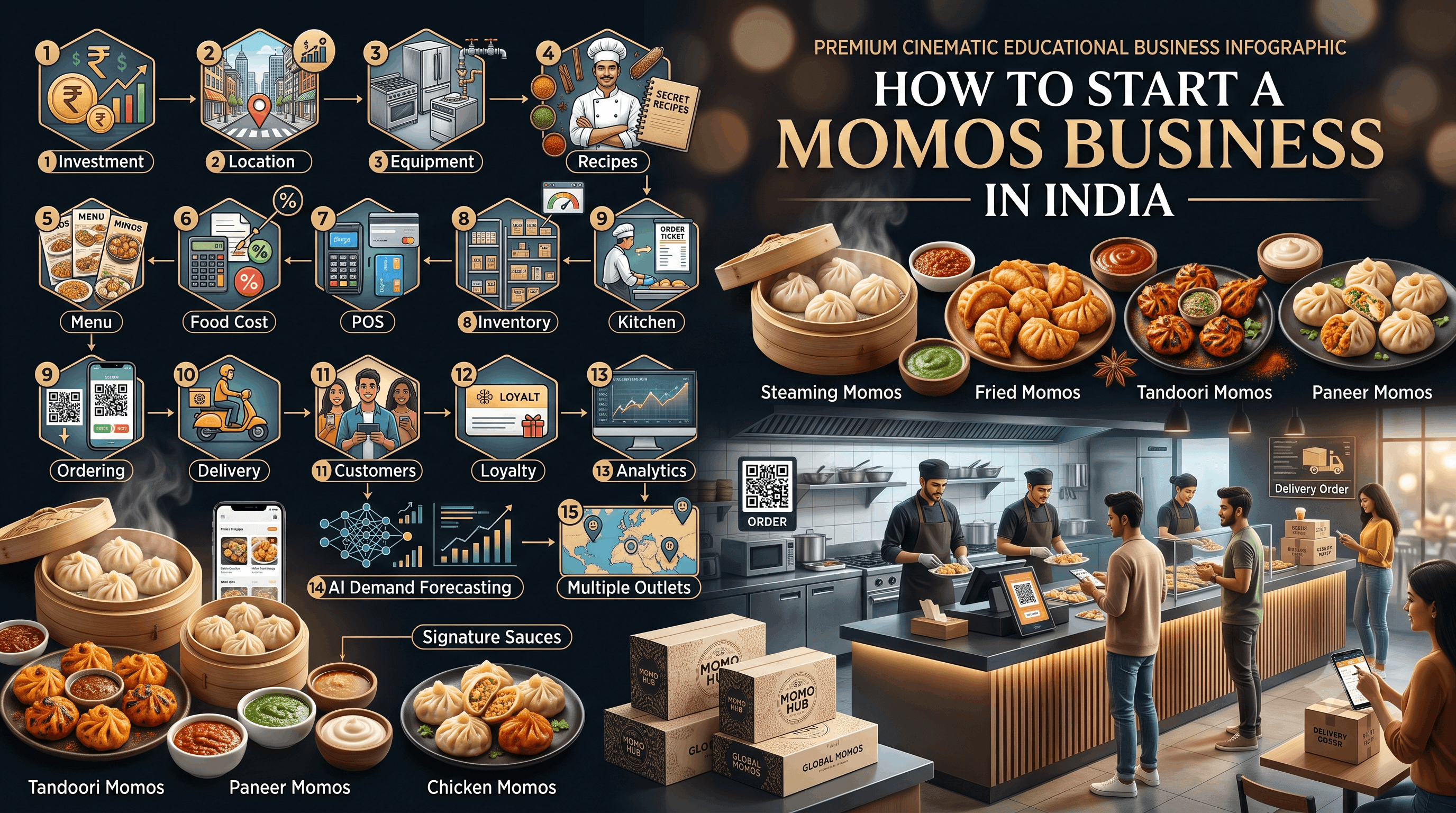
Momos started as a popular street food.
Today, they are much more than that.
You can find momos everywhere—from roadside carts and small kiosks to food courts, cafés and organized quick-service restaurant (QSR) chains.
Brands such as Wow! Momo demonstrated an important business lesson:
You can take a simple street-food product, build a standardized menu around it, create a strong brand, and turn it into a scalable QSR business.
That is the real opportunity.
You don't necessarily need to build the next Wow! Momo.
You can build your own momo brand by learning from the systems behind successful QSR businesses.
Momos have several characteristics that make them attractive for a food business.
Compared with a full-service restaurant, a momo-focused outlet can potentially start with a smaller kitchen and a focused menu.
One basic momo concept can become:
For example:
Momos + Drink
Momos + Fries
Momos + Dessert
Momos can work well for:
Momos are particularly popular among:
That makes branding and social media particularly important.
The interesting thing about Wow! Momo isn't simply that it sells momos.
The bigger lesson is product transformation.
Traditional thinking:
"Let's sell momos."
QSR thinking:
"Let's build a standardized momo brand."
That means thinking about:
Brand
↓
Menu
↓
Recipes
↓
Portion Sizes
↓
Kitchen Process
↓
Packaging
↓
Customer Experience
↓
Technology
↓
Expansion
That's what turns food into a scalable business.
If you're starting your own momo business, don't simply copy another company's:
Instead, learn from the underlying principles.
Every outlet should produce consistent food.
Don't sell only one type of momo.
Give customers a reason to remember you.
Reduce unnecessary kitchen complexity.
Consider:
Use data to improve operations.
You don't need a 1,500 sq. ft. restaurant.
There are several ways to start.
The smallest format.
Potential advantages:
The challenge is building a recognizable brand and maintaining consistent quality.
A small branded counter in:
This is closer to a modern QSR model.
A dedicated outlet with seating.
You can add:
This increases the average order value.
No dine-in.
Customers order through:
The focus becomes:
Food + packaging + delivery economics + digital marketing.
Once the first store works:
Store 1
↓
Standardization
↓
Store 2
↓
Centralized Purchasing
↓
Central Kitchen
↓
Multiple Outlets
↓
Franchise
This is where technology becomes increasingly important.
An illustrative small branded momo outlet could look like:
| Expense | Approx. Budget |
|---|---|
| Security deposit | ₹75,000 |
| Interior/setup | ₹75,000 |
| Steamer | ₹25,000 |
| Fryer | ₹20,000 |
| Refrigerator | ₹35,000 |
| Freezer | ₹30,000 |
| Prep tables & utensils | ₹25,000 |
| Exhaust/ventilation | ₹30,000 |
| POS system | ₹20,000 |
| Signage/branding | ₹30,000 |
| Initial inventory | ₹40,000 |
| Packaging | ₹15,000 |
| Licenses/miscellaneous | ₹25,000 |
| Working capital | ₹1,00,000 |
| Illustrative Total | ₹5,45,000 |
These are illustrative numbers, not fixed market costs.
A cart can cost considerably less.
A premium branded outlet can cost considerably more.
Location, equipment quality, size and format can dramatically change the investment.
Momos are a high-frequency impulse food.
Good potential locations include:
You want people who can easily think:
"Let's grab some momos."
Before opening, don't just count momo shops.
Study them.
Record:
You may discover that every competitor sells:
Steamed Veg Momos — ₹80
Instead of entering the same battle, you could differentiate through:
Premium fillings
or
Tandoori varieties
or
Unique sauces
or
Better combos
or
Experience
A common mistake is creating too many products.
Start with a focused menu.
Then create:
Combo Meals
Every successful food brand needs something customers remember.
Instead of:
"That momo shop."
You want:
"Let's go to that place for their ___ momos."
Your signature could be:
Smoked Tandoori Momos
Cheese Burst Momos
Kurkure Momos
Peri Peri Momos
Butter Garlic Momos
The exact product doesn't matter as much as having something memorable.
Suppose one plate contains:
8 momos
Every plate should ideally contain the same:
If one employee gives:
8 momos
and another gives:
10
your food cost changes.
That might seem small.
But at scale, it becomes significant.
Imagine:
8 Paneer Momos
Ingredient cost:
Total direct cost:
₹55
Suppose you sell them for:
₹149
Then:
₹149 − ₹55 = ₹94
This is your simplified contribution before accounting for:
That's why recipe-level costing is essential.
Many new food businesses make the same mistake:
"I'll sell cheaper than everyone."
This creates a price war.
Instead, build a product customers are willing to pay for.
For example:
₹79 basic momos
₹129 premium momos
₹169 signature momos
₹249 combo
Now you can serve multiple customer segments.
A customer orders:
Momos — ₹129
You can create:
Momos + Drink — ₹159
or:
Momos + Fries + Drink — ₹219
Instead of increasing the price of the core product, you increase the basket size.
This is called upselling and cross-selling.
Momos are often remembered not only for the filling but also for:
Chutney
You can create a signature sauce system.
For example:
Standardize the recipes.
Then package them consistently.
Your sauce can become part of your brand identity.
Here's where the Wow! Momo-style scaling concept becomes interesting.
Instead of preparing everything independently at every outlet:
Central Kitchen
↓
Prepare standardized:
↓
Distribute to:
Store 1
Store 2
Store 3
Store 4
This can improve consistency and purchasing efficiency, subject to appropriate food-safety and operational controls.
Suppose four stores independently buy ingredients.
Each store negotiates separately.
But a central purchasing system can consolidate demand.
Instead of:
50 kg
you may purchase:
200 kg
That can potentially improve supplier negotiations and consistency.
The actual savings depend on suppliers, volume and logistics.
Track:
Depending on your preparation model.
You need to know:
Opening Stock
Purchases
−
Consumption
−
Wastage
=
Closing Stock
Imagine a customer purchases:
Chicken Momos × 1
The POS records the sale.
Your inventory system can estimate consumption based on the standardized recipe.
After 100 orders:
Expected chicken consumption
can be compared with:
Actual consumption
If there is a significant difference, investigate:
Technology can help protect margins.
As orders increase, kitchen communication becomes important.
Instead of handwritten tickets:
ORDER #1084
2 × Paneer Momos
1 × Tandoori Momos
1 × Coke
STATUS:
Preparing
Kitchen staff can update:
Preparing → Ready
Front counter and delivery staff can see the same status.
A physical kiosk depends on foot traffic.
Delivery allows you to serve customers outside the immediate walking radius.
Your channels can become:
Dine-in
Takeaway
Delivery
But each channel has different economics.
Always calculate the contribution after:
You don't have to depend entirely on third-party platforms.
Eventually you could offer:
Website
QR Ordering
Loyalty Members
Customers can place orders directly.
This gives you more control over the customer relationship.
Imagine a regular customer sends:
"2 chicken momo plates and 1 peri peri fries."
Your system can:
Receive order → Confirm → Send to kitchen → Process payment → Prepare → Notify customer
That's a very simple form of food-tech.
You don't need a massive app to start.
At a kiosk or café:
Customer scans:
QR Code
↓
Digital menu opens
↓
Selects food
↓
Pays
↓
Kitchen receives order
↓
Customer gets order number
This can reduce manual order-taking.
Imagine a customer buys momos twice every week.
You could create:
Momo Club
For example:
The exact reward should be designed around your margins.
The goal is simple:
Turn occasional customers into regular customers.
Your system can eventually understand:
Now you can create personalized campaigns.
Instead of:
"20% OFF EVERYTHING!"
you might send:
"Your favorite Tandoori Momos are back with a new combo."
That's smarter marketing.
AI can be used for more than generating Instagram captions.
Predict orders by:
Estimate how much:
you may need.
Recommend products based on previous purchases.
Generate campaigns and promotional content.
Ask:
"Why did Store 2's profit fall this month?"
The system can analyze:
MOMO BRAND — DAILY DASHBOARD
Orders 487
Revenue ₹78,420
Average Order ₹161
Best Seller:
Chicken Steamed Momos
Fastest Growing:
Tandoori Momos
Highest Margin:
Paneer Momos
Wastage:
2.8%
Stock Alert:
Chicken — REORDER
AI Forecast:
Tomorrow's demand +14%
Now the owner isn't just looking at revenue.
They're looking at the health of the entire operation.
Momos are highly visual.
Create content around:
Short-form video can become a powerful acquisition channel.
Don't just create:
XYZ Momos
Create an identity.
Maybe your brand is:
Street-inspired
Youth-focused
Premium
Funny
Desi
Minimal
Tech-inspired
The customer should recognize your brand before seeing the name.
Imagine a customer carrying your momo box through a college campus.
The box should communicate:
Brand name
Logo
Social handle
QR code
Ordering link
Good packaging can turn every delivery into a mini billboard.
Suppose monthly fixed expenses are:
₹1,50,000
Average contribution per order:
₹100
Then:
₹1,50,000 ÷ ₹100 = 1,500 orders/month
That's approximately:
50 orders/day
under this simplified assumption.
Actual break-even will depend on your:
Use the calculation to understand the business model rather than treating it as a guaranteed profit projection.
A scalable momo business needs:
Everyone follows the same process.
Every plate has consistent quantities.
Every order looks like the same brand.
Employees know exactly what to do.
Every outlet reports data in the same format.
Management can see every store.
That's how:
One outlet → Multiple outlets
becomes possible.
The journey could look like:
Momo Cart
↓
Small Kiosk
↓
Branded Outlet
↓
Cloud Kitchen
↓
Second Outlet
↓
Central Kitchen
↓
Multiple Stores
↓
Franchise
↓
National Brand
The product may remain:
Momos
But the business system becomes increasingly sophisticated.
Learn principles, not identity.
Operational complexity increases.
Margins disappear.
Food costs become unpredictable.
The customer experience suffers.
Delivery customers judge presentation.
Revenue grows without healthy contribution.
You lose repeat-business opportunities.
Prove one outlet first.
The most valuable lesson isn't:
"Sell momos."
It's:
"Turn a simple food product into a standardized, recognizable, repeatable experience."
That's the foundation of a scalable QSR.
You can start with a small momo counter.
But from day one, think about:
Recipe
→ Cost
→ Process
→ Customer
→ Data
→ Brand
→ Technology
→ Scale
A momo business can start with:
One steamer
One counter
A small menu
A handful of customers
But the ambition doesn't have to stop there.
The opportunity is to build a system where:
Customers order easily
↓
Kitchen operates efficiently
↓
Inventory stays under control
↓
Food remains consistent
↓
Customers return
↓
Data improves decisions
↓
Technology enables scale
That's how a street-food idea can become a modern QSR brand.
You don't need to become the next Wow! Momo.
You need to build the first version of your own brand.
A momo shop might look like a food business.
But underneath, it can become a small technology company.
POS → Tracks every sale.
Inventory → Controls ingredients.
KDS → Connects counter and kitchen.
CRM → Understands customers.
Online Ordering → Creates a digital sales channel.
Analytics → Measures performance.
AI → Helps forecast demand and optimize decisions.
The momo may be traditional.
The business behind it doesn't have to be.
Pixels to Perfection Design that Impresses