
Rahul
 LeetCode #217: Contains Duplicate — Master Hash Sets and Fast Lookup
 Zero-Shot Prompting Explained: How to Get AI to Perform Tasks Without Examples
 Rust Ownership: The Concept That Makes Rust Different
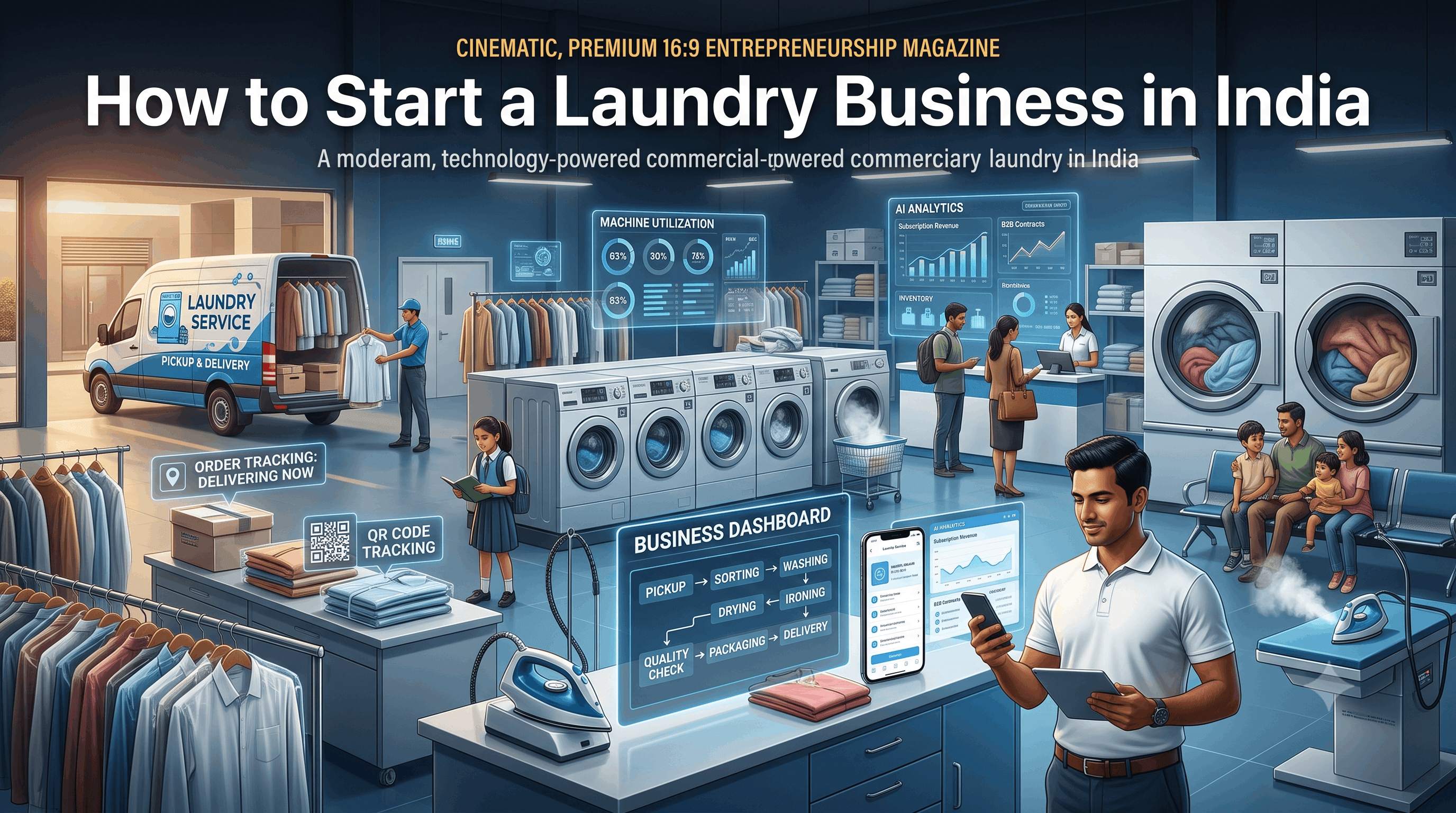 How to Start a Laundry Business in India: Investment, Machines, Pricing, Profit & Technology — Building a Laundry Brand Beyond Washing Clothes
 Merge Sort Explained: Divide and Conquer from Scratch
 Dissecting the High-Level System Architecture of Booking.com
 Kanban vs. Scrum: Which Agile Methodology to Choose?
 The Scaling Journey of LinkedIn: From Startup to Professional Powerhouse
 Mastering Code Review: A Guide for Reviewers and PR Creators
 ChatGPT: Unveiling the Power of AI in Conversational Experiences with Kairos Coders

Kairos Coders are here to help
Most people think a laundry business is simple.
Collect clothes.
Wash them.
Dry them.
Iron them.
Return them.
But the moment you try to scale it, you discover that laundry is actually a logistics and operations business disguised as a cleaning business.
The washing machine is only one part of the business.
The real challenge is managing:
Customers → Pickup → Sorting → Washing → Drying → Ironing → Quality Control → Packaging → Delivery → Payments → Repeat Orders
And technology can connect every one of those steps.
That is why businesses such as UClean and Tumbledry are interesting to study.
At first glance, you're selling:
Washing clothes.
But customers actually buy:
"I don't want to wash this myself."
"I don't have time to iron 15 shirts."
"I want my clothes returned when promised."
"I don't want my expensive clothes damaged."
"I need to know my clothes won't be lost."
That's an important distinction.
A laundry business sells convenience and trust—not just washing.
You don't have to depend only on washing.
You can offer:
This creates opportunities for both B2C and B2B revenue.
Don't try to serve everyone immediately.
You could target:
High frequency, price sensitive.
Convenience focused.
Large recurring loads.
High volume.
B2B recurring contracts.
Uniforms, towels and linen.
Towels and linens.
The economics of each segment are different.
Instead of opening an expensive premium laundry store immediately, consider:
Customer books online.
↓
You collect clothes.
↓
Central processing location.
↓
Wash / dry / iron.
↓
Quality check.
↓
Packed.
↓
Delivered.
This changes the business dramatically.
Your storefront doesn't necessarily need to be the most important part of the operation.
UClean is an interesting Indian case study because it has built a laundry and dry-cleaning network rather than operating purely as a traditional neighborhood washer.
Its model combines physical stores with technology-enabled customer ordering and pickup/delivery services.
Laundry can be standardized and converted into a repeatable branded service.
Instead of:
"Rahul's Laundry Shop"
you can build:
A recognizable laundry service with standardized processes.
Tumbledry has also positioned itself around organized laundry and dry-cleaning services, with stores and pickup/delivery operations.
The interesting business lesson is:
A local service can become a network when the processes are standardized.
That's the real opportunity.
This is one of the biggest mistakes.
People think:
"Let's buy commercial washing machines."
Wrong first question.
Ask:
How many kilograms of clothes can I realistically process every day?
For example:
Potential demand:

Day 1       80 kg
Day 2       95 kg
Day 3      120 kg
Day 4      105 kg
Day 5      160 kg
Day 6      210 kg
Day 7      190 kg
Your equipment should be selected based on your expected throughput.
Suppose your washing equipment can process:
30 kg per cycle
and one cycle takes approximately:
45 minutes
If you effectively achieve 8 productive cycles:
30 × 8 = 240 kg/day
That's your approximate washing capacity under those assumptions.
But washing isn't your only bottleneck.
You also have:
Drying
Ironing
Sorting
Folding
Packaging
One slow process can limit the entire operation.
Imagine:
300 kg/day
250 kg/day
180 kg/day
350 kg/day
Your actual processing capacity is closer to:
180 kg/day
because ironing is your bottleneck.
This is basic operations management.
But it's incredibly important.
Depending on your business size:
It is:
Your process.
Imagine two businesses with identical machines.
Business A:
Customer clothes get mixed.
Business B:
Every garment receives a unique order ID.
Which one can scale?
Obviously B.
Imagine:
ORDER #LDR-58291

Customer:
Rahul

Items:
8 Shirts
3 T-Shirts
2 Jeans
1 Jacket

Service:
Wash + Iron

Pickup:
29 Aug

Delivery:
31 Aug

Status:
Processing
Now the customer's clothes become trackable units.
Attach a washable-safe tag or order identification system.
At every stage:
Pickup
↓
Sorting
↓
Washing
↓
Drying
↓
Ironing
↓
Quality Check
↓
Packaging
↓
Delivery
The system records the movement.
        LAUNDRY OS

Today's Orders       84

Pending Pickup       19
Collected            27
Washing              18
Drying               11
Ironing               6
Quality Check         2
Ready                 1
Out for Delivery     12

Delayed Orders        3
Now the owner doesn't have to walk around asking:
"Where are those clothes?"
The system knows.
Imagine you collect:
100 customer orders
and put everything into one giant pile.
That's a disaster waiting to happen.
You need to sort by:
A cotton T-shirt isn't the same as:
Silk
Wool
Denim
Leather
Embroidered clothing
Delicate garments
Your system should store service instructions.
For example:
GARMENT #2391

Fabric:
Silk

Service:
Dry Clean

Temperature:
Special handling

Iron:
Low heat

Priority:
Premium
Technology helps reduce human memory dependency.
You can price based on:
Good for regular laundry.
Example:
Wash & Fold — ₹X/kg
Useful for:
Different prices for:
Wash
Wash + Iron
Dry Clean
Express
For example:
| Service | Example Pricing Model |
|---|---|
| Wash & Fold | ₹/kg |
| Wash & Iron | ₹/kg |
| Steam Iron | ₹/piece |
| Shirt Dry Clean | ₹/piece |
| Suit Dry Clean | ₹/piece |
| Blanket | ₹/piece |
| Shoes | ₹/pair |
These are illustrative pricing structures, not recommended market prices.
Your actual prices should be based on local competition and your costs.
Don't treat every customer equally.
Someone sending:
15 everyday T-shirts
has different economics from someone sending:
A designer suit.
Premium services can include:
Higher-value services can improve average order value.
This is where laundry gets interesting.
Imagine:
₹999/month
Includes:
Up to X kg laundry
or
X pickups
Customers don't have to think about ordering every week.
You have:
Predictable recurring revenue.
Imagine targeting PGs.
4 pickups/month
Special pricing
WhatsApp reminders
Scheduled pickup
Students get convenience.
You get recurring demand.
For families:
Monthly:
40 kg
60 kg
80 kg
The larger the household, the more attractive the subscription becomes.
An "unlimited" plan sounds attractive.
But it can destroy your economics.
Imagine:
Average customer:
20 kg/month
Heavy user:
70 kg/month
If both pay the same subscription, your heavy user can destroy your margin.
Use:
Fair usage limits
or
tiered plans.
Suppose you have:
50 pickups
across a city.
Sending one delivery person to every address individually is inefficient.
You need route optimization.
Imagine:
Pickup A
   ↓
Pickup B
   ↓
Pickup C
   ↓
Pickup D
   ↓
Processing Center
Instead of:
Center → A → Center
Center → B → Center
Center → C → Center
Center → D → Center
The difference becomes enormous as order volume increases.
Your system knows:
Customer location
Pickup time
Vehicle capacity
Delivery deadline
Priority
It can generate:
Driver Route #14
with the optimal sequence.
That's a direct technology advantage.
Instead of:
"We'll come sometime today."
Offer:
Customers get predictability.
You get better route planning.
Customer receives:
Your laundry has been picked up.
Then:
Your order is being washed.
Then:
Quality check completed.
Then:
Out for delivery.
This creates trust.
A customer could message:
Laundry pickup tomorrow
The system checks their address.
Available slot:
10–12 AM
Customer confirms.
Pickup order created.
No app download required.
That's a powerful principle:
Don't force customers to learn your technology.
Make technology invisible.
You might think:
"We need an app."
Maybe not.
Your first system could simply be:
Website
Admin dashboard
Delivery dashboard
Order database
That's enough to validate the business.
Your system can record:
CUSTOMER

Orders: 17

Average Order:
₹1,240

Monthly Frequency:
3.2

Preferred Service:
Wash + Iron

Last Pickup:
21 Aug

Lifetime Value:
₹21,080
Now you know your best customers.
Suppose a customer spends:
₹1,000/month
and stays for:
24 months
Simplified revenue:
₹24,000
Now compare:
Customer A:
₹2,000 one-time order
Customer B:
₹1,000 every month for two years
Customer B is much more valuable.
That's why retention matters.
Suppose a customer normally orders every:
14 days
but hasn't ordered for:
28 days
Your system could flag:
Customer inactive
Then send a useful reminder.
Not necessarily:
"50% OFF!!!"
It could simply say:
"Need a laundry pickup this week?"
Now move beyond consumers.
Imagine a small hotel has:
40 rooms
Every day it needs:
That's recurring demand.
One contract can be worth significantly more than many individual customers.
Hostels and PGs are another opportunity.
Imagine:
300 students
Even if only 30% become customers:
90 recurring users
Now you've created a concentrated customer base.
Instead of advertising individually to thousands of people, partner with the hostel.
Businesses constantly need clean textiles.
This can create predictable B2B revenue.
Instead of:
₹X per kg every time
offer:
Expected volume: 1,000 kg
Pickup: Daily
Delivery: Daily
Billing: Monthly
Now you've moved from transactional revenue to recurring B2B revenue.
Laundry has a unique problem:
Customers may notice damage immediately.
Imagine:
"My white shirt came back with a blue stain."
That's not just a refund.
That's a trust problem.
You need quality checkpoints.
For premium garments, photograph them at pickup.
Imagine:
GARMENT

Pickup Photo:
29 Aug, 10:14 AM

Condition:
Minor stain on sleeve

Service:
Dry Clean

Delivery:
31 Aug
If a customer later says:
"This stain wasn't there."
you have documented evidence.
This is particularly useful for high-value garments.
Your software can record:
Claim ID
Customer
Garment
Issue
Photos
Resolution
Refund/credit
Over time, analyze:
Which service produces the most complaints?
Maybe:
Premium shirts: 1.2%
Silk garments: 4.7%
Now you know where training is needed.
Suppose you have:
50,000 orders
AI can identify:
The owner doesn't need to manually analyze spreadsheets.
Machines are expensive.
Suppose your washing machine normally operates:
8 hours/day
Your system tracks:
It could alert:
Machine #3 showing abnormal maintenance pattern.
Fixing equipment before a major breakdown can prevent operational disruption.
Imagine:
MACHINE UTILIZATION

Washer #1    86%
Washer #2    91%
Washer #3    48%
Dryer #1     94%
Dryer #2     72%
Ironing #1   97%
You immediately see:
Ironing is becoming the bottleneck.
Maybe your next investment shouldn't be another washer.
It should be:
Additional ironing capacity.
That's data-driven capex.
Laundry businesses consume resources.
Track:
Water
Electricity
Detergent
Gas
Machine cycles
If your cost per kilogram increases unexpectedly, investigate.
Example:
Last month:
₹18/kg

This month:
₹23/kg
Why?
Maybe:
Without measurement, you won't know.
Imagine:
AVERAGE COST / KG

Water       ₹3.2
Electricity ₹4.5
Detergent   ₹2.8
Labour      ₹5.5
Packaging   ₹1.8
Other       ₹2.2

TOTAL      ₹20.0/kg
Now pricing becomes much more intelligent.
Suppose your cost is:
₹20/kg
and you charge:
₹25/kg
It looks profitable.
But after:
your real contribution may be much lower.
Calculate the complete unit economics.
Your dashboard could show:
MONTHLY PERFORMANCE

Revenue              ₹8.4L
B2C                  ₹5.1L
B2B                  ₹3.3L

Processing Cost      ₹2.1L
Labour               ₹1.7L
Rent                 ₹0.8L
Logistics            ₹0.9L
Marketing            ₹0.3L
Utilities            ₹0.5L

Operating Profit     ₹2.1L
These numbers are illustrative.
The important part is knowing where every rupee goes.
Laundry doesn't sound exciting.
So don't advertise:
"We wash clothes."
Sell the outcome.
Get your weekend back.
Never worry about laundry day again.
Clean clothes without wasting your Sunday.
Reliable linen processing at scale.
Marketing should speak to the customer's problem.
Customers search:
Your website should have dedicated pages for relevant services and locations.
For example:
/laundry-pickup-delivery
/dry-cleaning
/shirt-ironing
/laundry-in-ludhiana
/corporate-laundry
This can turn search traffic into customers.
Laundry is naturally local.
One customer can introduce:
Family
Friends
Neighbors
Colleagues
You can create:
Refer a friend → both receive a reward
The objective is to turn satisfied customers into acquisition channels.
Imagine:
Customer subscribes.
↓
Uses service regularly.
↓
Gets referral code.
↓
Friend joins.
↓
Friend subscribes.
↓
Both receive rewards.
Now you have:
Recurring revenue + organic acquisition.
Great Service
      ↓
Happy Customer
      ↓
Repeat Orders
      ↓
Subscription
      ↓
Higher Customer LTV
      ↓
More Data
      ↓
Better Routes
      ↓
Lower Operating Cost
      ↓
Better Service
      ↓
More Referrals
      ↓
More Customers
Technology accelerates the loop.
A possible roadmap:
One processing location
One delivery zone
B2C customers
Subscriptions
WhatsApp ordering
CRM
Hostel/PG contracts
Hotels
Restaurants
Route optimization
Automated inventory
Machine monitoring
Second processing center
Multiple zones
Franchise/licensing opportunity
Once you have:
Standard operating procedures
Brand
Technology
Training
Supplier network
Quality control
Unit economics
you can potentially explore franchising.
But don't franchise a business that only works because:
The founder personally supervises everything.
First make the operation reproducible.
Not the number of machines.
Not the size of the shop.
Not the number of employees.
The real scalability comes from:
Same process.
Know where every order is.
Efficient pickup/delivery.
Subscriptions and B2B contracts.
Connect every stage.
Measure everything.
Imagine a laundry owner opening the dashboard at 9 AM.
Instead of manually calling employees, they see:
╔════════════════════════════════════╗
║          LAUNDRY OS                ║
╠════════════════════════════════════╣
║ TODAY                              ║
║ Orders                  126        ║
║ KG to Process            438       ║
║ Pickups                   48       ║
║ Deliveries                37       ║
╠════════════════════════════════════╣
║ OPERATIONS                         ║
║ Washing                  72%       ║
║ Drying                   84%       ║
║ Ironing                  96%  🔴   ║
║ Packaging                61%       ║
╠════════════════════════════════════╣
║ AI ALERT                           ║
║ Ironing is today's bottleneck.     ║
║ Recommended: move 1 worker from    ║
║ sorting to ironing at 2 PM.       ║
╠════════════════════════════════════╣
║ DELIVERY                           ║
║ Route #12 delayed                  ║
║ 7 orders affected                  ║
╠════════════════════════════════════╣
║ CUSTOMERS                          ║
║ 19 subscriptions renewing today   ║
║ 14 inactive customers              ║
╠════════════════════════════════════╣
║ B2B                                ║
║ Hotel contract: 182 kg today      ║
║ Hostel contract: 94 kg today      ║
╚════════════════════════════════════╝
That's not just a laundry shop anymore.
It's a technology-enabled operations business.
A traditional laundry business might look like:
Customer → Laundry Shop → Washing → Customer
A modern laundry company can look like:
Customer
↓
WhatsApp / Website
↓
Automated Pickup
↓
Order Tracking
↓
Smart Sorting
↓
Processing
↓
Quality Control
↓
Route Optimization
↓
Delivery
↓
CRM
↓
Subscription
↓
AI Analytics
That transformation is exactly what technology can bring to traditional Indian businesses.
Before launching, answer these questions:
If you can answer these questions before opening the doors, you're already thinking more like a business builder than simply a shop owner.
Pixels to Perfection Design that Impresses