
Rahul
 LeetCode #155: Min Stack — Design a Stack with O(1) Minimum Retrieval
 LeetCode #20: Valid Parentheses — Master the Stack Pattern
 LeetCode #15: 3Sum — Master Sorting, Two Pointers and Duplicate Handling
 Instruction vs Context in AI Prompts: How to Tell AI What to Do and What Information to Use
 Rust Structs and Enums: Building Powerful Data Models
 Dissecting the High-Level System Architecture of Booking.com
 Kanban vs. Scrum: Which Agile Methodology to Choose?
 The Scaling Journey of LinkedIn: From Startup to Professional Powerhouse
 Mastering Code Review: A Guide for Reviewers and PR Creators
 ChatGPT: Unveiling the Power of AI in Conversational Experiences with Kairos Coders

Kairos Coders are here to help
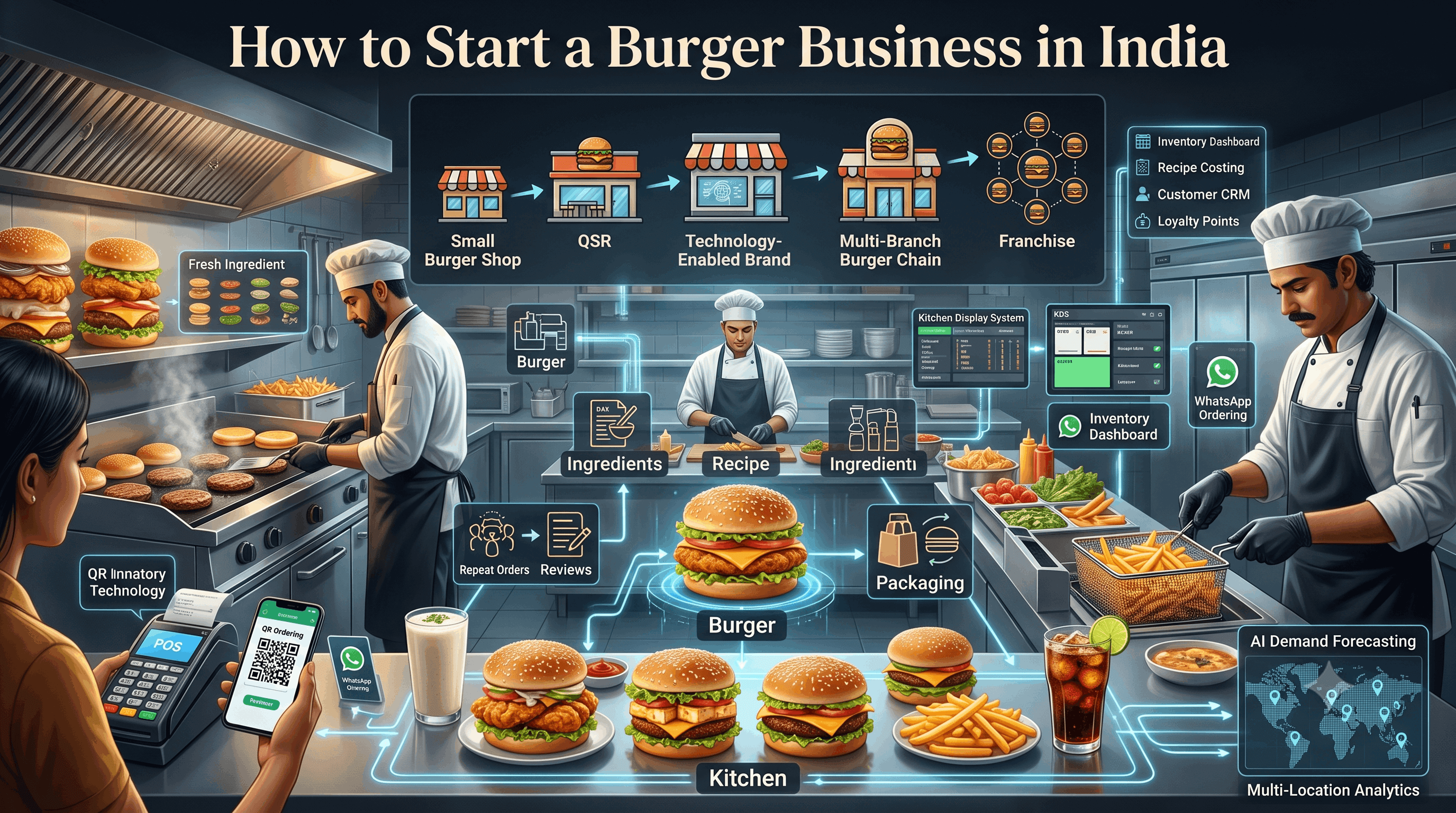
A burger business looks incredibly simple.
Bun + Patty + Sauce + Toppings = Burger.
But if that were all it took, every burger shop would become a successful chain.
The businesses that scale don't merely sell burgers.
They build a repeatable food system:
Recipe → Kitchen → Brand → Ordering → Delivery → Customer → Data → Repeat Purchase
That's why studying real businesses such as McDonald's, Burger King and Burger Singh is useful for an entrepreneur planning a burger business in India.
The biggest lesson?
Don't build a burger shop. Build a burger brand that can eventually be repeated across locations.
Burgers have several advantages:
You can sell:
Burger
Fries
Drink
Dessert
and turn a ₹200 purchase into a ₹350–₹500 order.
McDonald's is one of the world's strongest examples of operational standardization.
The important lesson isn't:
"McDonald's makes burgers."
Millions of restaurants make burgers.
The real lesson is:
McDonald's turned restaurant operations into a highly repeatable system.
Think about:
That is why the business can operate across thousands of locations.
You don't need thousands of stores.
You need the same philosophy at a smaller scale.
Your burger should have:
Standard bun
Standard patty
Standard sauce
Standard cheese quantity
Standard toppings
Standard cooking time
Standard assembly
Then document everything.
Indian burger brands have demonstrated that you don't have to simply copy Western burger chains.
A local brand can build its identity around:
Indian flavors + burgers + local pricing + Indian consumer preferences.
That is an important lesson.
You don't necessarily have to compete by becoming:
"Another McDonald's."
You can become:
An Indian burger brand with its own identity.
Imagine:
The objective is not to make everything unusual.
It's to create a few signature products people remember.
Burger King built its identity around flame-grilled burgers and a highly recognizable product architecture.
The broader lesson:
Give customers a reason to remember your burger.
Your USP might be:
Smoky patty
or:
Crispy chicken
or:
Indian masala
or:
Premium smashed burger
or:
Affordable ₹99 burger
Don't try to own everything.
Own one idea.
You could start with:
Minimal seating.
Low footprint.
Small kitchen.
Heavy online ordering.
Quick-service restaurant.
Takeaway + limited seating.
Higher prices.
Premium ambience.
Small footprint.
High footfall.
Investment depends heavily on:
For an illustrative small burger QSR, a planning budget might look like:
| Expense | Example |
|---|---|
| Security deposit | ₹1,00,000 |
| Interior/setup | ₹2,00,000 |
| Griddle/fryer | ₹1,00,000 |
| Refrigerator/freezer | ₹75,000 |
| Prep equipment | ₹50,000 |
| Exhaust/ventilation | ₹75,000 |
| POS/software | ₹30,000 |
| Furniture | ₹50,000 |
| Branding/signage | ₹50,000 |
| Licenses/misc. | ₹35,000 |
| Initial inventory | ₹50,000 |
| Packaging | ₹20,000 |
| Working capital | ₹1,50,000 |
| Illustrative total | ₹9,85,000 |
This is an example for planning—not a market quotation.
A premium dine-in outlet can cost substantially more.
You don't necessarily need:
1,500 sq. ft.
30 tables
Huge kitchen
₹20 lakh interiors
You can test the concept with:
250–500 sq. ft.
and focus on:
Takeaway + Delivery
If the product works, then expand.
A small burger kitchen may require:
Your biggest product decision is:
What kind of patty are you selling?
In India, a strong vegetarian and chicken menu can provide broad market appeal.
Suppose your patty is supposed to be:
100g
Employee A gives:
100g
Employee B gives:
130g
Employee C gives:
90g
Now your food cost is inconsistent.
Use:
Digital weighing scale
and define:
One patty = X grams.
That's a tiny operational decision with a huge effect at scale.
A burger can become memorable because of its sauce.
Create signature sauces such as:
Then build products around them.
Don't expect customers to remember:
35 different burgers.
Give them:
Your bestseller.
Vegetarian bestseller.
Premium signature.
Spicy/special edition.
These become your brand's identity.
A simple menu could be:
6–10 products
3–4 products
3–5 products
5–8 products
2–4 products
3–5 options
That's enough to begin testing demand.
Every additional item can create:
More inventory
More preparation
More training
More wastage
More errors
More complexity
Your goal should be:
Maximum customer choice with minimum operational complexity.
Imagine:
Chicken patty
is used in:
One core ingredient.
Multiple products.
That's efficient.
Similarly:
Paneer
can be used in:
Now your inventory becomes more efficient.
For every product:
| Product | Patty | Sauce | Cheese | Veggies | Bun |
|---|---|---|---|---|---|
| Classic Chicken | ✓ | ✓ | ✓ | ✓ | ✓ |
| Tandoori Chicken | ✓ | ✓ | ✓ | ✓ | ✓ |
| Paneer Tikka | ✓ | ✓ | ✓ | ✓ | ✓ |
| Spicy Veg | ✓ | ✓ | ✓ | ✓ |
Software can automatically calculate expected ingredient consumption.
Suppose your burger sells for:
₹249
Illustrative direct cost:
Bun:
₹20
Patty:
₹50
Cheese:
₹15
Vegetables:
₹10
Sauce:
₹8
Packaging:
₹15
Total:
₹118
Simplified contribution:
₹131
Again:
Contribution ≠ Net Profit.
Customer buys:
Burger ₹249
Then sees:
Add fries + drink for ₹99
Now order becomes:
₹348
This increases:
Average Order Value (AOV).
Example:
Burger + Fries + Drink
Signature Burger + Loaded Fries + Drink
2 Burgers + Large Fries + 2 Drinks
Burger + Small Fries
You can create different price points without dramatically expanding the menu.
Suppose:
100 orders/day
Average order:
₹300
Daily revenue:
₹30,000
Now increase AOV to:
₹350
Same 100 customers:
₹35,000/day
That's:
₹5,000 additional daily revenue
without acquiring another customer.
This is why menu engineering matters.
Your ordering system can ask:
Add cheese for ₹30?
Then:
Upgrade to loaded fries for ₹50?
Then:
Add a dessert for ₹70?
These tiny decisions can increase AOV.
But don't make the ordering experience annoying.
Suppose:
Burger preparation = 8 minutes
Packaging = 2 minutes
Pickup = 5 minutes
Delivery = 20 minutes
Total:
35 minutes
Now improve:
Preparation:
8 → 6
Packaging:
2 → 1
Pickup:
5 → 3
Delivery:
20 → 18
New total:
28 minutes
Seven minutes can significantly change customer perception.
Instead of:
Paper tickets everywhere
use:
ORDER #1837

2 × Classic Chicken
1 × Paneer Burger
1 × Large Fries
2 × Coke

STATUS:
PREPARING
Then:
PREPARING
→
READY
→
PICKED UP
This creates visibility.
Suppose orders are delayed.
Where?
Your system should measure timestamps:
Order Received
↓
Cooking Started
↓
Cooking Finished
↓
Packed
↓
Picked Up
Now you know exactly where time is being lost.
Suppose:
Burger A
requires:
Your software knows the ingredient prices.
If cheese price increases:
₹400/kg → ₹470/kg
the system recalculates your food cost.
You can then decide:
Increase price?
Change portion?
Change supplier?
Absorb the cost?
Your dashboard might show:
INVENTORY

Burger Buns
Stock: 180
Days: 2

Chicken Patty
Stock: 240
Days: 3

Cheese
Stock: 8.4 kg
Days: 4

Potatoes
Stock: 40 kg
Days: 5

ALERT:
Buns may run out
Saturday 8 PM
That's much better than discovering:
"We're out of buns."
during peak hours.
Suppose historical data shows:
120 orders
210 orders
340 orders
280 orders
AI can forecast expected demand.
It can also consider:
Then recommend procurement.
Friday morning:
Expected orders: 260–290
Chicken patties required: 340
Buns required: 310
Fries required: 42 kg
Packaging required: 300 units
Expected peak: 7:30–9:30 PM
Recommendation: Add one kitchen employee from 7–10 PM.
That's where a normal restaurant becomes a data-driven restaurant.
Every customer can become a profile.
CUSTOMER

Name: Rahul

Orders: 17

Favourite:
Spicy Chicken Burger

Average Order:
₹426

Visits:
3/month

Last Order:
12 days ago

Reward Points:
340
Now you can market intelligently.
Instead of:
20% OFF FOR EVERYONE
send:
"Your favourite Spicy Chicken Burger is back."
"We haven't seen you in a while. Here's ₹100 off."
"Try our signature burger."
Different customers need different messages.
Imagine:
Customer:
"Same order as last time."
Your system identifies:
2 Spicy Chicken Burgers + Fries + Coke
Then:
Confirm order?
Customer:
YES
Payment.
Kitchen.
Delivery.
No app download required.
For example:
₹100 spent = 5 points
Then:
500 points = ₹100 reward
You can also offer:
The goal is:
Increase repeat purchases.
Suppose you sell:
₹299 burger
and constantly give:
₹100 discount.
Customers learn:
"Your burger is actually ₹199."
Eventually, the full price feels fake.
Instead build:
Product value + brand + loyalty
and use discounts strategically.
Imagine your customer receives:
plain white box
versus:
beautiful branded box
with:
"WARNING: May cause burger cravings."
and a QR code:
SCAN TO REORDER
The second package becomes part of the brand experience.
QR code could open:
Order Again
Join Loyalty
Feedback
Refer a Friend
One package can become a customer-acquisition channel.
A customer searching:
"best burger near me"
might compare:
Rating
Reviews
Photos
Price
Distance
Delivery time
Therefore your online reputation directly affects sales.
Suppose you have:
5,000 reviews.
AI can categorize:
TASTE              91% positive
BURGER SIZE        73%
FRIES              84%
PACKAGING          89%
DELIVERY           67%
PRICE              62%

MAIN ISSUE:
Fries become cold
during long delivery.
Now you have an actionable problem.
Maybe the solution isn't:
More advertising.
Maybe it's:
Better packaging.
If fries become soggy:
Try:
Technology can track complaints before and after the change.
Build:
Order
↓
Customer
↓
Rating
↓
Review Analysis
↓
Problem Detection
↓
Product Improvement
↓
New Order
This is essentially a software feedback loop.
Here's the bigger Kairos Coders opportunity.
                    CUSTOMER
                       ↓
             WEBSITE / QR / APP
                       ↓
                      POS
                       ↓
          ┌────────────┼────────────┐
          ↓            ↓            ↓
       KITCHEN      INVENTORY      CRM
          ↓            ↓            ↓
      DELIVERY      PROCUREMENT   LOYALTY
          └────────────┼────────────┘
                       ↓
                   ANALYTICS
                       ↓
                       AI
             ┌─────────┼─────────┐
             ↓         ↓         ↓
         FORECAST   MARKETING   PRICING
This is no longer just POS software.
It's a restaurant operating system.
Once you open three locations:
BURGER OS

BRANCH 1
Revenue: ₹8.4L
Rating: 4.6
Orders: 2,840

BRANCH 2
Revenue: ₹6.9L
Rating: 4.4
Orders: 2,210

BRANCH 3
Revenue: ₹10.2L
Rating: 4.7
Orders: 3,190

AI ALERT

Branch 2:
Food cost +4.2%

Branch 3:
Demand expected +18%
tomorrow.
Now the owner doesn't need to manually inspect every shop.
With one store:
You might buy:
Cheese
from a local supplier.
With ten stores:
You can negotiate centrally.
Your system tracks:
Then identifies:
Supplier B is currently 8% cheaper for cheese while meeting your quality requirements.
If your goal is eventually franchising, technology becomes even more valuable.
A franchisee should have access to:
This makes your business much easier to control across locations.
Imagine:
Your brand
Your recipes
Your SOPs
Your technology
Franchisee investment
=
New outlet
That's significantly more scalable than funding every store yourself.
First prove:
Product
Demand
Unit economics
Operations
Customer retention
Brand
Then franchise.
Otherwise:
You don't franchise a successful system.
You franchise a problem.
Suppose:
Average order:
₹350
Orders/day:
120
Daily revenue:
₹42,000
26 days:
₹10,92,000/month
Now subtract:
What remains is your actual operating profit.
Suppose:
Monthly fixed expenses:
₹3,50,000
Average contribution per order:
₹140
Break-even:
₹3,50,000 ÷ ₹140
≈ 2,500 orders/month
At 26 days:
≈ 96 orders/day
Now you know approximately how many daily orders you need under this simplified model.
Don't obsess only over revenue.
Track:
Average Order Value
Ingredient cost / revenue
Selling price − variable costs
Customer Acquisition Cost
Customer Lifetime Value
How many customers return?
How quickly can you fulfill orders?
How much inventory is wasted?
Customer satisfaction.
A strong burger brand can create:
Great Burger
↓
Happy Customer
↓
Good Review
↓
More Discovery
↓
More Orders
↓
More Data
↓
Better Operations
↓
Better Customer Experience
↓
More Repeat Orders
↓
More Revenue
That's your growth flywheel.
Too much complexity.
Customers notice.
Margins suffer.
Delivery quality suffers.
Brand value falls.
Wastage increases.
You lose repeat-order opportunities.
Capital gets locked into the wrong place.
Problems multiply.
Start:
One Small Outlet
↓
5–10 Burgers
↓
Find Your Hero Product
↓
100–500 Customers
↓
Measure Repeat Rate
↓
Fix Unit Economics
↓
Document SOPs
↓
Implement POS + Inventory + CRM
↓
Open Location #2
↓
Centralize Procurement
↓
Build Loyalty
↓
Develop Franchise System
↓
Scale
This is much safer than:
"Let's open ten burger shops."
Standardization + systems + scalability
Strong product identity + brand differentiation
Localizing the burger for Indian consumers
These businesses demonstrate that the burger itself is only the beginning.
The real business is:
Product
Brand
Operations
Distribution
Technology
Customer Relationship
Here's where this series becomes especially relevant to Kairos Coders.
A burger business can become a technology business.
Imagine building:
POS
→ QR Ordering
→ Kitchen Display
→ Recipe Management
→ Food Cost Calculator
→ Inventory
→ Supplier Management
→ CRM
→ Loyalty
→ WhatsApp Ordering
→ Review Analytics
→ AI Demand Forecasting
→ Multi-Branch Dashboard
→ Franchise Management
Now imagine the owner receives this notification at 10 AM:
AI Forecast: Saturday demand is expected to increase 23%.
Inventory: You need approximately 18 kg additional potatoes and 12 kg additional chicken.
Staffing: Add one kitchen employee between 7–10 PM.
Marketing: Your 74 highest-value customers haven't ordered in 21+ days.
Recommendation: Send a personalized reactivation campaign.
That's the difference between:
a burger shop
and
a technology-enabled burger company.
Pixels to Perfection Design that Impresses