Rahul
 LeetCode #155: Min Stack — Design a Stack with O(1) Minimum Retrieval
 LeetCode #20: Valid Parentheses — Master the Stack Pattern
 LeetCode #15: 3Sum — Master Sorting, Two Pointers and Duplicate Handling
 Instruction vs Context in AI Prompts: How to Tell AI What to Do and What Information to Use
 Rust Structs and Enums: Building Powerful Data Models
 Dissecting the High-Level System Architecture of Booking.com
 Kanban vs. Scrum: Which Agile Methodology to Choose?
 The Scaling Journey of LinkedIn: From Startup to Professional Powerhouse
 Mastering Code Review: A Guide for Reviewers and PR Creators
 ChatGPT: Unveiling the Power of AI in Conversational Experiences with Kairos Coders

Kairos Coders are here to help
Artificial Intelligence (AI) is often discussed as if it were a single technology. In reality, AI includes many different systems, each designed for specific purposes and possessing varying levels of capability.
Some AI systems can recommend your next favorite movie. Others can recognize faces, drive vehicles, or generate realistic images and text. Yet none of these systems possess the broad, adaptable intelligence of a human.
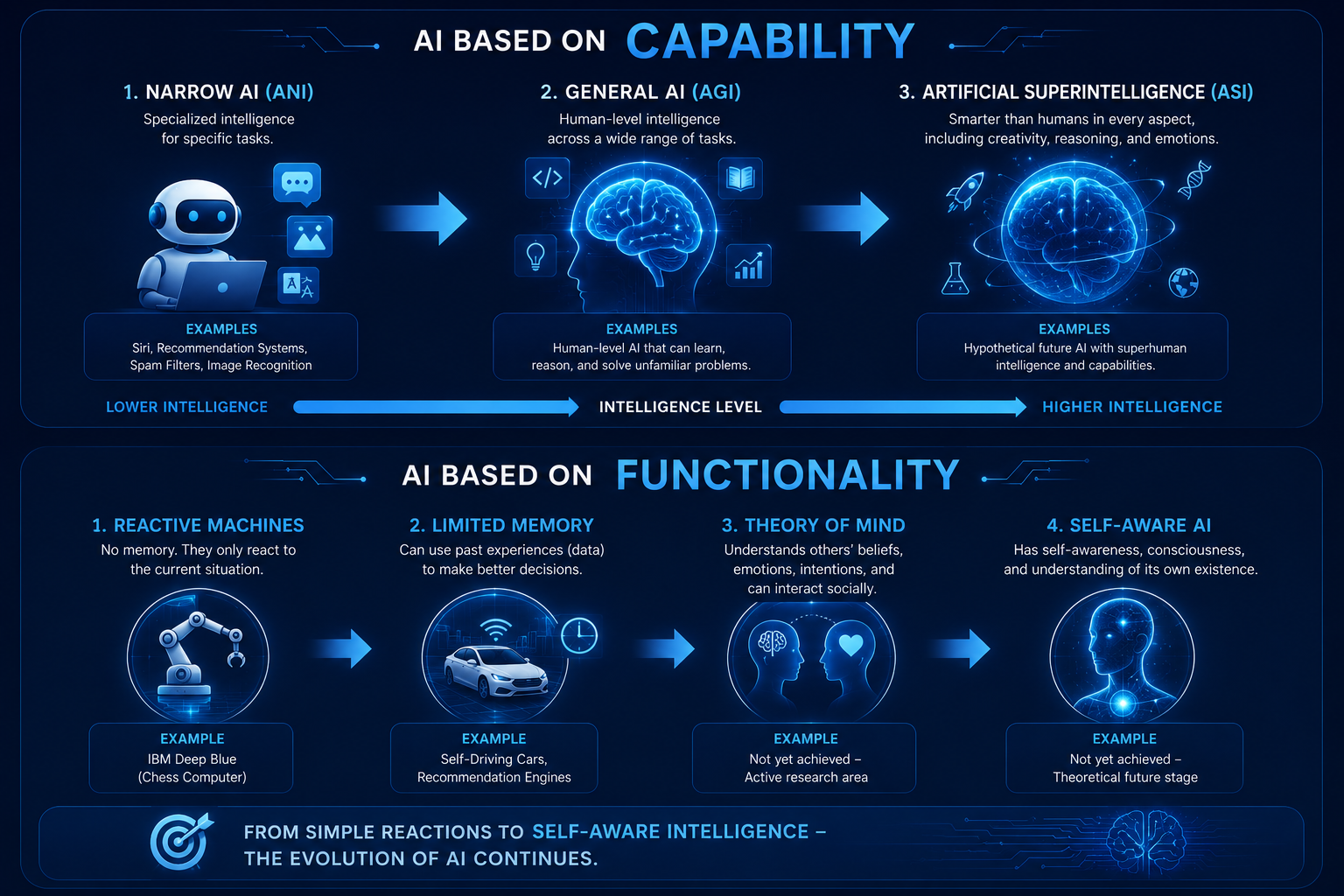
To better understand AI, researchers commonly classify it in two ways:
Understanding these classifications helps explain not only where AI stands today but also what future advancements may look like.
Imagine classifying vehicles.
Cars, motorcycles, trucks, airplanes, and ships are all forms of transportation, but each has different abilities and purposes.
Artificial Intelligence works the same way.
Some AI systems excel at one specific task, while others are theoretical systems that could one day solve almost any intellectual problem.
Classification provides a framework for understanding these differences.
The most common classification divides AI into three categories:
These categories represent increasing levels of intelligence and flexibility.
Also called Weak AI, Artificial Narrow Intelligence is designed to perform one specific task or a limited set of related tasks.
It cannot think beyond its programmed or trained domain.
Every AI system widely used today belongs to this category.
Although conversational AI can discuss many topics, it remains Narrow AI because it does not independently understand the world or operate with human-like general intelligence.
Think of a world-class chess player.
They may defeat nearly everyone at chess but might not know how to fly an airplane or perform surgery.
Similarly, Narrow AI can become exceptionally capable within its area of expertise while remaining limited outside it.
Artificial General Intelligence refers to a machine capable of understanding, learning, and applying knowledge across a wide range of tasks, much like a human.
Rather than mastering only one domain, an AGI could adapt its knowledge to entirely new challenges.
For example, an AGI that learns medicine could potentially apply similar reasoning strategies to law, engineering, education, or scientific research.
Unlike today's AI, it would not require separate systems for each discipline.
Imagine asking one intelligent system to:
An AGI would be expected to perform all these tasks competently without being built separately for each one.
No.
Researchers and companies are actively exploring pathways toward more general AI systems, but there is no consensus that human-level general intelligence has been achieved.
Researchers continue to investigate major challenges, including:
These remain active areas of research.
Artificial Superintelligence is a hypothetical form of AI that would surpass human intelligence across nearly every domain.
This includes:
An ASI could potentially solve problems far beyond current human capabilities.
Artificial Superintelligence does not exist today.
It remains a theoretical concept discussed in research, philosophy, and long-term AI governance.
Because it is hypothetical, predictions about its capabilities and timeline vary widely.
Another common classification focuses on how AI systems operate rather than how intelligent they are.
There are four categories:
Reactive AI represents the simplest category.
These systems respond only to current inputs.
They do not:
Every decision is based solely on the present situation.
IBM's Deep Blue chess computer evaluated the current board position without remembering previous games or learning new strategies after deployment.
Most modern AI systems belong here.
Limited Memory AI uses previous information to improve decisions.
Examples include:
These systems retain useful information for specific tasks, though they do not possess lifelong understanding like humans.
Theory of Mind AI refers to systems that could understand:
Such AI would adapt its behavior based on how people think and feel.
Not in the full sense.
Current AI can recognize emotional cues or sentiment in text and speech, but this should not be confused with genuine understanding of human mental states.
Researchers continue exploring more socially aware AI systems.
Self-Aware AI is the most advanced theoretical category.
It would possess awareness of its own internal state and potentially recognize itself as an independent entity.
Potential characteristics often discussed include:
There is no scientific evidence that such AI currently exists.
| Type | Exists Today | Learns Multiple Skills | Human-Level Intelligence |
|---|---|---|---|
| Narrow AI | ✅ Yes | Limited | ❌ No |
| AGI | ❌ No | Yes | Goal of the concept |
| ASI | ❌ No | Far beyond humans | Beyond human capability |
| Type | Memory | Learning | Exists Today |
|---|---|---|---|
| Reactive Machines | ❌ | ❌ | Rare |
| Limited Memory | ✅ | Limited | ✅ Yes |
| Theory of Mind | Partial research | Experimental | ❌ Not fully realized |
| Self-Aware AI | Hypothetical | Hypothetical | ❌ No |
Most AI systems in everyday use—including recommendation engines, image generators, language models, and virtual assistants—are best described as:
They can perform impressive tasks but remain specialized and do not possess general human intelligence or self-awareness.
No.
Even highly capable conversational AI remains Narrow AI because it operates within learned patterns and does not exhibit human-like general reasoning across all situations.
No.
Artificial Superintelligence is a theoretical concept and has not been achieved.
Current AI can generate useful responses and identify patterns, but it does not experience consciousness or understand the world in the same way people do.
The AI systems widely used today are examples of Artificial Narrow Intelligence (ANI), with many also classified as Limited Memory AI.
Researchers continue exploring AGI, but there is no agreement on when—or whether—it will be achieved.
No. Increasing performance on one task does not automatically result in general intelligence. AGI would require advances beyond current specialized systems.
No. Self-aware AI remains a hypothetical concept and has not been demonstrated.
Artificial Intelligence is not a single technology but a broad field encompassing systems with different capabilities and functions. From the specialized Narrow AI powering today's applications to the theoretical concepts of AGI and ASI, these classifications provide a roadmap for understanding where AI is today and where research may lead in the future.
As you continue learning about AI, remember that today's impressive systems remain specialized tools. The pursuit of more general intelligence is an active area of research, and its future development will depend not only on technical breakthroughs but also on responsible design and governance.
Pixels to Perfection Design that Impresses