Rahul
 LeetCode #155: Min Stack — Design a Stack with O(1) Minimum Retrieval
 LeetCode #20: Valid Parentheses — Master the Stack Pattern
 LeetCode #15: 3Sum — Master Sorting, Two Pointers and Duplicate Handling
 Instruction vs Context in AI Prompts: How to Tell AI What to Do and What Information to Use
 Rust Structs and Enums: Building Powerful Data Models
 Dissecting the High-Level System Architecture of Booking.com
 Kanban vs. Scrum: Which Agile Methodology to Choose?
 The Scaling Journey of LinkedIn: From Startup to Professional Powerhouse
 Mastering Code Review: A Guide for Reviewers and PR Creators
 ChatGPT: Unveiling the Power of AI in Conversational Experiences with Kairos Coders

Kairos Coders are here to help
Imagine reading this sentence:
"The developer put the laptop on the table because it was heavy."
When you read "it", you naturally look at the surrounding context to determine what it refers to.
Humans do this almost effortlessly.
For an AI model, however, the relationship between tokens must be represented mathematically.
This is where the Attention Mechanism comes in.
Attention allows a neural network to dynamically determine which parts of the input are important when processing a particular token.
It became one of the most important ideas in modern Artificial Intelligence.
The basic idea can be summarized as:
Token
  ↓
Look at other tokens
  ↓
Calculate relevance
  ↓
Assign attention weights
  ↓
Combine information
  ↓
Create contextual representation
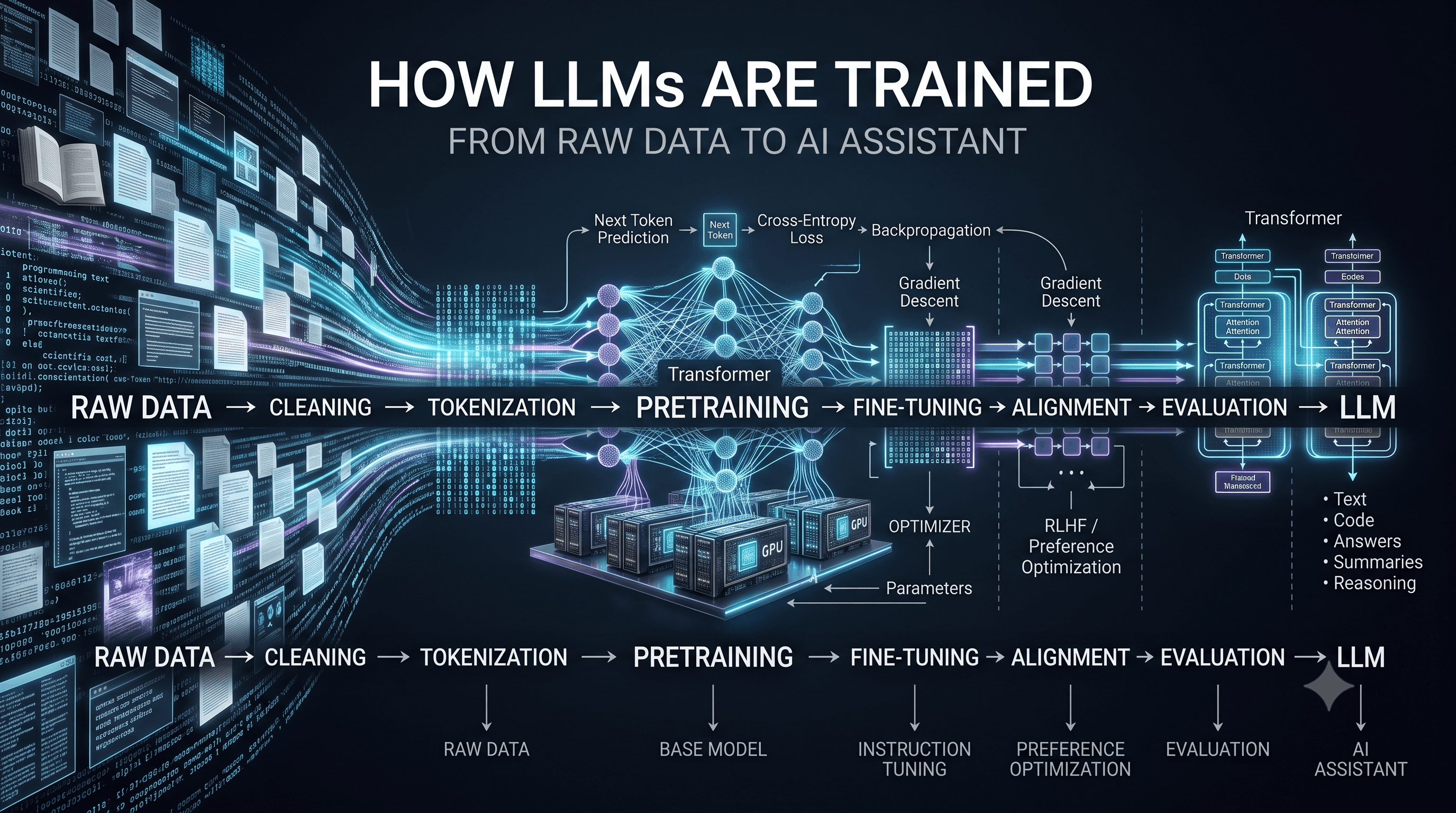
And from this relatively simple concept emerged the architecture behind modern Large Language Models:
Attention is a mechanism that allows a model to assign different levels of importance to different parts of an input when producing a representation for a particular position.
Instead of treating every token equally, the model calculates relationships between tokens.
For example:
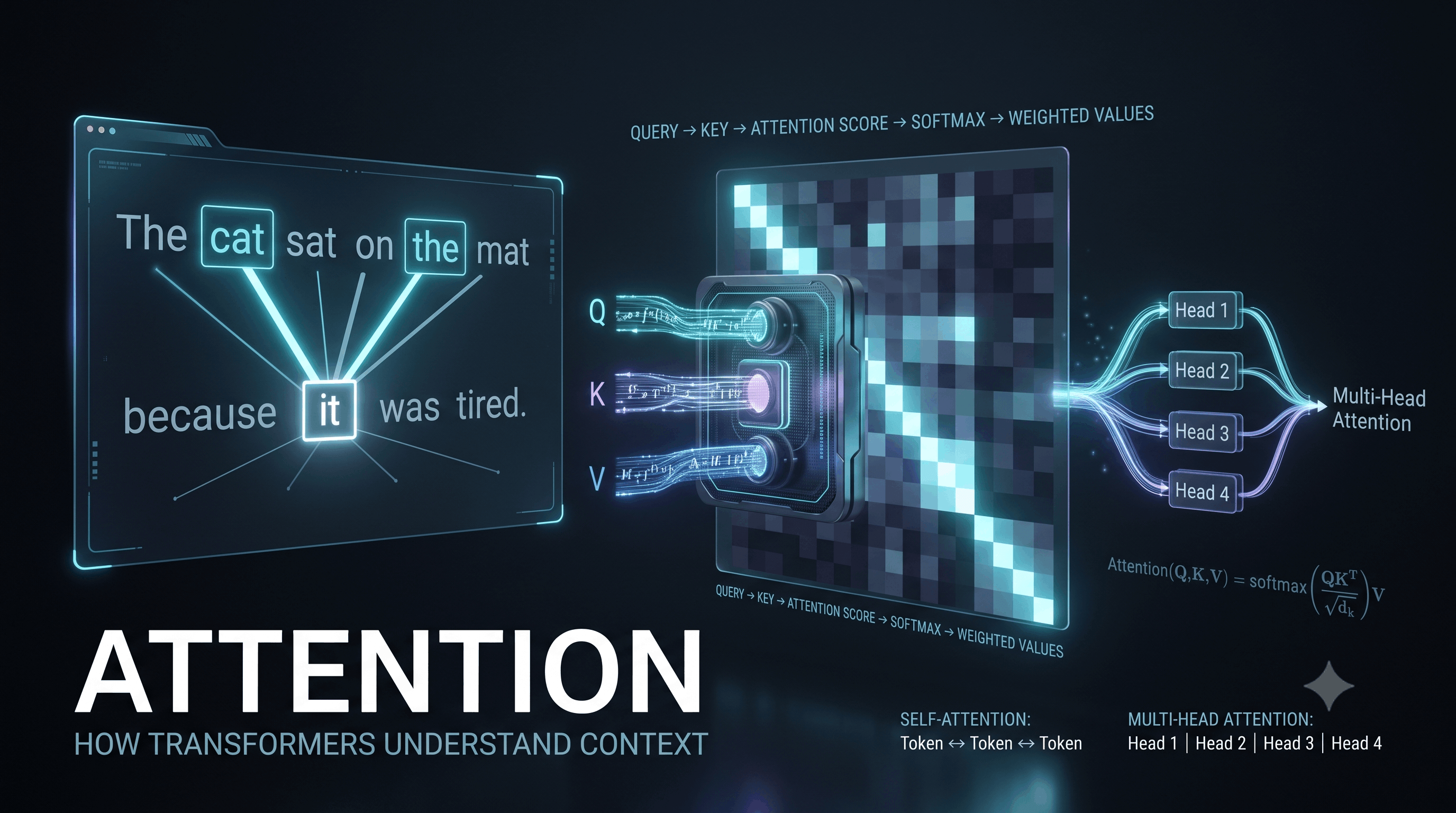
The cat sat on the mat because it was tired.
When processing:
"it"
the model can assign different attention weights to surrounding tokens.
Conceptually:
it
 ↓
The       0.02
cat       0.45
sat       0.08
on        0.03
the       0.02
mat       0.05
because   0.04
it        0.20
was       0.06
tired     0.05
These numbers are illustrative, not actual model attention values.
The important idea is:
Some tokens can contribute more strongly than others.
Before Transformers, sequence processing often relied heavily on architectures such as:
These models processed sequences step by step.
For example:
Token 1
 ↓
Token 2
 ↓
Token 3
 ↓
Token 4
 ↓
Token 5
This sequential structure could make it difficult to efficiently capture relationships across very long sequences.
Attention introduced a different idea:
Token 1 ───────┐
Token 2 ───────┤
Token 3 ───────┼──→ Relationships
Token 4 ───────┤
Token 5 ───────┘
Tokens could directly interact through attention.
Consider:
"Rahul gave the developer his laptop because he needed it."
To interpret:
"he"
the model may need to examine several earlier tokens.
Attention provides a mechanism for the model to calculate which tokens are relevant.
Conceptually:
"he"
 ↓
Rahul        → relevant
developer    → potentially relevant
laptop       → less relevant
because      → contextual
The actual internal representations are far more complex than this simplified visualization.
This is an important distinction.
Attention doesn't literally mean the model has human-like awareness.
It is a mathematical mechanism for calculating weighted relationships between representations.
At its core:
Input Representations
        ↓
Similarity Scores
        ↓
Normalized Weights
        ↓
Weighted Combination
A simplified attention mechanism can be represented as:
Attention(Q, K, V)
where:
Q = Queries
K = Keys
V = Values
The classic scaled dot-product attention formula is:
Attention(Q,K,V)
=
softmax(QKᵀ / √dₖ)V
This equation is one of the most important equations in modern Deep Learning.
Let's break it down.
The three central components are:
Query
Key
Value
Think of them conceptually as:
What information am I looking for?
What information do I contain that might match the query?
What information should actually be passed along if I am relevant?
This analogy is simplified, but it is useful for understanding the mechanics.
A Query represents what a particular token is looking for in the current attention operation.
For example, suppose we're processing:
"the developer"
The representation for the current position is transformed into a query vector.
Conceptually:
Token Representation
        ↓
Linear Transformation
        ↓
Query Vector
Mathematically:
Q = XWQ
where:
X = input representationWQ = learned query projection matrixEach token also produces a key vector.
The key represents features that can be compared with queries.
X
 ↓
WK
 ↓
Keys
Mathematically:
K = XWK
The model compares queries against keys to determine relevance.
Each token also produces a value vector.
X
 ↓
WV
 ↓
Values
Mathematically:
V = XWV
The values contain the information that gets combined after attention weights have been calculated.
The entire process begins with the input matrix:
X
Then:
X → WQ → Q
X → WK → K
X → WV → V
So:
                 ┌→ Query
Input X ─────────┼→ Key
                 └→ Value
These three projections are learned during model training.
The first major operation is:
QKᵀ
This calculates how strongly queries and keys relate to one another using dot products.
Conceptually:
Query × Key
      ↓
Similarity Score
Higher score:
More relevant
Lower score:
Less relevant
Suppose:
Q = [1, 2]
K = [3, 4]
Their dot product is:
(1 × 3) + (2 × 4)
Therefore:
3 + 8 = 11
So the similarity score is:
11
For real Transformers, these operations happen across large matrices rather than one pair of two-dimensional vectors.
The Transformer formula divides the dot products by:
√dₖ
where dₖ is the dimensionality of the key vectors.
So:
QKᵀ
─────
 √dₖ
Why?
Because dot products can become large as vector dimensions increase.
Large values can cause the softmax function to become extremely sharp, which can make optimization more difficult.
Scaling helps keep the values in a more manageable range.
The scaled attention scores are passed through Softmax.
Softmax converts scores into normalized weights.
For example:
Raw scores:

[2.0, 1.0, 0.5]
After softmax, conceptually:
[0.63, 0.23, 0.14]
The values sum to approximately:
1.0
Now the model has attention weights.
The attention weights are multiplied by the value vectors.
Suppose:
Attention weights:

0.7
0.2
0.1
and:
Value 1
Value 2
Value 3
The output becomes approximately:
0.7 × Value 1
+
0.2 × Value 2
+
0.1 × Value 3
This produces a new representation containing information gathered from the relevant tokens.
Now the entire operation makes sense:
Attention(Q,K,V)
=
softmax(QKᵀ / √dₖ)V
Breaking it down:
QKᵀ
 ↓
Similarity Scores
 ↓
Scale by √dₖ
 ↓
Softmax
 ↓
Attention Weights
 ↓
Multiply by V
 ↓
Attention Output
This is the heart of scaled dot-product attention.
Now we reach the concept that made Transformers so powerful:
In self-attention, the queries, keys, and values come from the same input sequence.
Suppose:
The cat sat on the mat.
Every token can interact with other tokens according to the attention mechanism.
Conceptually:
The  ─────────────→ cat
 ↓       ↘
cat ─────────────→ mat
 ↓
sat ───────→ cat
Every position can potentially attend to other positions, subject to the attention mask used by the architecture.
Consider:
"The cat drank the milk."
When processing:
"drank"
the model can calculate attention scores against:
The
cat
drank
the
milk
Conceptually:
drank
 ↓
The     0.05
cat     0.35
drank   0.20
the     0.05
milk    0.35
Again, these values are illustrative.
The resulting representation of "drank" incorporates information from the other positions according to the learned attention weights.
For a sequence of n tokens, attention can produce an n × n matrix of scores or normalized weights.
For five tokens:
          The   cat   drank   the   milk

The       ●     ●      ●      ●      ●

cat       ●     ●      ●      ●      ●

drank     ●     ●      ●      ●      ●

the       ●     ●      ●      ●      ●

milk      ●     ●      ●      ●      ●
Each row represents the attention distribution for one query position.
Each column represents a key position.
In causal self-attention, future positions are masked.
One attention mechanism can learn one set of relationships.
But language contains many types of relationships.
For example:
Subject ↔ Verb
Pronoun ↔ Noun
Word ↔ Modifier
Entity ↔ Attribute
Instead of using just one attention operation, Transformers use:
Suppose we have four heads:
Input
 ↓
 ┌────────┬────────┬────────┬────────┐
 Head 1   Head 2   Head 3   Head 4
 └────────┴────────┴────────┴────────┘
              ↓
          Concatenate
              ↓
          Projection
              ↓
            Output
Each head has its own learned projection matrices.
Therefore, different heads can potentially specialize in different patterns.
Imagine reading:
"The developer who built the application fixed the bug."
Different attention patterns could potentially focus on:
developer ↔ built
or:
developer ↔ fixed
or:
application ↔ bug
The model doesn't receive explicit instructions saying:
"Head 1 must learn grammar."
Instead, useful patterns can emerge from optimization.
Large language models that generate text autoregressively generally use causal self-attention.
The key rule is:
A token cannot attend to future tokens that it is supposed to predict.
Consider:
The
cat
sat
When predicting the next token, the model can use:
The
cat
sat
but not the future answer.
The attention matrix is therefore masked.
Conceptually:
●
● ●
● ● ●
● ● ● ●
rather than allowing every position to access every future position.
Without causal masking, training a next-token prediction model could accidentally reveal the answer.
Suppose the training sequence is:
The cat sat on the mat
When predicting:
on
the model should not be allowed to inspect:
the mat
because those are future tokens.
Causal masking prevents this information leakage.
The original Transformer architecture contained an encoder and a decoder.
Encoder self-attention can allow a token to attend to other positions across the input sequence.
This is useful for understanding an input sequence as a whole.
Models such as BERT use encoder-style Transformer architectures.
The original Transformer decoder also uses a different mechanism called:
Here, queries come from one sequence or representation while keys and values come from another.
Conceptually:
Decoder Query
      ↓
   Attention
      ↑
Encoder Keys + Values
This allows one representation to retrieve relevant information from another.
Cross-attention became particularly important in sequence-to-sequence architectures.
Q ← same sequence
K ← same sequence
V ← same sequence
Q ← one representation
K ← another representation
V ← another representation
This distinction is extremely useful when studying Transformer architectures.
A simplified Transformer block looks like:
Input
  ↓
Multi-Head Attention
  ↓
Add & Norm
  ↓
Feed-Forward Network
  ↓
Add & Norm
  ↓
Output
Modern Transformer implementations can vary in exact ordering and components, but the central idea remains.
Another common misconception:
Transformer = Attention
Not exactly.
Attention is one major component.
A Transformer block also typically contains:
Together, these components create the architecture.
Let's compare the conceptual processing.
Token 1
 ↓
Token 2
 ↓
Token 3
 ↓
Token 4
Information moves sequentially.
Token 1 ↔ Token 2
   ↕        ↕
Token 3 ↔ Token 4
Tokens can directly interact through attention.
This makes Transformer computations highly parallelizable during training.
RNNs naturally process sequences sequentially.
Transformers can process many token positions in parallel during training because the attention operations can be expressed as matrix computations.
Conceptually:
RNN:

Token 1 → Token 2 → Token 3 → Token 4


Transformer:

Token 1 ─┐
Token 2 ─┼→ Parallel Matrix Computation
Token 3 ─┤
Token 4 ─┘
This was a major practical advantage.
Consider:
"The scientist who worked at the university for ten years published a paper. The research was groundbreaking."
Understanding:
research
may require connecting information across multiple words.
Attention provides direct pairwise interaction paths between positions within the context.
This makes long-range dependencies easier to represent than in purely sequential architectures.
However, attention does not magically solve every long-context problem. Retrieval quality, model capacity, position representation, and computational constraints still matter.
There is an important downside.
For a sequence of length:
n
standard full self-attention requires an attention matrix of roughly:
n × n
This leads to approximately:
O(n²)
scaling with sequence length for the attention computation.
So if sequence length doubles:
n → 2n
the number of pairwise interactions grows roughly by:
4×
This is one reason long-context Transformer optimization is such an important research area.
Attention changed AI because it provided a flexible way for representations to interact.
The core idea is remarkably elegant:
What am I looking for?
        ↓
       Query

What information is relevant?
        ↓
        Key

What information should I retrieve?
        ↓
       Value
Mathematically:
Q → Compare with K → Weights → Combine V
This simple mechanism can be stacked into enormous networks.
The evolution looks roughly like:
Sequence Models
      ↓
Attention
      ↓
Transformer
      ↓
Large-Scale Training
      ↓
Foundation Models
      ↓
Large Language Models
      ↓
Modern Generative AI
The Transformer architecture was introduced in the 2017 paper:
"Attention Is All You Need."
That paper fundamentally changed the trajectory of modern AI research.
A simplified LLM architecture looks like:
Text
 ↓
Tokenizer
 ↓
Token IDs
 ↓
Embeddings
 ↓
Transformer Block
 ↓
Self-Attention
 ↓
Feed-Forward Network
 ↓
More Transformer Blocks
 ↓
Output Layer
 ↓
Next-Token Probabilities
This process happens repeatedly as the model generates text.
Suppose the input is:
"Python is a programming language. It is widely used for AI."
When processing later tokens, the model can use contextual relationships from earlier tokens.
The representation at each position is influenced by other positions through the attention mechanism.
This allows the model to build context-sensitive representations.
One of the most important characteristics of attention is that the relationships aren't fixed.
The attention weights depend on:
Current Input
+
Learned Parameters
Therefore, the same token can participate in different attention patterns in different contexts.
For example:
"bank" in:
"I deposited money at the bank."

"bank" in:
"We sat on the river bank."
The surrounding context changes the representation.
It's tempting to say:
"The model understands the sentence because it pays attention."
That's an oversimplification.
Attention provides a mechanism for contextual information exchange.
Whether a model "understands" something in a philosophical or human sense is a much deeper question.
From an engineering perspective, the important point is:
Attention allows neural representations to interact based on learned relevance scores.
If you're learning Transformers, remember this:
QUERY
"What am I looking for?"

       ↓

KEY
"How relevant is this token?"

       ↓

SCORE
"How strongly do they match?"

       ↓

SOFTMAX
"Convert scores into weights."

       ↓

VALUE
"Bring information from relevant tokens."

       ↓

OUTPUT
"Create a context-aware representation."
That's attention.
No.
Attention is a mathematical mechanism.
Not necessarily.
In multi-head attention, there are multiple attention distributions, and each layer has its own attention computations.
No.
Attention is a component of Transformer-based architectures.
Attention weights are useful signals, but interpreting them as a simple universal measure of "importance" can be misleading.
No.
Transformer blocks also contain feed-forward networks, residual connections, normalization, and positional mechanisms.
It is a mathematical mechanism that calculates how strongly different representations should contribute to one another.
Self-attention allows tokens within the same sequence to interact through queries, keys, and values.
Query represents what a position is looking for, Key represents information used to determine relevance, and Value contains the information that gets aggregated.
The standard scaled dot-product attention formula is:
softmax(QKᵀ / √dₖ)V
It converts attention scores into normalized weights.
It runs multiple attention operations in parallel using separate learned projections, then combines their outputs.
Causal attention prevents a token from attending to future positions during autoregressive generation.
Attention provides flexible token-to-token interactions and enables highly parallelizable computation during training.
It helps represent long-range relationships, but standard full attention has quadratic scaling with sequence length and long-context performance has additional challenges.
No. The term is an analogy. Neural-network attention is a mathematical computation.
We can now connect everything we've learned so far.
Learn parameters
Represent information as vectors
Convert text into token IDs
Connect tokens based on learned relevance
And together:
                TEXT
                  ↓
             TOKENIZATION
                  ↓
              TOKEN IDs
                  ↓
              EMBEDDINGS
                  ↓
             TRANSFORMER
                  ↓
          ┌───────────────┐
          │ SELF-ATTENTION│
          └───────────────┘
                  ↓
          FEED-FORWARD NET
                  ↓
          MORE TRANSFORMER
              BLOCKS
                  ↓
           OUTPUT LOGITS
                  ↓
            NEXT TOKEN
The key equation:
Attention(Q,K,V)
=
softmax(QKᵀ / √dₖ)V
may look intimidating at first.
But conceptually, it says:
Compare what I'm looking for with what every token offers, turn those comparisons into weights, and combine the relevant information.
That deceptively simple idea became one of the foundations of modern generative AI.
But there's still a major piece missing.
We know that Transformers use attention.
We know they use multiple attention heads.
But what happens after attention?
What is the mysterious neural network that processes each token representation inside every Transformer block?
And why does it contain so many parameters?
Pixels to Perfection Design that Impresses