Rahul
 LeetCode #155: Min Stack — Design a Stack with O(1) Minimum Retrieval
 LeetCode #20: Valid Parentheses — Master the Stack Pattern
 LeetCode #15: 3Sum — Master Sorting, Two Pointers and Duplicate Handling
 Instruction vs Context in AI Prompts: How to Tell AI What to Do and What Information to Use
 Rust Structs and Enums: Building Powerful Data Models
 Dissecting the High-Level System Architecture of Booking.com
 Kanban vs. Scrum: Which Agile Methodology to Choose?
 The Scaling Journey of LinkedIn: From Startup to Professional Powerhouse
 Mastering Code Review: A Guide for Reviewers and PR Creators
 ChatGPT: Unveiling the Power of AI in Conversational Experiences with Kairos Coders

Kairos Coders are here to help
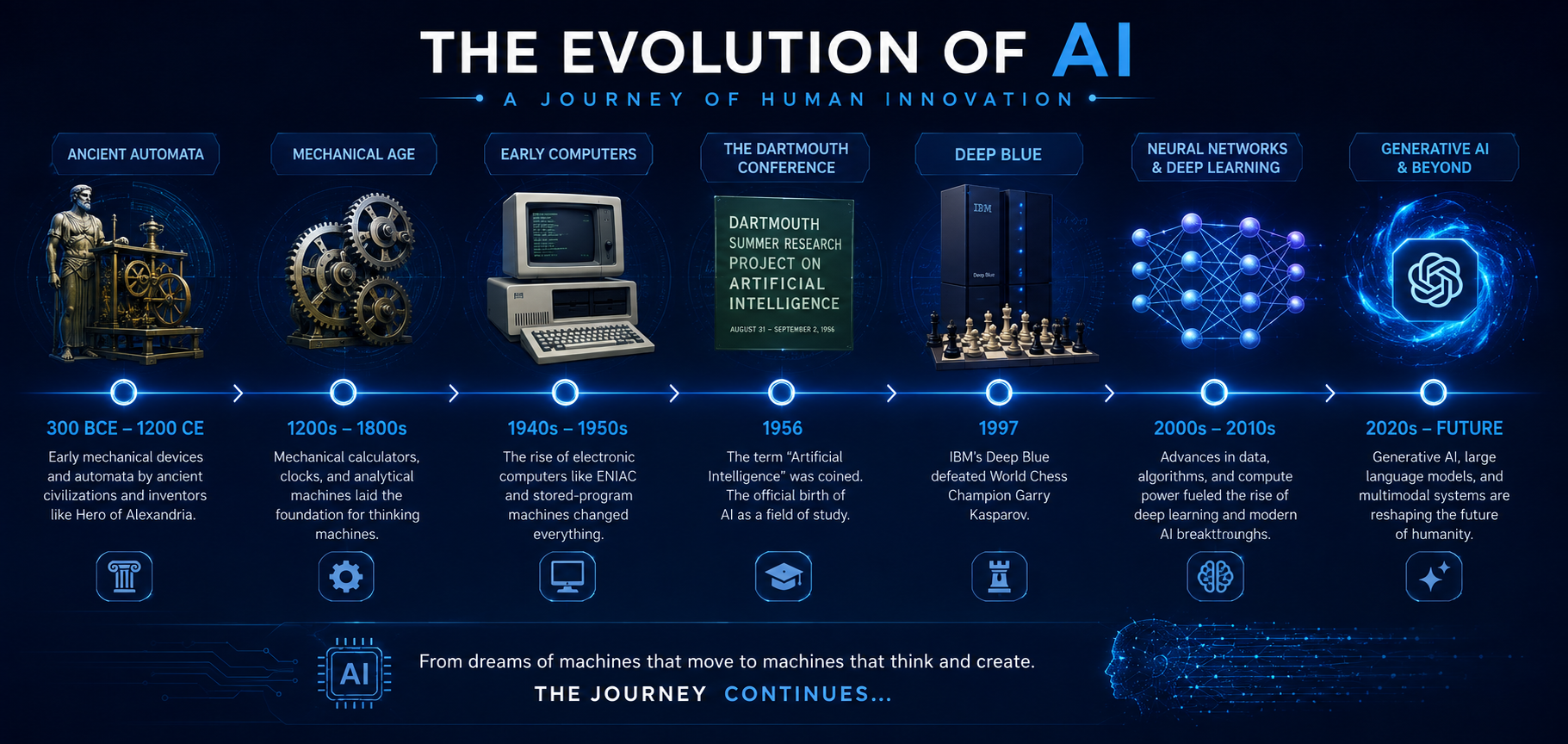
Artificial Intelligence (AI) is often seen as one of the newest technologies of the 21st century. In reality, its roots stretch back thousands of years. Long before computers existed, philosophers, inventors, and storytellers imagined machines capable of thinking, learning, and helping humans.
Today's AI systems—capable of generating text, creating images, writing code, and assisting with scientific research—are the result of centuries of ideas, decades of research, and rapid advances in computing power.
Understanding the history of AI helps us appreciate how the technology evolved, why it experienced periods of excitement and disappointment, and where it may be heading next.
Long before computers existed, civilizations imagined intelligent creations.
Ancient Greek mythology described Talos, a giant bronze guardian said to protect the island of Crete.
In ancient China and Egypt, stories spoke of mechanical servants and automated devices.
Although these were myths rather than technology, they reveal an enduring human fascination: creating machines that could imitate intelligence.
During the Middle Ages and Renaissance, inventors designed increasingly sophisticated mechanical devices.
Examples included:
These inventions could not think, but they demonstrated that machines could perform complex sequences of actions without constant human intervention.
In the 19th century, British mathematician Charles Babbage designed the Analytical Engine, a mechanical computer that introduced concepts remarkably similar to modern computers:
Although it was never fully built during his lifetime, it became one of the most influential ideas in computing history.
Ada Lovelace, often regarded as the world's first computer programmer, recognized that such a machine might someday manipulate not only numbers but also symbols, music, and other forms of information.
Her vision anticipated many modern AI applications.
The 20th century brought electronic computers capable of performing calculations at unprecedented speed.
World War II accelerated research in computing, cryptography, and electronics.
These advances laid the foundation for Artificial Intelligence.
Few individuals shaped AI as profoundly as Alan Turing.
In 1950, he published the groundbreaking paper:
"Computing Machinery and Intelligence."
Instead of asking:
Can machines think?
Turing proposed a practical question:
Can machines behave intelligently enough that humans cannot distinguish them from another human?
This idea became known as the Turing Test.
Imagine communicating with two hidden participants through text:
If you cannot reliably identify which is the machine, the computer has demonstrated behavior similar to human intelligence in that context.
Although modern AI research extends far beyond the Turing Test, it remains one of the most influential ideas in AI history.
The official birth of Artificial Intelligence occurred during the Dartmouth Summer Research Project on Artificial Intelligence.
A group of researchers believed that every aspect of learning and intelligence could eventually be described precisely enough for machines to simulate.
During this conference, the term:
Artificial Intelligence
was formally introduced.
This event transformed AI into an independent scientific discipline.
The decades following Dartmouth were filled with excitement.
Researchers successfully built programs that could:
Many scientists believed human-level AI might arrive within a few decades.
However, they underestimated the complexity of intelligence.
As expectations grew, progress slowed.
Computers lacked:
Many AI projects failed to meet ambitious promises.
Funding agencies reduced investments.
This period became known as the First AI Winter.
The term reflects a time when enthusiasm and financial support for AI declined significantly.
AI regained momentum through Expert Systems.
Instead of trying to imitate general intelligence, these systems captured the knowledge of human specialists using thousands of manually written rules.
Example:
A medical expert system could recommend possible diseases based on symptoms entered by a doctor.
Businesses quickly adopted expert systems for:
However, maintaining thousands of rules proved expensive and difficult.
Expert systems eventually revealed their limitations.
They struggled with:
Businesses reduced investments once again.
AI entered another period of slower growth.
Instead of programming every rule manually, researchers began asking a different question:
What if computers could learn directly from data?
This idea became Machine Learning.
Rather than relying on predefined instructions, algorithms improved by analyzing examples.
This shift marked one of the biggest turning points in AI history.
One of AI's most famous milestones occurred when IBM's Deep Blue defeated world chess champion Garry Kasparov.
For the first time, a reigning chess champion lost a match to a computer under standard tournament conditions.
The victory demonstrated that computers could outperform humans in highly structured strategic tasks.
The growth of the internet transformed AI.
Companies suddenly had access to enormous amounts of data generated by:
This explosion of data fueled better AI models.
Although neural networks had existed for decades, they became practical only after three major developments:
In 2012, a deep learning model dramatically outperformed previous image recognition systems in the ImageNet competition.
This success sparked widespread adoption of deep learning.
Soon afterward, AI achieved remarkable progress in:
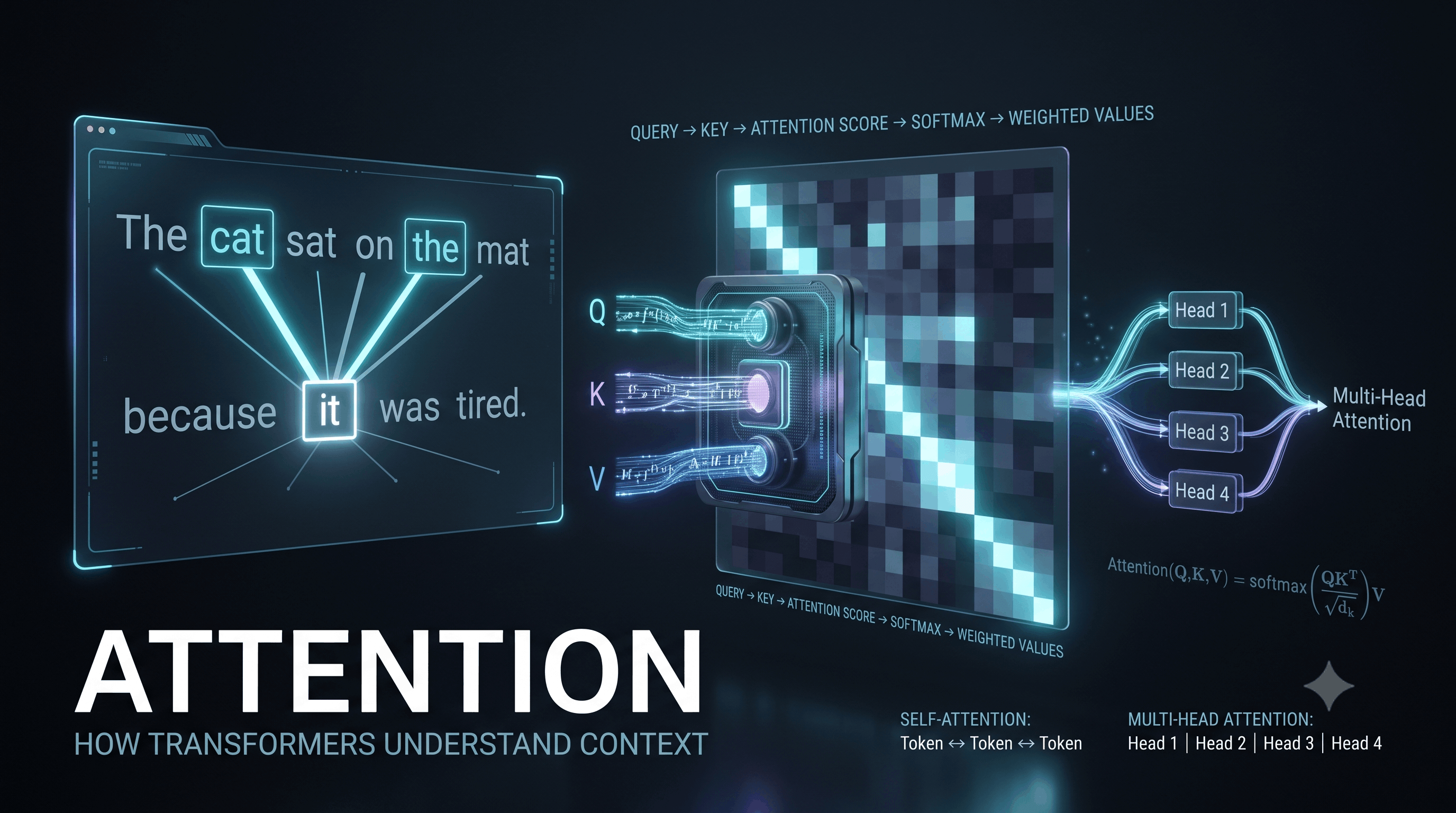
One of the most influential research papers ever published in AI introduced the Transformer architecture.
Unlike previous approaches, Transformers could process relationships within language far more efficiently.
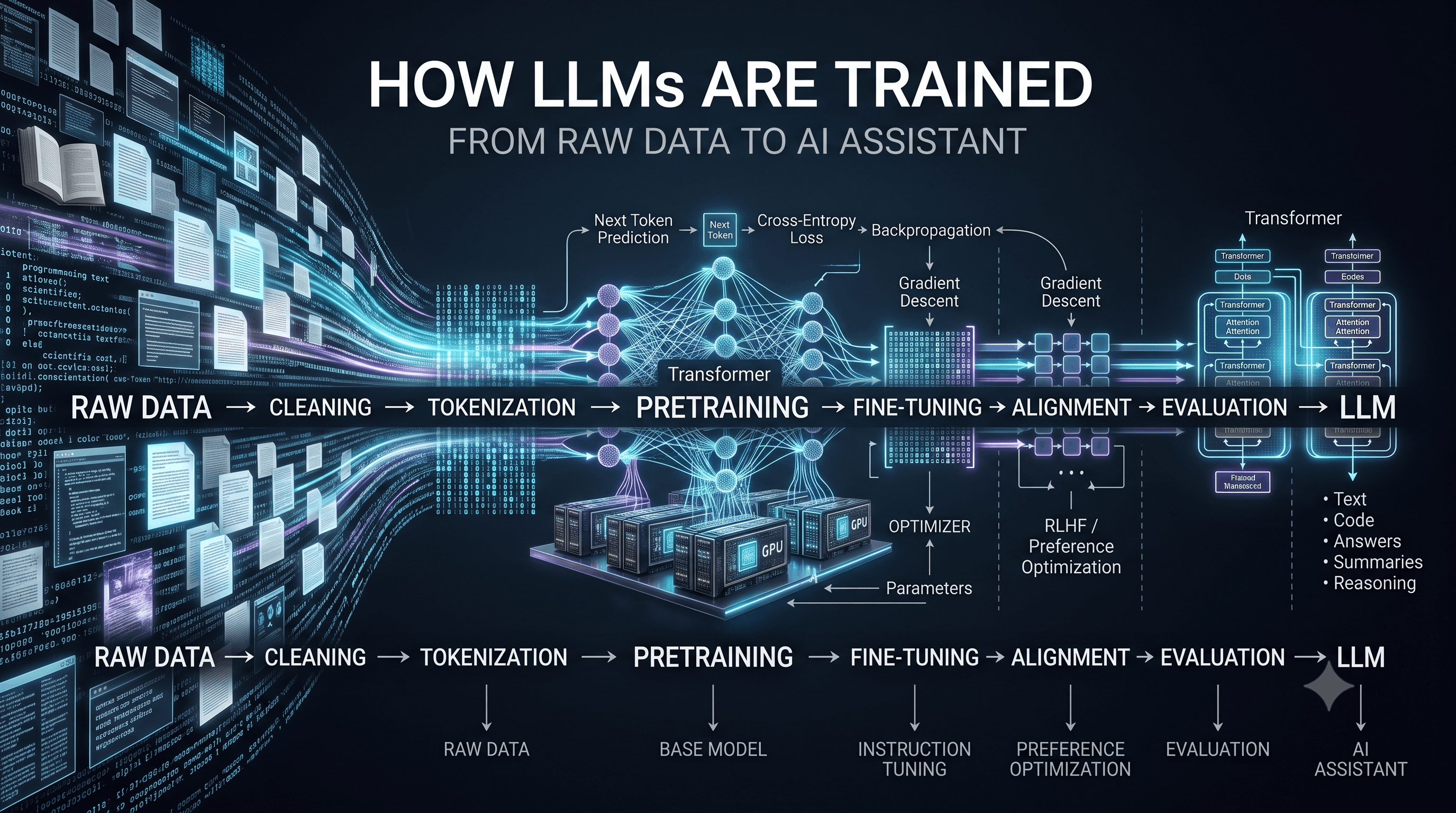
This breakthrough became the foundation for modern Large Language Models (LLMs).
Without Transformers, today's conversational AI systems would not exist in their current form.
The early 2020s marked a new era.
Instead of merely recognizing patterns, AI systems could now generate original content.
Examples include:
Generative AI rapidly expanded from research labs into classrooms, businesses, and households.
Artificial Intelligence now powers products and services across nearly every industry.
Common applications include:
| Year | Milestone |
|---|---|
| Ancient Times | Myths of intelligent machines |
| 1837 | Charles Babbage designs the Analytical Engine |
| 1843 | Ada Lovelace publishes the first algorithm |
| 1950 | Alan Turing proposes the Turing Test |
| 1956 | Dartmouth Conference coins the term "Artificial Intelligence" |
| 1960s | Early AI programs emerge |
| 1974 | First AI Winter begins |
| 1980s | Expert Systems gain commercial success |
| Late 1980s | Second AI Winter |
| 1997 | Deep Blue defeats Garry Kasparov |
| 2000s | Internet fuels AI with massive datasets |
| 2012 | Deep Learning breakthrough in image recognition |
| 2017 | Transformer architecture introduced |
| Early 2020s | Generative AI becomes mainstream |
| 2026 | AI is widely integrated across industries |
The history of AI reveals several important lessons:
There is no single inventor. Many researchers contributed to AI's development, though the Dartmouth Conference in 1956 is widely regarded as the formal beginning of the field.
Alan Turing introduced foundational ideas about machine intelligence and proposed the Turing Test, which remains historically significant in AI research.
AI Winters occurred when technological limitations prevented researchers from achieving ambitious goals, leading to reduced funding and slower progress.
Advances in hardware (especially GPUs), larger datasets, and improved algorithms enabled deep learning models to solve increasingly complex problems.
Yes. AI continues to advance rapidly, with ongoing research in reasoning, robotics, multimodal systems, and more capable language models.
The history of Artificial Intelligence is a story of persistence, imagination, and scientific discovery. From mythical automata to modern generative AI, each generation built upon the work of those before it.
By understanding where AI came from, we gain a clearer perspective on its current capabilities and future potential. As research continues to evolve, the next chapters of AI history will likely be shaped not only by technological innovation but also by thoughtful governance, ethical development, and human creativity.
Pixels to Perfection Design that Impresses