Rahul
 Client-Server Architecture: How a Web Request Travels Through a Modern Application
 LeetCode #121: Best Time to Buy and Sell Stock — Master the One-Pass Array Pattern
 The Anatomy of a Perfect AI Prompt: 7 Essential Components for Better Results
 Rust Functions: Parameters, Return Values, Expressions, Generics & Scope
 How to Start a Biryani Business in India: Investment, Equipment, Menu, Profit & Technology — What Biryani By Kilo, Behrouz Biryani & Paradise Teach Entrepreneurs
 Dissecting the High-Level System Architecture of Booking.com
 Kanban vs. Scrum: Which Agile Methodology to Choose?
 The Scaling Journey of LinkedIn: From Startup to Professional Powerhouse
 Mastering Code Review: A Guide for Reviewers and PR Creators
 ChatGPT: Unveiling the Power of AI in Conversational Experiences with Kairos Coders

Kairos Coders are here to help
Writing a good AI prompt is not about finding a magical sentence that makes an AI model produce perfect answers.
It is about giving the model the right instructions, context, constraints, and expectations.
A weak prompt leaves too many decisions to the AI.
A strong prompt defines what needs to be done, who should do it, what information should be used, and what the final result should look like.
Consider this prompt:
"Write an article about Python."
It technically works.
But what kind of article?
For whom?
How long?
Beginner or advanced?
Tutorial or opinion?
SEO optimized?
With code examples?
Now compare it with:
"Act as a senior Python developer and technical writer. Write a beginner-friendly 2,000-word tutorial explaining Python decorators to developers who understand functions but have never used decorators. Start with a real-world analogy, explain the syntax, provide practical examples, discuss common mistakes, and finish with five practice questions. Use Markdown headings and keep the language simple."
The difference is enormous.
The second prompt gives the AI a specification.
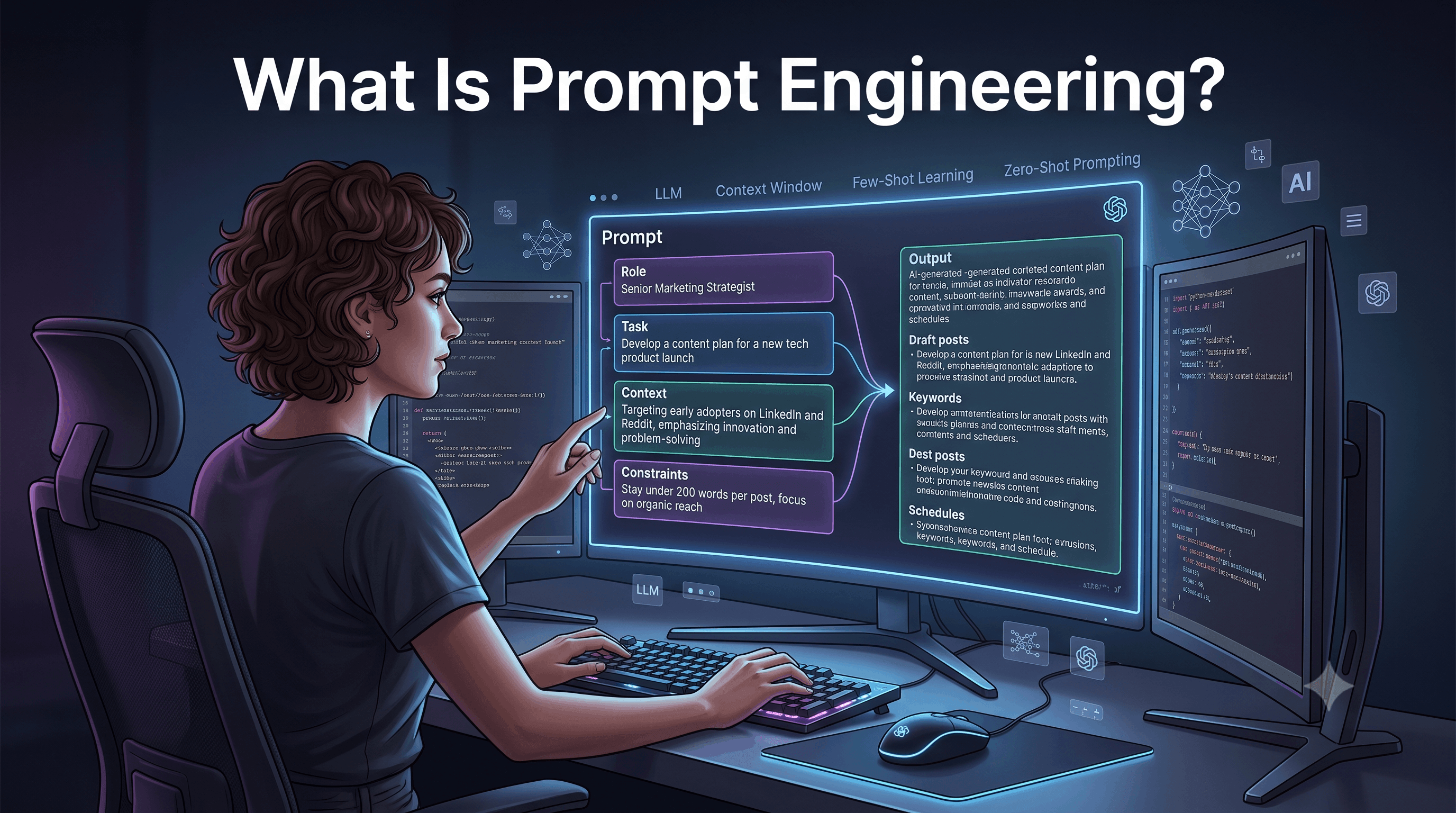
In this article, we'll break down the anatomy of a powerful AI prompt and learn how to use each component effectively.
A strong prompt commonly contains several building blocks:
Role
   ↓
Objective
   ↓
Context
   ↓
Instructions
   ↓
Examples
   ↓
Constraints
   ↓
Output Format
Not every prompt needs every component.
A simple question may require only an instruction.
A complex AI application may require all of them.
The goal is not to make every prompt unnecessarily long.
The goal is to make the prompt clear enough for the task.
The first component is the role.
A role establishes a perspective or expertise relevant to the task.
For example:
"Act as a senior software architect."
Or:
"Act as an experienced SEO strategist."
Or:
"Act as a Python programming instructor."
This can influence the vocabulary, priorities, style, and approach used in the response.
"Review my code."
This is vague.
"Act as a senior backend engineer and review my code for correctness, security, performance, and maintainability."
Now the AI has a much clearer perspective.
No.
This is an important point.
Role prompting is useful when the desired perspective matters.
For example:
"Convert 10 kilometers to miles."
You don't need:
"Act as a world-renowned mathematician..."
The task is already straightforward.
Similarly:
"Return today's date."
doesn't require an elaborate role.
A good prompt engineer knows when not to add unnecessary instructions.
The objective is the heart of the prompt.
Ask yourself:
What exactly do I want the AI to accomplish?
Examples:
"Summarize this document."
"Generate a Python function."
"Compare PostgreSQL and MongoDB."
"Extract customer names from this document."
"Rewrite this email professionally."
The objective should be specific enough that you can determine whether the AI succeeded.
"Help me with my website."
"Analyze my website homepage and identify five UX problems that could reduce conversions. For each problem, explain why it matters and provide a specific improvement."
The second objective is measurable.
Context answers:
What does the AI need to know before performing the task?
Suppose you're asking an AI to create a marketing campaign.
This:
"Create a marketing campaign for my product."
is incomplete.
A better prompt might provide:
"The product is a project-management SaaS platform for small software teams. Its main advantage is automated task prioritization. The target customers are startups with 5–30 employees."
Now the AI has useful information.
Depending on the task, context might include:
For example:
Context:
We are building a university management platform.
The backend uses Node.js and PostgreSQL.
The frontend uses React.
The application supports multiple universities.
The API must support tenant isolation.
Now a software-related prompt can be much more precise.
The objective says what you want.
Instructions can explain how you want it done.
For example:
"Explain the concept using a real-world analogy."
"Analyze the code line by line."
"Prioritize security issues over style issues."
"Use simple language."
"Compare the solutions based on cost, scalability, and complexity."
Multiple instructions can be organized as a list:
Instructions:
1. Explain the concept simply.
2. Start with a real-world analogy.
3. Provide a practical example.
4. Mention common mistakes.
5. End with a short summary.
This structure is often easier to maintain than a giant paragraph.
Sometimes words aren't enough.
Examples can demonstrate the exact pattern you expect.
Suppose you want an AI to classify support tickets.
You could write:
Customer: "I forgot my password."
Category: Account

Customer: "My payment was declined."
Category: Billing

Customer: "I want to change my email address."
Category: Account

Customer: "I was charged twice."
Category:
The AI can infer the pattern.
Expected output:
BillingThis is called few-shot prompting.
Examples can communicate:
We'll explore few-shot prompting deeply in a later article.
Constraints tell the AI what it should or shouldn't do.
For example:
"Keep the answer under 500 words."
Or:
"Use Python 3.12."
Or:
"Do not use external libraries."
Or:
"Return exactly five recommendations."
Constraints are especially valuable when you need predictable output.
"Write approximately 1,000 words."
"Use PostgreSQL and Node.js."
"Return the result as JSON."
"Don't discuss Kubernetes."
"Use a professional but conversational tone."
"Provide exactly ten examples."
Not every instruction has equal importance.
Compare:
"Keep the article around 1,500 words."
with:
"Return valid JSON."
The first is a preference.
The second may be a strict technical requirement.
When designing prompts for applications, clearly distinguish between requirements that are mandatory and preferences that are merely desirable.
For example:
Requirements:
- Return valid JSON.
- Include all required fields.

Preferences:
- Keep explanations concise.
- Use simple language.
This makes the prompt easier to reason about.
One of the most overlooked prompt components is output formatting.
Suppose you ask:
"Analyze these products."
You might receive a long essay.
But perhaps you actually need:
| Product | Price | Rating | Recommendation |
|---|---|---|---|
| A | ₹999 | 4.5 | Yes |
| B | ₹1,299 | 4.2 | Maybe |
Tell the model.
"Return the analysis as a Markdown table with columns: Product, Price, Rating, Pros, Cons, Recommendation."
Now the output structure is clear.
Output formatting becomes even more important when integrating LLMs into applications.
Instead of:
"Extract the customer's information."
You can request:
Return the result as JSON with exactly these fields:

{
  "name": "",
  "email": "",
  "phone": "",
  "company": ""
}
This makes downstream processing easier.
However, when building production systems, prompt instructions alone should not be your only validation mechanism. Your application should validate model output before trusting it.
Let's construct a complete prompt.
Act as a senior technical writer.
Write an article explaining REST APIs.
The audience consists of beginners who understand basic programming but have never worked with APIs.
Start with a real-world analogy. Explain HTTP methods and status codes. Then provide a simple JavaScript example.
Avoid advanced distributed-system concepts. Keep the article under 1,500 words.
Use Markdown headings, bullet points, and code blocks.
Combined:
Act as a senior technical writer. Write a beginner-friendly article explaining REST APIs to readers who understand basic programming but have never worked with APIs. Start with a real-world analogy, then explain HTTP methods and common status codes. Include a simple JavaScript example. Avoid advanced distributed-system concepts. Keep the article under 1,500 words and use Markdown headings, bullet points, and code blocks.
This is a strong prompt because the model has a clear specification.
You can remember the framework like this:
1. ROLE
Who should the AI be?

2. OBJECTIVE
What should it accomplish?

3. CONTEXT
What information does it need?

4. INSTRUCTIONS
How should it approach the task?

5. EXAMPLES
What does the desired behavior look like?

6. CONSTRAINTS
What limitations must it follow?

7. OUTPUT
What should the final response look like?
A simple acronym isn't necessary.
Instead, remember the underlying question:
Who? What? Why/Context? How? Examples? Limits? Format?
Suppose you want an AI to build a function.
"Write a function to process orders."
The model has to guess almost everything.
Let's improve it.
"Write a Python function that processes orders."
Better, but still vague.
"Write a Python function that calculates the total price of an order."
Better.
"Write a Python function that calculates the total price of an order. Each order contains a list of products with
priceandquantityfields."
Now the data structure is clearer.
"Act as a senior Python developer. Write a clean, type-hinted Python function that calculates the total price of an order. Each product contains
priceandquantity. Reject negative prices and quantities. Include three test cases and explain the time complexity."
Now we have:
That's prompt engineering.
There is another important lesson.
You don't need to write a 500-word prompt to ask:
"Convert 100 USD to INR."
Overengineering a simple task can introduce unnecessary complexity.
Good prompt engineering means using the minimum useful specification.
Think:
Simple task → Simple prompt

Complex task → More structured prompt
The complexity of the prompt should match the complexity of the task.
A common misconception is:
Longer prompt = Better prompt.
Not necessarily.
Consider:
A 2,000-word prompt filled with irrelevant information, contradictory instructions, and unnecessary background.
A 150-word prompt containing exactly the relevant context, requirements, and output format.
The second may perform better.
The objective is not maximum length.
The objective is maximum signal with minimum unnecessary noise.
Beginners sometimes search for:
"secret ChatGPT prompts"
or:
"magic prompts"
But professional prompt engineering is less about clever phrases and more about clear specifications.
Instead of trying to sound sophisticated:
"Harness your advanced cognitive capabilities to..."
simply say:
"Compare these two architectures based on scalability, cost, complexity, and maintainability."
Clear beats fancy.
Suppose you're asking the AI to summarize an article.
Instead of:
"Summarize this article and don't confuse it with the instructions..."
Use clear boundaries:
Task:
Summarize the document in five bullet points.

Document:
<document>
[ARTICLE CONTENT]
</document>
This helps distinguish instructions from data.
This becomes particularly important when working with:
When developing AI applications, a useful mindset is:
A prompt is a specification for model behavior.
For example:
SYSTEM
↓
Define behavior and boundaries

CONTEXT
↓
Provide relevant information

TASK
↓
Define objective

CONSTRAINTS
↓
Define limitations

OUTPUT
↓
Define expected structure
This mindset is far more useful than thinking:
"What magic words should I type?"
You can use this template as a starting point:
# Role
You are a [role/expert].

# Objective
Your task is to [specific objective].

# Context
Here is the relevant background:
[context]

# Instructions
- [instruction 1]
- [instruction 2]
- [instruction 3]

# Requirements
- [requirement 1]
- [requirement 2]

# Constraints
- [constraint 1]
- [constraint 2]

# Examples
[input/output examples if needed]

# Output Format
Return the result as:
[format]
For simple tasks, remove the sections you don't need.
Let's take one final example.
"Write a LinkedIn post about AI."
"Write a LinkedIn post about AI agents."
"Write a LinkedIn post explaining AI agents to software developers."
"Act as a technology writer targeting software developers. Write a LinkedIn post explaining why AI agents differ from traditional LLM chatbots. Start with a strong technical hook, explain the role of tools, planning, memory, and autonomous execution, and finish with a practical example. Keep it under 1,200 characters. Use a professional but conversational tone and avoid generic AI hype."
The final prompt gives the model a much more precise target.
A powerful prompt doesn't necessarily look complicated.
It simply removes unnecessary ambiguity.
Think about it this way:
Weak Prompt
     ↓
AI must guess
     ↓
Unpredictable output

Strong Prompt
     ↓
AI has clear specifications
     ↓
More predictable output
This is the foundation upon which more advanced prompt engineering techniques are built.
Before sending an important prompt, ask:
Do I need to establish a perspective?
Is the task unambiguous?
Does the AI have the information it needs?
Have I explained how I want the task approached?
Would examples make my expectation clearer?
Are there important boundaries?
Have I specified the desired format?
Did I remove unnecessary information?
If the answer to these questions is yes, you are already thinking like a prompt engineer.
Prompt engineering begins with a simple idea:
AI systems perform better when we communicate our intent clearly.
The seven components of a strong prompt are:
You don't need to use all seven every time.
For a simple question, one sentence may be enough.
For a complex AI application, you may need a carefully structured prompt with examples, context, constraints, and validation.
As this series progresses, we will move from these fundamentals into increasingly powerful techniques.
In the next article, we'll explore one of the most important concepts in practical prompt engineering:
Zero-Shot Prompting — How to Make AI Perform Tasks Without Giving It Examples.
Pixels to Perfection Design that Impresses