
Rahul
 LeetCode #155: Min Stack — Design a Stack with O(1) Minimum Retrieval
 LeetCode #20: Valid Parentheses — Master the Stack Pattern
 LeetCode #15: 3Sum — Master Sorting, Two Pointers and Duplicate Handling
 Instruction vs Context in AI Prompts: How to Tell AI What to Do and What Information to Use
 Rust Structs and Enums: Building Powerful Data Models
 Dissecting the High-Level System Architecture of Booking.com
 Kanban vs. Scrum: Which Agile Methodology to Choose?
 The Scaling Journey of LinkedIn: From Startup to Professional Powerhouse
 Mastering Code Review: A Guide for Reviewers and PR Creators
 ChatGPT: Unveiling the Power of AI in Conversational Experiences with Kairos Coders

Kairos Coders are here to help
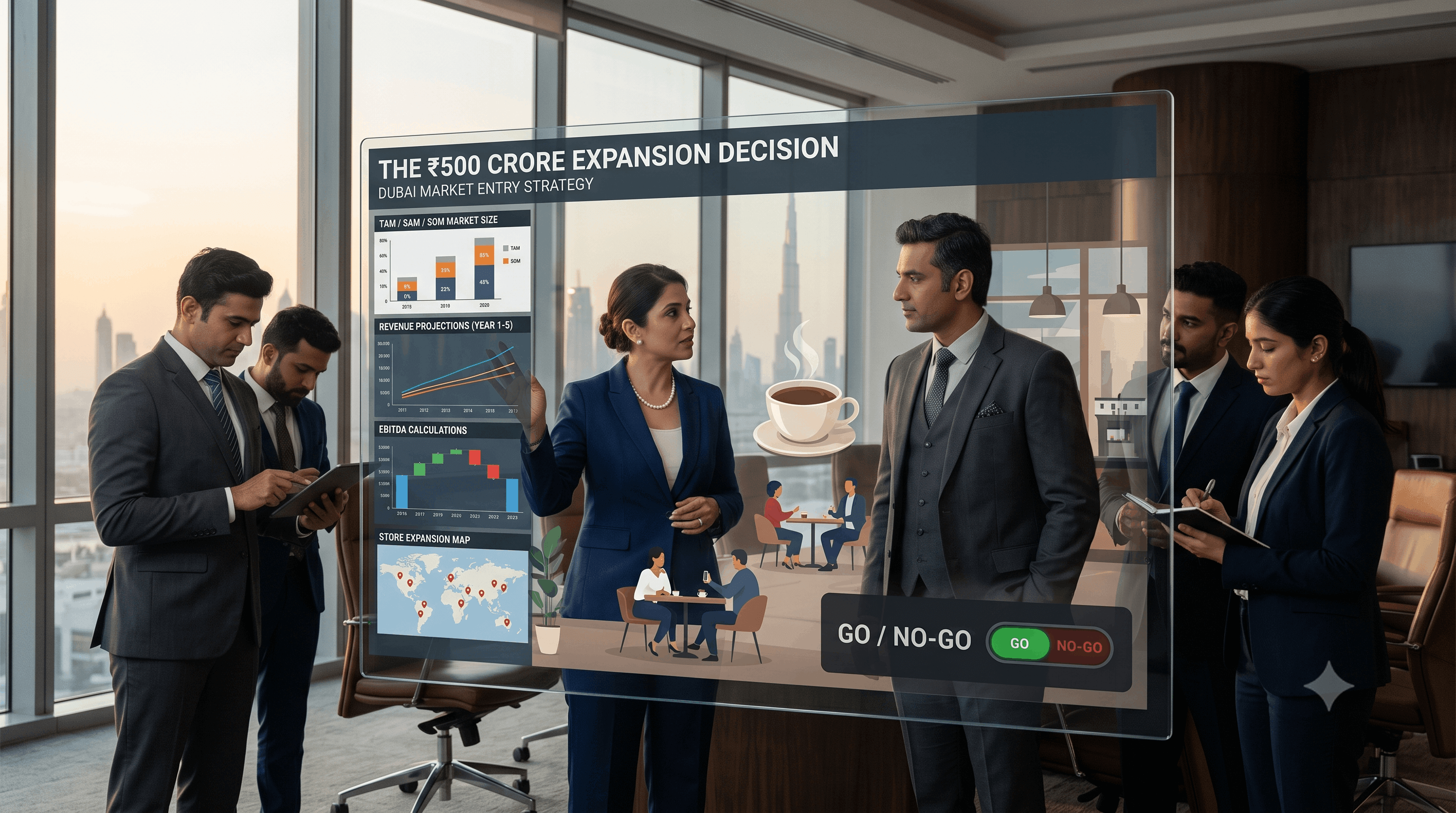
You are sitting in the office of the CEO of BrewVista, one of India's fastest-growing premium coffee chains.
The company currently operates 420 stores across India.
The business is profitable.
Revenue is growing.
The brand has strong customer loyalty.
Now the CEO wants to take the company international.
The proposed destination?
Management believes Dubai could become the company's gateway to the Middle East.
The CEO has one question:
"Should we invest ₹500 crore to enter Dubai?"
Your consulting team has been given four weeks to make a recommendation.
There is no obvious answer.
Dubai has:
But it also has:
Your job is not to prove that Dubai is attractive.
Your job is to determine:
Is the opportunity attractive enough to justify ₹500 crore of investment?
An inexperienced consultant might say:
"Dubai has lots of coffee shops, so let's enter."
That's not enough.
We need a structured framework.
Our issue tree:
                 MARKET ENTRY
                      │
       ┌──────────────┼──────────────┐
       │              │              │
    Market          Economics      Competition
       │              │              │
   Size/Demand     Investment     Existing Players
   Growth          Revenue        Differentiation
   Customers       Costs          Market Share
       │              │
       └──────────────┼──────────────┘
                      │
                    Risks
                      │
               Recommendation
We will answer five questions:
Before investing ₹500 crore, we need to understand the opportunity.
Our research team estimates the relevant premium café market in Dubai at approximately:
Suppose BrewVista believes it can realistically capture:
Then potential annual revenue is:
₹4,000 Cr × 5%
At first glance, that doesn't look particularly exciting.
You are investing:
to eventually generate:
But revenue isn't profit.
So we need to go deeper.
This is where consultants use one of the most important market-sizing frameworks.
The entire theoretical market.
For example:
if we include every type of coffee and café customer in the broader region.
The portion BrewVista can realistically serve.
Suppose premium cafés represent:
That's our SAM.
What BrewVista can realistically capture.
If management believes it can achieve:
then:
₹4,000 Cr × 5% = ₹200 Cr
Therefore:
This distinction is critical.
A common business mistake is saying:
"The market is worth ₹10,000 crore."
That doesn't mean your company can generate ₹10,000 crore.
Now the CEO asks:
"How many stores would we need to reach ₹200 crore?"
Suppose an average mature BrewVista store generates:
Then:
₹200 Cr ÷ ₹2 Cr
So the strategy would require approximately:
to reach the ₹200 crore revenue target.
But opening 100 stores isn't cheap.
Suppose the estimated investment per store is:
| Investment Component | Per Store |
|---|---|
| Store construction | ₹1.5 Cr |
| Equipment | ₹0.5 Cr |
| Technology | ₹0.1 Cr |
| Initial inventory | ₹0.1 Cr |
| Pre-opening costs | ₹0.1 Cr |
| Working capital | ₹0.2 Cr |
| Total | ₹2.5 Cr |
For 100 stores:
= ₹250 crore
But management has budgeted:
Why?
Because the remaining investment is expected to fund:
Now the economics become more interesting.
Suppose mature stores achieve a:
At ₹200 crore revenue:
₹200 Cr × 20%
The CEO invested:
to generate approximately:
That's an 8% EBITDA yield on the investment before considering taxes, depreciation, financing costs, and other factors.
Is that attractive?
We need more information.
The CEO asks:
"When do we recover our investment?"
If annual EBITDA reaches ₹40 crore:
₹500 Cr ÷ ₹40 Cr
That's a very long payback period.
But this calculation is simplistic.
Stores don't become fully mature immediately.
Let's model the ramp-up.
Suppose stores perform like this:
| Year | Average Store Revenue |
|---|---|
| Year 1 | ₹1.0 Cr |
| Year 2 | ₹1.6 Cr |
| Year 3 | ₹2.0 Cr |
| Year 4 | ₹2.2 Cr |
New stores need time to reach maturity.
This means the company won't immediately generate ₹200 crore revenue.
That's why timing matters.
Now we investigate the competitive landscape.
Dubai already has:
BrewVista cannot simply enter and say:
"We also sell coffee."
The consultant asks:
Possible differentiation:
Option A — Price
Compete on affordability.
Option B — Premium
Compete on quality and experience.
Option C — Indian Identity
Build a premium Indian-origin café brand.
Option D — Technology
Create an extremely convenient digital ordering and loyalty ecosystem.
Option E — Hybrid
Combine premium coffee with Indian flavors.
Suppose BrewVista's research identifies three major customer segments.
| Customer | Need |
|---|---|
| Professionals | Convenience |
| Students | Affordable social space |
| Tourists | Experience |
| Coffee enthusiasts | Quality |
Trying to serve everyone is dangerous.
The consultant recommends initially targeting:
Why?
They have:
This gives BrewVista a more focused entry strategy.
The financial team identifies a major concern.
Premium locations have extremely high rent.
Suppose store economics look like this:
| Expense | % of Revenue |
|---|---|
| Coffee/Food | 28% |
| Labor | 18% |
| Rent | 15% |
| Marketing | 5% |
| Delivery/Technology | 4% |
| Other | 10% |
| Total Costs | 80% |
EBITDA:
The business works.
But what happens if rent rises?
Suppose rent becomes:
instead of 15%.
EBITDA falls from:
At ₹200 crore revenue:
₹200 Cr × 15% = ₹30 Cr EBITDA
Now payback becomes:
₹500 Cr ÷ ₹30 Cr
The investment case is becoming significantly weaker.
This is where consultants become more useful than simple forecasts.
We don't ask:
"What is our forecast?"
We ask:
"What happens if our assumptions are wrong?"
Consider three scenarios.
| Scenario | Revenue | EBITDA Margin | EBITDA |
|---|---|---|---|
| Bear | ₹140 Cr | 12% | ₹16.8 Cr |
| Base | ₹200 Cr | 20% | ₹40 Cr |
| Bull | ₹260 Cr | 23% | ₹59.8 Cr |
Now the CEO can see the range of outcomes.
The investment isn't simply:
"₹500 crore → ₹40 crore."
It could produce dramatically different results depending on:
This is where strategic thinking becomes interesting.
Instead of immediately investing ₹500 crore, what if BrewVista tests the market?
Open:
Initial investment:
10 × ₹2.5 Cr = ₹25 crore
Plus:
Suppose total pilot investment:
Now the company can test:
before committing ₹500 crore.
This dramatically reduces risk.
The pilot creates something valuable:
BrewVista doesn't have to make:
₹500 crore decision today.
It can make:
Then, based on evidence:
Go → Scale
or
No-Go → Exit
This is often much better than making a huge irreversible investment immediately.
After analyzing:
we recommend:
Instead:
Open approximately:
over 18–24 months.
Then evaluate predefined KPIs.
Before opening the first store, management should define what success means.
For example:
If the pilot meets the thresholds:
If it doesn't:
The CEO asks:
"So, should we enter Dubai?"
A weak consultant says:
"Yes, because Dubai is a growing premium market."
Another weak consultant says:
"No, because competition is too high."
The strong consultant says:
"The market appears attractive, but the economics do not justify committing ₹500 crore upfront. We recommend a ₹50 crore pilot across 10 stores. If the pilot demonstrates the required store-level economics and customer adoption, we should scale toward the larger investment."
That's a much more defensible recommendation.
The question wasn't:
"Is Dubai a good market?"
The real question was:
"Can our company profitably win in Dubai at an acceptable level of risk?"
That's a completely different question.
For a market-entry case, remember:
              MARKET ENTRY
                   │
        ┌──────────┼──────────┐
        │          │          │
      Market    Economics  Competition
        │          │          │
      TAM        Revenue    Players
      SAM        Costs      Positioning
      SOM        Margin     Advantage
        │          │          │
        └──────────┼──────────┘
                   │
                  Risk
                   │
              Entry Mode
                   │
          Pilot / Scale / Exit
Then ask five questions:
That final question is often overlooked.
Now it's your turn.
Imagine an interviewer tells you:
"A successful Indian restaurant chain with 300 outlets wants to enter London. The CEO is prepared to invest ₹300 crore. Should they do it?"
Before reading the solution, try to structure the problem yourself.
Ask:
Market
Competition
Economics
Investment
Risk
Strategy
And finally:
Go, No-Go, or Pilot?
That's how you should approach a market-entry case in a consulting interview.
This case introduced:
The deeper lesson is:
A good strategy isn't just about maximizing upside. It's about creating upside while controlling downside.
Pixels to Perfection Design that Impresses