Rahul
 LeetCode #155: Min Stack — Design a Stack with O(1) Minimum Retrieval
 LeetCode #20: Valid Parentheses — Master the Stack Pattern
 LeetCode #15: 3Sum — Master Sorting, Two Pointers and Duplicate Handling
 Instruction vs Context in AI Prompts: How to Tell AI What to Do and What Information to Use
 Rust Structs and Enums: Building Powerful Data Models
 Dissecting the High-Level System Architecture of Booking.com
 Kanban vs. Scrum: Which Agile Methodology to Choose?
 The Scaling Journey of LinkedIn: From Startup to Professional Powerhouse
 Mastering Code Review: A Guide for Reviewers and PR Creators
 ChatGPT: Unveiling the Power of AI in Conversational Experiences with Kairos Coders

Kairos Coders are here to help
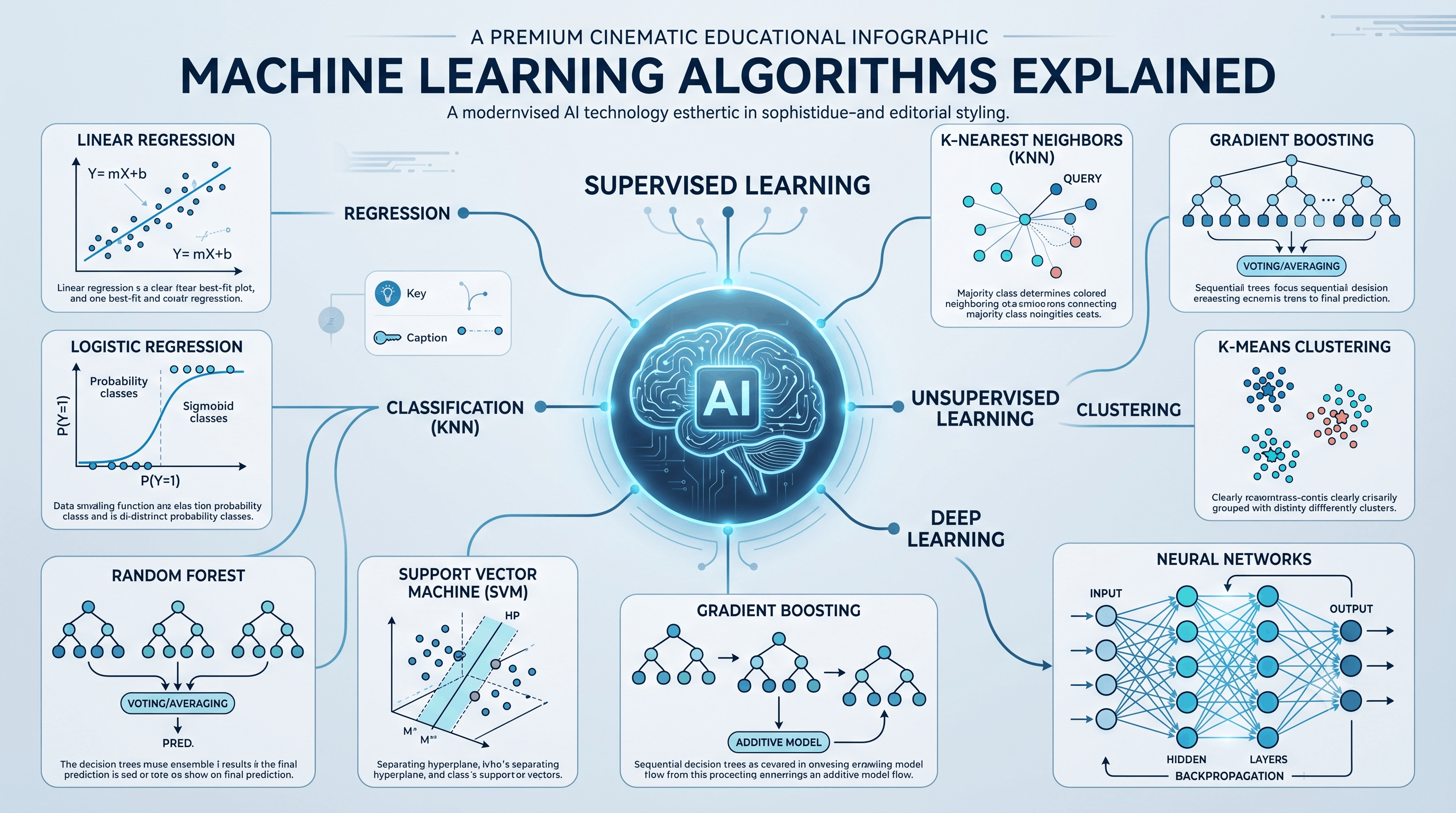
Machine Learning can seem overwhelming at first.
You hear names like:
And naturally, one question appears:
What does each algorithm actually do?
The good news is that you don't need to memorize dozens of algorithms.
The important thing is to understand what problem each algorithm solves, how it thinks about data, and when you should consider using it.
At a high level, Machine Learning algorithms can be grouped into several families:
Machine Learning
│
├── Supervised Learning
│   ├── Regression
│   └── Classification
│
├── Unsupervised Learning
│   ├── Clustering
│   └── Dimensionality Reduction
│
└── Reinforcement Learning
In this article, we'll build a practical understanding of some of the most important algorithms you'll encounter in Machine Learning.
A Machine Learning algorithm is a mathematical procedure used to learn patterns from data and produce predictions, classifications, rankings, or other useful outputs.
For example:
Training Data
      ↓
Machine Learning Algorithm
      ↓
Learned Model
      ↓
New Data
      ↓
Prediction
An algorithm provides the learning procedure.
The resulting trained model is what you actually use to make predictions.
There is no single algorithm that is best for every problem.
Your choice depends on:
A useful mindset is:
Start with a sensible baseline, then experiment and evaluate.
Don't choose an algorithm simply because it sounds advanced.
Linear Regression is one of the simplest and most important Machine Learning algorithms.
It is primarily used for predicting a continuous numerical value.
Examples:
Suppose we want to predict house prices based on house size.
We might observe:
1000 sq ft → ₹40 lakh
1500 sq ft → ₹60 lakh
2000 sq ft → ₹80 lakh
Linear Regression attempts to find a relationship between the input and output.
Conceptually:
Price
  │
  │          ●
  │       ●
  │    ●
  │ ●
  └────────────────
       House Size
The algorithm attempts to find a line that best represents the relationship between the variables.
A simple linear equation is:
y = mx + b
Where:
y = predictionx = inputm = slopeb = interceptWith multiple features, the model can use multiple coefficients:
y = β₀ + β₁x₁ + β₂x₂ + ... + βₙxₙ
Linear Regression is useful when:
It may struggle when relationships are highly nonlinear unless appropriate transformations or nonlinear features are introduced.
Despite its name, Logistic Regression is primarily a classification algorithm.
It is commonly used to predict probabilities for categories.
For binary classification:
0 → No
1 → Yes
Examples:
The model first computes a weighted combination of the input features.
It then transforms that value using the logistic function, producing an output between 0 and 1.
Conceptually:
Features
   ↓
Weighted Combination
   ↓
Sigmoid Function
   ↓
Probability
For example:
Customer → 0.87
You might interpret that as a high predicted probability of the positive class, depending on how the model and labels are defined.
A classification threshold can then convert the score into a class.
It is:
It remains widely used despite the popularity of complex models.
K-Nearest Neighbors (KNN) uses nearby examples to make predictions.
The central idea is simple:
Similar data points tend to have similar outcomes.
Suppose you have customers represented by:
A new customer arrives.
KNN looks at nearby customers.
        ● ●
      ● New ●
        ●
                 ▲
              Other class
The algorithm identifies the K closest examples.
Suppose:
K = 5
The five nearest customers are:
Yes
Yes
Yes
No
Yes
The majority is:
Yes
So the new customer is classified as:
Yes
A Decision Tree makes predictions by asking a sequence of questions.
Imagine deciding whether a customer is likely to purchase:
Previous Purchases > 5?
       │
    ┌──┴──┐
   Yes    No
    │      │
Visits > 10? ...
Each decision divides the data into smaller groups.
Decision Trees are attractive because they are relatively easy to understand.
They can handle:
They can also be used for both classification and regression.
A tree can become too deep.
For example:
Question
  ↓
Question
  ↓
Question
  ↓
Question
  ↓
Question
  ↓
Question...
Eventually, it may memorize the training data.
This can lead to overfitting.
Common controls include:
A Random Forest combines many Decision Trees.
Instead of relying on one tree:
Decision Tree
we build many:
Tree 1
Tree 2
Tree 3
Tree 4
...
Tree 100
Their predictions are then combined.
For classification, this often involves voting.
For regression, predictions are commonly averaged.
Because it is essentially a collection—or "forest"—of decision trees, with randomness introduced during training.
Random Forest commonly uses techniques related to:
These help make the individual trees less correlated.
Support Vector Machines (SVMs) attempt to find a decision boundary that separates classes.
Imagine two groups of points:
● ● ● ●

        | Decision Boundary |

○ ○ ○ ○
SVM tries to find a boundary that separates the groups while maximizing the margin between them.
The margin is the distance between the decision boundary and the closest relevant training examples.
These critical examples are called:
Support Vectors.
Conceptually:
Class A       Support Vectors       Class B

  ●                ●
  ●         |      ●
  ●         |      ○
            |
       Decision Boundary
The support vectors help determine the boundary.
One of the powerful ideas associated with SVMs is the kernel trick.
It allows SVMs to model nonlinear relationships by effectively working in a transformed feature space.
Common kernels include:
SVMs can work particularly well when:
They can become computationally expensive on very large datasets.
Naive Bayes is a probabilistic classification algorithm based on Bayes' theorem.
It makes a simplifying assumption that features are conditionally independent given the class.
That assumption is often unrealistic, hence the name "naive."
Yet the algorithm can work surprisingly well for certain tasks.
Suppose an email contains:
"Congratulations"
"Prize"
"Winner"
Naive Bayes can estimate how likely the email is to belong to the spam class based on patterns learned from training data.
It has historically been popular for:
It is:
Now let's move into unsupervised learning.
Unlike supervised algorithms, K-Means doesn't require predefined labels.
The goal is to divide data into K clusters.
Suppose an online store has customer data.
You might discover groups such as:
Cluster 1 → Low-frequency customers
Cluster 2 → Frequent customers
Cluster 3 → High-value customers
A simplified process:
Choose K
  ↓
Initialize cluster centers
  ↓
Assign points to nearest center
  ↓
Recalculate centers
  ↓
Repeat
The process continues until the cluster assignments stabilize or a stopping condition is reached.
Suppose:
K = 3
The algorithm attempts to organize the data into three groups.
       ● ●
     ● ●

                  ▲ ▲
                ▲ ▲

   ■ ■
 ■ ■
Each symbol represents a different cluster.
You need to choose K.
Should there be:
K = 2?
K = 3?
K = 5?
K = 10?
Techniques such as the elbow method and silhouette analysis can help evaluate clustering choices.
Gradient Boosting is a powerful ensemble learning technique.
Instead of building independent models and simply averaging them, boosting builds models sequentially.
Each new model attempts to improve on the errors made by the previous models.
Conceptually:
Model 1
   ↓
Errors
   ↓
Model 2
   ↓
Remaining Errors
   ↓
Model 3
   ↓
Final Model
The models are combined into a stronger predictor.
Gradient boosting can perform extremely well on structured or tabular datasets.
It is commonly used for:
Popular implementations include:
These are related to gradient-boosted decision tree techniques but have different engineering and algorithmic characteristics.
XGBoost stands for Extreme Gradient Boosting.
It is a highly optimized implementation of gradient-boosted decision trees.
XGBoost became extremely popular because it offers:
For many tabular Machine Learning problems, XGBoost is an excellent model to benchmark.
Neural Networks are inspired loosely by the idea of interconnected neurons, although modern neural networks are mathematical computational systems rather than biological brains.
A simple neural network contains:
Input Layer
     ↓
Hidden Layer
     ↓
Hidden Layer
     ↓
Output Layer
Each connection has parameters called weights.
During training, these weights are adjusted to reduce prediction error.
Neural Networks are especially powerful for complex unstructured data such as:
They form the foundation of many modern Deep Learning systems.
When neural networks contain multiple layers capable of learning hierarchical representations, we commonly refer to them as Deep Learning models.
Different architectures are suited to different tasks.
Examples include:
Historically and still commonly used for image and spatial data.
Designed for sequential data and historically important for language and time-series tasks.
Highly influential for modern:
| Algorithm | Typical Use | Strength | Limitation |
|---|---|---|---|
| Linear Regression | Regression | Simple, interpretable | Limited nonlinear modeling |
| Logistic Regression | Classification | Fast, interpretable | Linear decision boundary |
| KNN | Classification/Regression | Simple | Slow prediction at scale |
| Decision Tree | Both | Interpretable, nonlinear | Can overfit |
| Random Forest | Both | Strong baseline | Less interpretable |
| SVM | Classification | Effective in high dimensions | Can scale poorly |
| Naive Bayes | Classification | Very fast | Strong independence assumption |
| K-Means | Clustering | Simple clustering | Must choose K |
| Gradient Boosting | Both | Excellent tabular performance | Requires tuning |
| Neural Networks | Both / complex tasks | Highly expressive | Data and compute intensive |
Here's a practical starting point.
Try:
Linear Regression
        ↓
Random Forest
        ↓
Gradient Boosting
Compare their validation performance.
Try:
Logistic Regression
        ↓
Decision Tree
        ↓
Random Forest
        ↓
Gradient Boosting
Depending on the dataset, SVM or other methods may also be useful.
Potential starting points include:
Naive Bayes
Logistic Regression
Linear SVM
        ↓
Transformer-based model
The right choice depends on dataset size, complexity, latency, and requirements.
Try:
K-Means
Then compare against other clustering approaches if necessary.
Modern Deep Learning approaches are usually more appropriate than classical algorithms operating directly on raw pixels.
Don't begin by asking:
"What's the most powerful algorithm?"
Instead ask:
"What's the simplest model that can solve this problem well?"
Then build progressively.
For example:
Baseline
   ↓
Logistic Regression
   ↓
Random Forest
   ↓
Gradient Boosting
   ↓
Deep Learning
At every stage:
Train
 ↓
Validate
 ↓
Evaluate
 ↓
Compare
This makes experimentation much more scientific.
A sophisticated algorithm doesn't automatically produce a better result.
For example:
Complex Model + Poor Data
        ↓
Poor Results
while:
Simple Model + Excellent Data
        ↓
Strong Results
Data quality, feature engineering, evaluation strategy, and deployment conditions all matter.
First determine:
Then choose candidate algorithms.
Deep Learning is powerful, but it isn't automatically the best choice for every dataset.
For many structured/tabular problems, tree-based methods can be extremely competitive.
Always establish a baseline.
For classification, a simple Logistic Regression model can be useful.
For regression, Linear Regression can be a useful starting point.
Then compare more complex models.
Remember:
Training Performance ≠ Generalization
Always evaluate on appropriate unseen data.
There is no universally best algorithm. The right choice depends on the dataset, problem, metric, constraints, and deployment environment.
Yes. Linear Regression is one of the classic supervised Machine Learning algorithms.
Yes. Despite its name, Logistic Regression is primarily used for classification.
A Decision Tree is a single tree. Random Forest combines predictions from many randomized trees.
Often it generalizes better than a single unrestricted tree, but the best model depends on the dataset and evaluation metric.
K-Means is an unsupervised clustering algorithm used to divide data into groups based on similarity.
No. XGBoost is based on gradient-boosted decision trees, not neural networks.
They are particularly useful for complex problems involving images, audio, text, video, and other high-dimensional data, especially when sufficient data and compute are available.
No. Start with the major concepts and a small set of important algorithms. Understanding when and why to use an algorithm is more valuable than memorizing dozens of names.
Machine Learning isn't about memorizing a giant list of algorithms.
It's about understanding which type of problem you're solving and which tools are appropriate for that problem.
If you're predicting a number, Linear Regression may be a useful starting point.
If you're classifying customers, Logistic Regression, Random Forest, or Gradient Boosting may be worth testing.
If you're discovering customer groups without labels, K-Means could be a starting point.
And if you're working with images, audio, language, or other highly complex data, Deep Learning may become the natural direction.
The most important skill isn't knowing every algorithm.
It's knowing why you're choosing one algorithm over another—and proving that choice through proper evaluation.
Pixels to Perfection Design that Impresses