
Rahul
 LeetCode #155: Min Stack — Design a Stack with O(1) Minimum Retrieval
 LeetCode #20: Valid Parentheses — Master the Stack Pattern
 LeetCode #15: 3Sum — Master Sorting, Two Pointers and Duplicate Handling
 Instruction vs Context in AI Prompts: How to Tell AI What to Do and What Information to Use
 Rust Structs and Enums: Building Powerful Data Models
 Dissecting the High-Level System Architecture of Booking.com
 Kanban vs. Scrum: Which Agile Methodology to Choose?
 The Scaling Journey of LinkedIn: From Startup to Professional Powerhouse
 Mastering Code Review: A Guide for Reviewers and PR Creators
 ChatGPT: Unveiling the Power of AI in Conversational Experiences with Kairos Coders

Kairos Coders are here to help
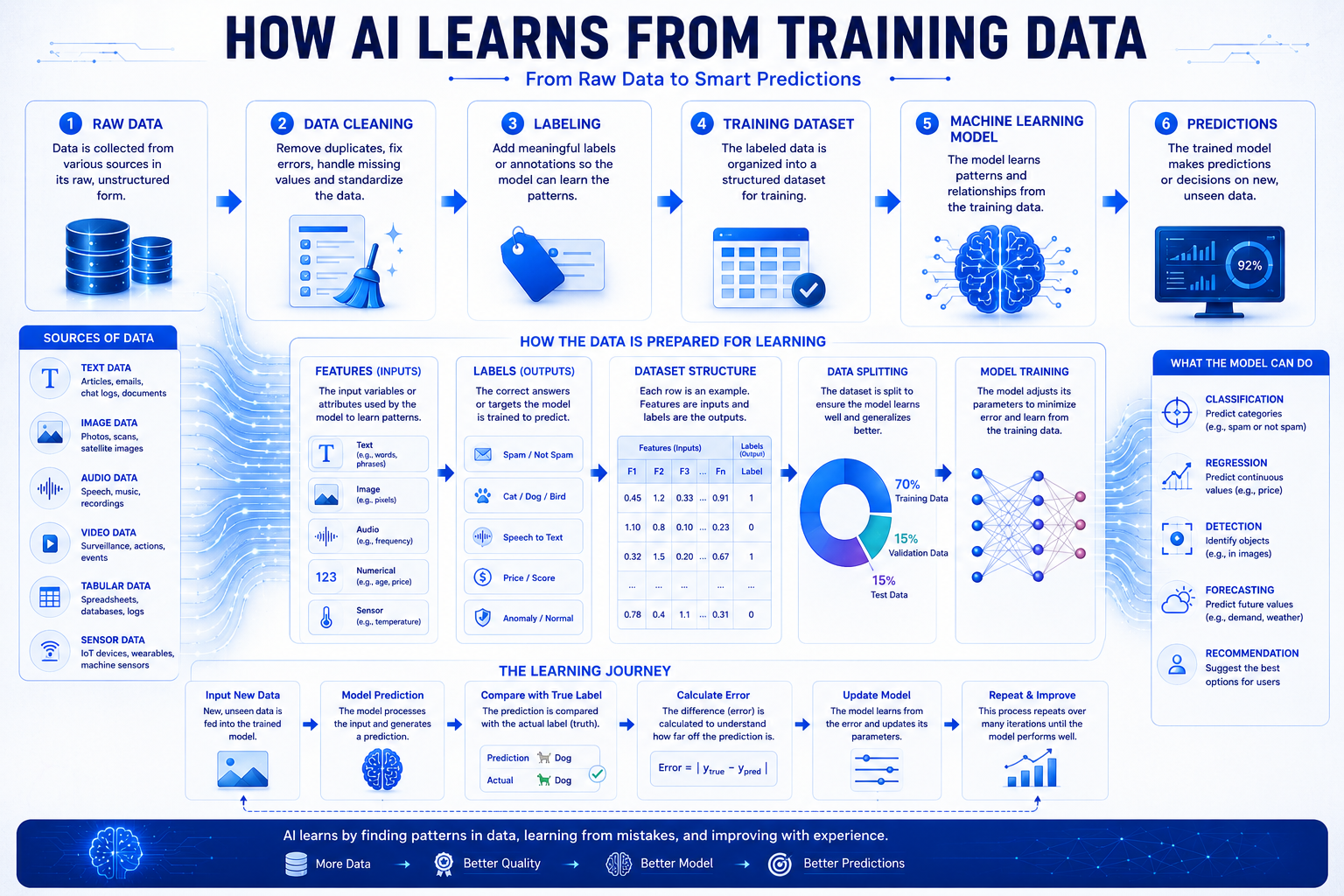
Artificial Intelligence may look intelligent, but behind every Machine Learning model is something much more fundamental:
Data.
An AI model cannot learn patterns without information to learn from. Whether it is identifying cats in photographs, detecting fraudulent transactions, predicting house prices, or understanding human language, the quality and quantity of data play a critical role in determining what the model can learn.
This collection of examples used to teach a Machine Learning model is called training data.
Training data is one of the most important concepts in Artificial Intelligence. Understanding it helps explain why some AI systems perform remarkably well while others produce inaccurate, biased, or unreliable results.
In this guide, we'll explore what training data is, how it is prepared, how features and labels work, the difference between training, validation, and test data, common data problems, and why data quality often matters more than simply having more data.
Training data is the collection of examples used to teach a Machine Learning model how to identify patterns and make predictions.
Depending on the type of Machine Learning system, training data can contain:
Training data is the information a Machine Learning model analyzes during training so it can learn patterns and relationships that help it perform a task.
Imagine asking a computer:
"Which emails are spam?"
A traditional program could use manually written rules such as:
IF email contains "WIN MONEY"
→ Spam
But real-world spam is far more complicated.
Spammers constantly change:
Instead of programming thousands of rules manually, Machine Learning can learn patterns from previous examples.
For example:
Email A → Spam
Email B → Not Spam
Email C → Spam
Email D → Not Spam
...
After analyzing enough examples, the model can learn patterns that help it classify new emails.
The basic process looks like this:
Collect Data
     ↓
Clean Data
     ↓
Label / Structure Data
     ↓
Prepare Dataset
     ↓
Train Model
     ↓
Evaluate Model
     ↓
Deploy Model
     ↓
Monitor Performance
The model doesn't simply memorize every example.
The goal is to learn general patterns that can be applied to new data.
Two important concepts in supervised Machine Learning are:
Understanding these concepts is essential for understanding datasets.
Features are the pieces of information used by a model to make a prediction.
Suppose we're building a model to predict house prices.
Our features could include:
These variables provide information about the house.
A label is the target answer the model is learning to predict.
For our house-price example:
Features:

Area: 1,500 sq ft
Bedrooms: 3
Bathrooms: 2
Location: Delhi

↓

Label:

₹85,00,000
The model learns the relationship between the features and the label.
Imagine a small dataset for predicting whether a customer will purchase a product.
| Age | Previous Purchases | Website Visits | Purchased |
|---|---|---|---|
| 22 | 1 | 3 | No |
| 28 | 4 | 12 | Yes |
| 35 | 6 | 15 | Yes |
| 24 | 0 | 2 | No |
| 42 | 8 | 20 | Yes |
Here:
Features:
Label:
The model analyzes these examples and attempts to learn patterns associated with purchasing behavior.
A common Machine Learning mistake is to train a model using all available data.
Instead, datasets are typically divided into separate subsets.
The training set is used to teach the model.
The model adjusts its parameters based on these examples.
For example:
100,000 examples

↓

Training

↓

Model learns patterns
The validation set is used during development to help make decisions such as:
The validation data should not be treated as part of the model's direct training examples.
The test set is reserved for final evaluation.
It should represent previously unseen examples.
The goal is to answer:
"How well does this model perform on data it hasn't seen during development?"
Complete Dataset
       │
       ├── Training Data
       │
       ├── Validation Data
       │
       └── Test Data
A common split might be:
70% Training
15% Validation
15% Testing
But there is no universal ratio. The appropriate split depends on the dataset, task, and evaluation strategy.
Because we need an independent way to determine whether the model has actually learned useful patterns.
Suppose you give a student the exact questions that will appear on the exam.
The student could memorize the answers.
That doesn't necessarily mean they understand the subject.
Machine Learning models can have a similar problem.
This leads to one of the most important concepts in Machine Learning:
Overfitting.
Overfitting happens when a model learns the training data too closely, including noise or accidental patterns, and performs poorly on new data.
For example:
Training accuracy: 99%
Test accuracy: 65%
The model looks excellent during training but performs poorly in the real world.
A good Machine Learning system should generalize.
Generalization is the ability of a model to perform well on previously unseen data.
This is ultimately what we want.
The goal isn't:
"Memorize the training dataset."
The goal is:
"Learn patterns that continue to work on new examples."
Good training data should be:
It should represent the actual problem.
Incorrect information can teach the model incorrect patterns.
The dataset should cover different situations and populations relevant to the intended use.
The data should reflect the conditions in which the model will operate.
Labels and formatting should follow clear rules.
There should be enough useful examples for the model to learn the task.
A common misconception is:
More data automatically means a better AI model.
Not necessarily.
Consider these two datasets.
1 million poor-quality examples.
200,000 carefully curated examples.
Dataset B could potentially produce a better model depending on the task.
A useful principle is:
Quality, relevance, diversity, and coverage matter—not just the number of examples.
Training data can take many forms.
Used for:
Examples:
Used for:
Examples:
Used for:
Examples:
Used for:
Organized into rows and columns.
Examples:
Data labeling is the process of assigning meaningful information to training examples.
For example:
Image → Cat
Image → Dog
Image → Horse
Or:
Transaction → Fraud
Transaction → Legitimate
Labels provide the target information required by many supervised learning systems.
Labeling can be:
For example, labeling medical images may require trained medical professionals.
Similarly, evaluating the quality of a legal document may require legal expertise.
Many AI systems use humans to create, review, or correct training data.
A common workflow is:
Raw Data
   ↓
Initial Label
   ↓
Human Review
   ↓
Correction
   ↓
Final Dataset
Human review can substantially improve dataset quality when the task requires nuanced judgment.
Data bias occurs when a dataset does not adequately represent the real-world population, situations, or conditions relevant to the task.
For example, imagine a face recognition dataset containing images mostly from one demographic group.
The resulting system might perform very well on that group but poorly on others.
This is why diverse and representative datasets are critical.
Training datasets can contain many issues.
Important information is absent.
The same example appears multiple times.
The provided answer is wrong.
Some examples are very different from the majority.
One category may contain far more examples than another.
For example:
99,000 Normal Transactions
1,000 Fraudulent Transactions
A model could achieve 99% accuracy simply by predicting "Normal" every time.
That would be practically useless for fraud detection.
Data leakage occurs when information that should not be available during training or evaluation accidentally gives the model an unfair advantage.
For example, imagine predicting whether a patient will be hospitalized.
If your training data contains a variable recorded after hospitalization, the model may accidentally learn information about the future.
The resulting performance may look excellent during testing but fail in real-world use.
It can produce misleadingly high evaluation scores.
You might see:
Accuracy: 98%
But after deployment:
Real-world accuracy: 72%
This is why datasets must be carefully designed around the actual timeline and information available when predictions will be made.
One of the most important principles in Machine Learning is:
Garbage In, Garbage Out.
If the training data is:
the resulting model can also be unreliable.
A sophisticated algorithm cannot magically turn fundamentally bad data into trustworthy knowledge.
Modern Large Language Models (LLMs) are trained using enormous collections of text and other data.
During training, the model learns statistical patterns in language.
For example, it can learn relationships between:
The exact datasets and training procedures vary between models.
Importantly, an LLM's training process is much more complex than simply storing a collection of documents and retrieving them later.
The model learns parameters that encode statistical patterns from its training process.
Not in the simple sense of copying every training example into a searchable database.
A trained neural network stores learned information primarily through its parameters.
However, models can sometimes memorize portions of their training data, especially under certain conditions. This is one reason dataset construction, privacy, evaluation, and responsible AI practices matter.
A useful way to think about AI performance is:
Data
  +
Model Architecture
  +
Training Process
  +
Evaluation
  +
Computing Resources
  ↓
Model Performance
Training data is extremely important, but it is only one part of the overall Machine Learning pipeline.
Training data:
Spam emails
+
Legitimate emails
The model learns patterns associated with spam.
Training data can include:
Models learn to identify objects and understand driving environments.
Training data can include:
Models learn patterns that help predict what content or products may be relevant.
Training datasets may include:
Because mistakes can have serious consequences, these systems require careful validation and oversight.
When building an AI system, consider the following:
Know exactly what the model is expected to predict or accomplish.
Don't collect massive quantities of information that don't contribute to the task.
Look for:
Make sure the dataset adequately represents the situations in which the model will operate.
Ensure information from the future or evaluation process does not accidentally enter training.
Test on data that realistically represents deployment conditions.
Real-world data can change over time.
A model that performs well today may degrade as user behavior, markets, language, or environments change.
Training data is the collection of examples used to teach a Machine Learning model patterns and relationships needed to perform a task.
Training data is used to learn model parameters. Test data is kept separate and used to evaluate how well the finished system performs on unseen examples.
Features are input variables used by the model. A label is the target output the model is trained to predict in supervised learning.
No. More data can help, but relevance, quality, diversity, accuracy, and coverage are often equally or more important.
Data leakage occurs when information that would not legitimately be available at prediction time influences training or evaluation, resulting in overly optimistic performance estimates.
Yes. Unlabeled data is commonly used in approaches such as unsupervised learning and self-supervised learning.
Training data is the foundation upon which modern Machine Learning is built.
Algorithms and neural networks may receive most of the attention, but even the most sophisticated model cannot compensate indefinitely for poor, biased, incomplete, or irrelevant data.
The difference between a useful AI system and an unreliable one often begins long before model training—with decisions about what data to collect, how to label it, how to clean it, how to represent it, and how to evaluate it.
Understanding training data therefore isn't just useful for Machine Learning engineers. It is essential for anyone who wants to understand how modern AI systems actually work.
And once we understand training data, we can move to another fundamental question:
What exactly does a Machine Learning model learn from that data?
The answer begins with features and labels.
Pixels to Perfection Design that Impresses