
Rahul
 LeetCode #155: Min Stack — Design a Stack with O(1) Minimum Retrieval
 LeetCode #20: Valid Parentheses — Master the Stack Pattern
 LeetCode #15: 3Sum — Master Sorting, Two Pointers and Duplicate Handling
 Instruction vs Context in AI Prompts: How to Tell AI What to Do and What Information to Use
 Rust Structs and Enums: Building Powerful Data Models
 Dissecting the High-Level System Architecture of Booking.com
 Kanban vs. Scrum: Which Agile Methodology to Choose?
 The Scaling Journey of LinkedIn: From Startup to Professional Powerhouse
 Mastering Code Review: A Guide for Reviewers and PR Creators
 ChatGPT: Unveiling the Power of AI in Conversational Experiences with Kairos Coders

Kairos Coders are here to help
Imagine you're teaching a child to recognize different fruits.
You point to an apple and say, "This is an apple."
Then you point to a banana and say, "This is a banana."
You repeat this process with hundreds of examples. Eventually, the child learns to recognize new fruits without your help.
This is exactly how Supervised Learning works.
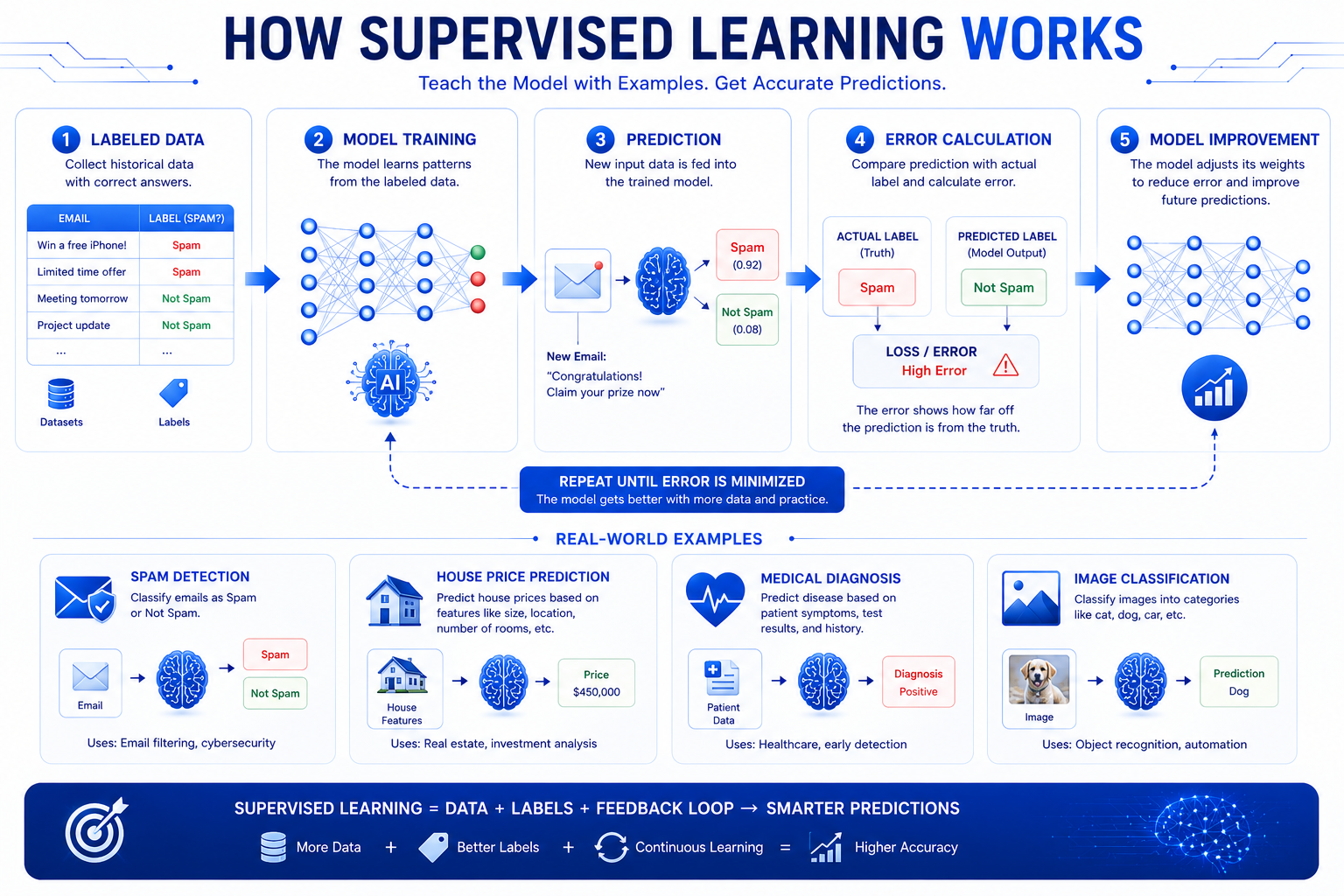
Instead of teaching a child, we teach a computer using labeled data. Every training example already contains the correct answer, allowing the algorithm to learn the relationship between inputs and outputs.
Supervised Learning is the most widely used type of Machine Learning and powers many of the AI systems we rely on every day—from spam filters and fraud detection to medical diagnosis and price prediction.
In this guide, you'll learn what Supervised Learning is, how it works, the types of problems it solves, common algorithms, real-world applications, advantages, limitations, and best practices.
Supervised Learning is a Machine Learning technique where an algorithm learns from labeled training data.
Each training example contains:
The algorithm studies many examples until it can predict the correct output for new, unseen data.
Supervised Learning is a Machine Learning approach where models learn from labeled examples to make predictions or classifications on new data.
The word supervised means the algorithm learns under guidance.
Imagine a teacher grading homework.
Every answer is marked as correct or incorrect.
The student gradually improves by learning from mistakes.
Similarly, in Supervised Learning:
Suppose you're preparing for a driving license test.
Your instructor tells you:
Because someone provides the correct answers, you improve quickly.
Without feedback, learning would be much harder.
That's why this approach is called Supervised Learning.
Every Supervised Learning project generally follows these six steps.
The first requirement is a dataset where every example has a known answer.
Example:
| Label | |
|---|---|
| Congratulations! You won ₹10 lakh. | Spam |
| Team meeting tomorrow at 10 AM | Not Spam |
The label tells the algorithm what the correct answer is.
Before training, data is cleaned by:
High-quality data is essential for accurate models.
Different problems require different algorithms.
Common choices include:
The algorithm depends on the type of prediction being made.
The algorithm analyzes thousands—or sometimes millions—of labeled examples.
During training, it adjusts its internal parameters to minimize prediction errors.
The trained model is evaluated using data it has never seen before.
This helps determine whether it has learned general patterns rather than simply memorizing the training data.
Once deployed, the model predicts outcomes for new inputs.
Examples:
Every supervised model consists of three essential elements.
Features describe the input.
Example for house price prediction:
These are the variables the model uses to make predictions.
Labels are the correct answers.
Examples:
The model learns to predict these labels.
The model is the mathematical relationship learned from the data.
It connects features to labels.
Supervised Learning is divided into two main categories.
Classification predicts categories.
Examples:
The output belongs to a predefined class.
Input:
Output:
Spam
Another example:
Medical Scan
↓
Cancer
or
Healthy
Regression predicts continuous numerical values.
Examples:
Unlike classification, regression outputs numbers rather than categories.
House Details
↓
₹72,50,000
Best for predicting continuous values.
Examples:
Simple, fast, and easy to interpret.
Despite its name, Logistic Regression is primarily used for classification.
Applications include:
Decision Trees split data into branches based on conditions.
Example:
Income > ₹10 Lakh?

        Yes
       /
Approve Loan

       No
       \
Reject Loan
They are easy to visualize and explain.
Random Forest combines many Decision Trees.
Benefits:
SVM identifies the optimal boundary that separates different classes.
Common uses:
Neural Networks can solve both:
They are widely used for:
Supervised Learning powers many technologies we use daily.
The model learns from millions of labeled emails.
Output:
Spam
or
Not Spam
Doctors use supervised models to assist in detecting diseases from:
Banks train models using historical fraud data.
The system predicts whether new transactions are suspicious.
Real estate platforms estimate property values using:
Retail platforms predict which products customers are likely to purchase based on past behavior.
Smartphones identify authorized users by comparing facial features with labeled training data.
Banks analyze historical loan data to estimate repayment risk and support lending decisions.
With high-quality labeled data, supervised models often produce excellent predictive performance.
Because the correct answers are known, measuring model performance is straightforward.
Supervised Learning is useful across healthcare, finance, retail, manufacturing, education, and many other industries.
Many reliable algorithms and evaluation techniques are available.
Obtaining accurate labels can be expensive and time-consuming.
For example:
A hospital may need medical experts to label thousands of X-rays.
A model may memorize training examples instead of learning general patterns.
This reduces performance on new data.
If historical data contains biases, the model may reproduce those biases.
Careful data collection and evaluation are essential.
Poor-quality data often results in poor predictions.
To build effective supervised models:
Not necessarily.
High-quality, representative data is often more valuable than simply having a larger quantity of data.
No.
The model identifies mathematical patterns.
It does not possess human understanding or common sense.
Many AI systems use supervised learning, but others rely on unsupervised learning, reinforcement learning, self-supervised learning, or combinations of multiple approaches.
Yes.
Supervised Learning is one of the most widely used approaches within Machine Learning, which is itself a branch of Artificial Intelligence.
Labels provide the correct answers, allowing the model to learn the relationship between inputs and outputs.
Classification predicts categories, while regression predicts continuous numerical values.
Yes.
Many Neural Networks are trained using supervised learning, especially for image recognition, speech recognition, and natural language processing.
Supervised Learning is one of the most practical and widely adopted Machine Learning techniques. By learning from labeled examples, models can make accurate predictions across a wide variety of real-world tasks.
Understanding supervised learning provides a strong foundation for exploring more advanced learning paradigms. In the next article, we'll examine Unsupervised Learning, where algorithms discover hidden patterns in data without being given the correct answers.
Pixels to Perfection Design that Impresses