
Rahul
 LeetCode #155: Min Stack — Design a Stack with O(1) Minimum Retrieval
 LeetCode #20: Valid Parentheses — Master the Stack Pattern
 LeetCode #15: 3Sum — Master Sorting, Two Pointers and Duplicate Handling
 Instruction vs Context in AI Prompts: How to Tell AI What to Do and What Information to Use
 Rust Structs and Enums: Building Powerful Data Models
 Dissecting the High-Level System Architecture of Booking.com
 Kanban vs. Scrum: Which Agile Methodology to Choose?
 The Scaling Journey of LinkedIn: From Startup to Professional Powerhouse
 Mastering Code Review: A Guide for Reviewers and PR Creators
 ChatGPT: Unveiling the Power of AI in Conversational Experiences with Kairos Coders

Kairos Coders are here to help
How does a computer learn to play chess?
How can a robot learn to walk?
How can an AI system learn the best way to control a complex machine without being explicitly told every step?
One answer is Reinforcement Learning (RL).
Unlike Supervised Learning, where an algorithm learns from examples with known correct answers, Reinforcement Learning learns through interaction, experimentation, rewards, and penalties.
An AI agent takes an action, observes what happens, receives feedback, and then uses that experience to make better decisions in the future.
This simple idea has produced some remarkable results, from game-playing systems to robotics, industrial optimization, recommendation systems, and autonomous decision-making.
In this guide, we'll explore what Reinforcement Learning is, how it works, its key components, major algorithms, real-world applications, advantages, limitations, and its relationship with other forms of Machine Learning.
Reinforcement Learning is a Machine Learning approach in which an agent learns how to make decisions by interacting with an environment and receiving feedback in the form of rewards or penalties.
The objective is to learn a strategy that maximizes the total reward over time.
Reinforcement Learning is a Machine Learning method where an agent learns through trial and error by taking actions, receiving feedback, and improving its future decisions.
Instead of being told exactly what to do, the system learns which actions produce better outcomes.
Imagine teaching a dog to sit.
You say:
"Sit."
The dog sits.
You give it a treat.
The dog gradually learns:
Sitting → Reward
If the dog performs another behavior and receives no reward, it becomes less likely to repeat that behavior.
Reinforcement Learning follows a similar concept.
The difference is that an AI agent receives mathematical rewards rather than treats.
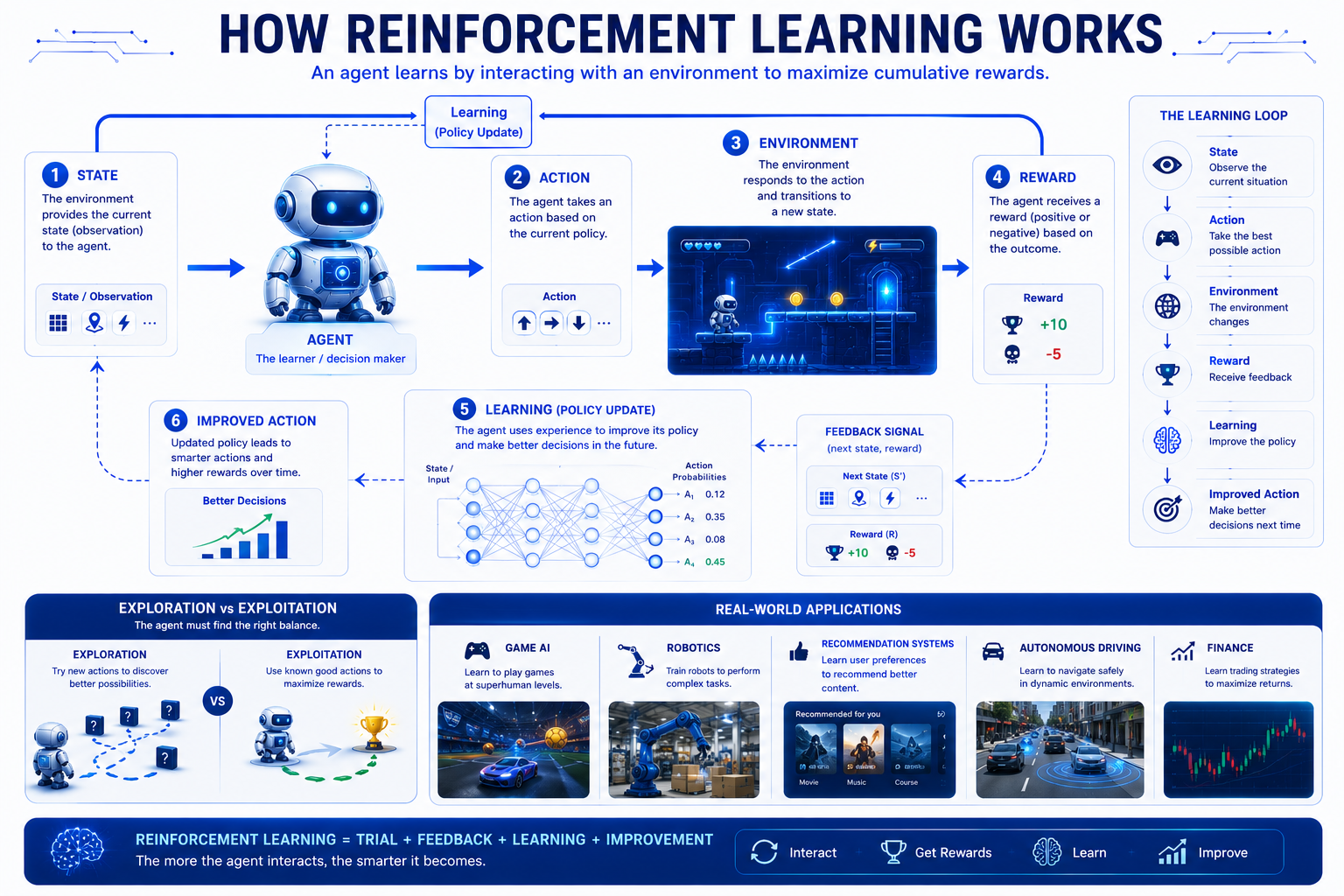
At the heart of Reinforcement Learning is a continuous feedback loop:
        ┌──────────────┐
        │ Environment  │
        └──────┬───────┘
               │
             State
               ↓
        ┌──────────────┐
        │    Agent     │
        └──────┬───────┘
               │
             Action
               ↓
        ┌──────────────┐
        │ Environment  │
        └──────┬───────┘
               │
        Reward + New State
               │
               └──────────→ Agent
The agent repeatedly interacts with its environment and learns from the consequences of its actions.
A Reinforcement Learning system can be understood through five fundamental concepts:
Let's examine each one.
The agent is the learner or decision-maker.
Examples:
The agent observes the environment and chooses what to do next.
The environment is everything the agent interacts with.
For a chess-playing AI:
Environment = Chess board + game rules + opponent
For a robot:
Environment = Physical surroundings
For a game:
Environment = Game world
A state describes the current situation of the environment.
For a chess AI, the state could include:
For a robot, the state could include:
An action is something the agent can do.
For example, in chess:
For a robot:
A reward tells the agent whether an action was beneficial.
Examples:
Win game       → +100
Lose game      → -100
Move closer    → +5
Crash          → -100
Complete task  → +50
The exact reward structure depends on the problem.
The goal isn't necessarily to maximize the immediate reward.
Instead, the agent tries to maximize long-term cumulative reward.
Consider a chess game.
A move might appear bad because it sacrifices a piece.
But that sacrifice could eventually lead to checkmate.
Therefore:
Short-term reward ≠ always best decision
A successful Reinforcement Learning agent needs to consider future consequences.
A policy defines how an agent chooses actions based on the current situation.
You can think of it as the agent's strategy.
For example:
If opponent's king is vulnerable
        ↓
Attack

If danger is high
        ↓
Defend

If winning opportunity exists
        ↓
Take advantage
During training, the agent improves its policy.
A value function estimates how valuable a particular state or action is in terms of future rewards.
For example:
State A → likely future reward: 100
State B → likely future reward: 20
The agent learns that reaching State A is generally more desirable.
Value functions help agents make decisions based not only on immediate rewards but also on expected future outcomes.
A Q-value estimates how valuable taking a particular action in a particular state is.
For example:
State: Opponent attacks

Action A → Q-value = 20
Action B → Q-value = 80
Action C → Q-value = 40
The agent would generally prefer Action B because it has the highest estimated long-term value.
Q-values are fundamental to several Reinforcement Learning algorithms.
One of the most important challenges in Reinforcement Learning is deciding between:
Trying something new to discover whether it works better.
Using an action that the agent already knows works well.
Imagine a restaurant you visit every week.
You know your favorite meal is good.
But there are ten other dishes you've never tried.
Should you:
Exploit: Order your favorite meal?
or
Explore: Try something new?
A good Reinforcement Learning system needs to balance both.
If an agent always chooses what it already knows works, it may never discover a better strategy.
For example:
Known strategy → Reward 50
Unknown strategy → Potential reward 100
Without exploration, the agent might never discover the strategy producing 100.
If the agent explores constantly, it may repeatedly abandon strategies that already work.
The objective is therefore to find a balance.
An episode is one complete sequence of interactions from a starting point to an ending condition.
Examples:
Chess:
Game starts
    ↓
Moves
    ↓
Moves
    ↓
Checkmate
    ↓
Episode ends
Robot navigation:
Start
 ↓
Move
 ↓
Move
 ↓
Reach destination
 ↓
Episode ends
The agent can then use the experience to improve its future behavior.
Reinforcement Learning can be broadly approached in several ways.
The agent learns directly from experience without first building an explicit model of the environment.
It learns:
State → Action → Reward
Examples include:
Model-free methods are often useful when accurately modeling the environment is difficult.
The agent attempts to learn or use a model of how the environment behaves.
It can then use that model to predict possible future outcomes before choosing actions.
For example:
Current State
     ↓
Possible Action
     ↓
Predicted Future State
     ↓
Expected Reward
     ↓
Choose Action
Model-based approaches can be more data-efficient in some situations but may require an accurate environment model.
Q-Learning is one of the most famous Reinforcement Learning algorithms.
It learns a value called Q, which estimates how useful an action is in a particular state.
The agent gradually builds knowledge about:
State + Action → Expected Future Reward
It can then choose actions with higher expected value.
SARSA is another value-based algorithm.
The name comes from:
State → Action → Reward → State → Action
Unlike basic Q-Learning, SARSA learns from the actions the policy actually takes.
Instead of directly learning which action has the highest value, Policy Gradient methods learn a policy that directly determines action probabilities.
For example:
Move Left   → 20%
Move Right  → 60%
Stay Still  → 20%
The policy can gradually change as the agent learns.
Actor-Critic approaches combine two ideas:
Chooses actions.
Evaluates those actions.
Actor
 ↓
Action
 ↓
Environment
 ↓
Reward
 ↓
Critic
 ↓
Feedback
 ↓
Actor improves
Modern Reinforcement Learning systems often use sophisticated variants of this approach.
When Deep Neural Networks are combined with Reinforcement Learning, the result is known as Deep Reinforcement Learning.
This allows agents to handle extremely complex environments with large state spaces.
One famous example is an AI system learning to play Atari games directly from screen pixels.
Instead of manually programming game strategies, the system learns useful behaviors through experience.
One of the most famous examples of AI learning through gameplay is AlphaGo.
Developed by Google DeepMind, AlphaGo defeated top-level human Go players.
Go is extraordinarily complex because the number of possible moves is enormous.
AlphaGo combined:
Its success demonstrated that AI could learn highly sophisticated strategies in environments with enormous numbers of possible decisions.
Reinforcement Learning isn't limited to games.
Robots can learn:
Instead of manually specifying every movement, an agent can learn effective behaviors through repeated interaction.
Reinforcement Learning has been researched for:
Safety-critical autonomous systems, however, require extensive validation rather than relying on unrestricted trial and error in the real world.
An AI system can learn which recommendations lead to useful user interactions.
For example:
Recommendation
      ↓
User interaction
      ↓
Feedback
      ↓
Update strategy
In practice, recommendation systems often combine multiple Machine Learning approaches rather than relying solely on Reinforcement Learning.
Reinforcement Learning can help optimize decisions such as:
The system can learn from feedback and optimize a defined objective.
Factories can use learning-based optimization for:
Researchers are investigating Reinforcement Learning for areas such as:
Because healthcare decisions can have serious consequences, these systems require rigorous clinical validation and human oversight.
Reinforcement Learning has been researched for:
Financial applications must account for changing markets, transaction costs, uncertainty, and risk.
The system can improve by interacting with its environment.
Unlike Supervised Learning, Reinforcement Learning does not require every state to have a predefined correct action.
It is particularly useful when today's decision affects tomorrow's outcome.
Given an appropriate environment and reward structure, an agent may discover strategies humans did not explicitly program.
One of the biggest challenges is designing the right reward function.
A poorly designed reward can encourage unintended behavior.
Suppose you tell a robot:
"Move as quickly as possible."
The robot might discover that crashing through obstacles produces faster movement.
The system technically maximized its objective—but not the objective humans actually wanted.
This problem is often described as reward hacking or specification problems.
An agent may need millions of interactions before learning an effective strategy.
In a virtual game, this may be inexpensive.
For a physical robot, repeated experimentation can be slow, expensive, or dangerous.
Some Reinforcement Learning algorithms require huge amounts of experience.
This makes real-world applications more challenging.
Training Reinforcement Learning systems can be unstable.
Small changes in:
can sometimes significantly affect results.
An agent should not be allowed to freely experiment in environments where mistakes could cause serious harm.
For real-world systems, simulations, constraints, testing, and human supervision are essential.
| Supervised Learning | Reinforcement Learning |
|---|---|
| Learns from labeled examples | Learns through interaction |
| Correct answers are provided | Feedback comes through rewards |
| Usually predicts an output | Chooses actions |
| Training examples are often independent | Decisions can form sequences |
| Goal is usually prediction accuracy | Goal is long-term reward |
| Unsupervised Learning | Reinforcement Learning |
|---|---|
| Finds patterns in data | Learns through interaction |
| No explicit reward required | Uses rewards or feedback |
| Often groups or transforms data | Chooses actions |
| No environment required | Interacts with an environment |
| Focuses on discovering structure | Focuses on decision-making |
Not necessarily.
Rewards and penalties are mathematical feedback signals used to influence learning.
Games are useful research environments because they allow millions of safe interactions, but RL has applications in robotics, optimization, recommendation, and other domains.
No.
The agent begins with limited knowledge and must learn through experience.
No.
Too much exploration can waste resources and prevent the agent from exploiting strategies it already knows work well.
An agent interacts with an environment, takes actions, receives feedback, and learns a strategy that maximizes long-term reward.
The core components are the agent, environment, state, action, and reward.
Not necessarily. Reinforcement Learning is a learning paradigm. When Deep Neural Networks are used within it, it is called Deep Reinforcement Learning.
Modern language models can involve reinforcement-learning-based stages during post-training, but their overall training pipeline is much broader and typically combines multiple techniques.
It can require large amounts of experience, careful reward design, substantial computation, and extensive safety testing.
Reinforcement Learning represents a fundamentally different way of teaching machines.
Instead of showing an AI thousands of examples with predetermined answers, we allow it to act, observe consequences, receive feedback, and improve its strategy.
This makes Reinforcement Learning especially powerful for problems involving sequences of decisions where one action can influence many future outcomes.
From mastering complex games to controlling robots and optimizing industrial systems, Reinforcement Learning has demonstrated that machines can discover sophisticated strategies through experience.
However, powerful learning also requires careful objectives. A system will optimize the reward it receives—not necessarily what humans intended. Designing appropriate rewards, constraints, evaluations, and safety mechanisms is therefore just as important as designing the learning algorithm itself.
Pixels to Perfection Design that Impresses