
Rahul
 LeetCode #155: Min Stack — Design a Stack with O(1) Minimum Retrieval
 LeetCode #20: Valid Parentheses — Master the Stack Pattern
 LeetCode #15: 3Sum — Master Sorting, Two Pointers and Duplicate Handling
 Instruction vs Context in AI Prompts: How to Tell AI What to Do and What Information to Use
 Rust Structs and Enums: Building Powerful Data Models
 Dissecting the High-Level System Architecture of Booking.com
 Kanban vs. Scrum: Which Agile Methodology to Choose?
 The Scaling Journey of LinkedIn: From Startup to Professional Powerhouse
 Mastering Code Review: A Guide for Reviewers and PR Creators
 ChatGPT: Unveiling the Power of AI in Conversational Experiences with Kairos Coders

Kairos Coders are here to help
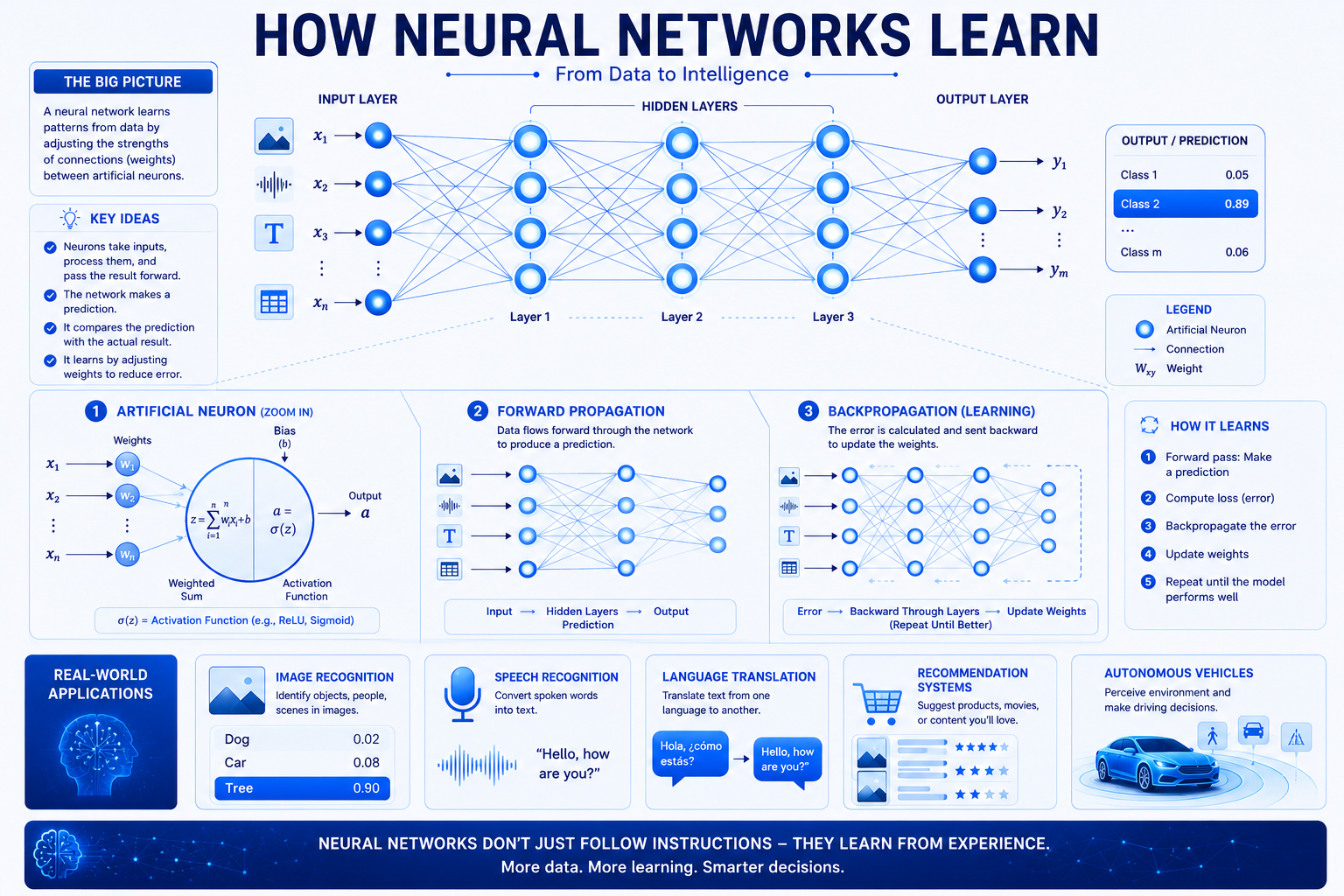
Every time your phone unlocks using Face ID, a self-driving car recognizes a pedestrian, or an AI chatbot generates a human-like response, there's a good chance a Neural Network is working behind the scenes.
Neural Networks are the foundation of modern Artificial Intelligence (AI). They power image recognition, speech assistants, recommendation systems, language translation, fraud detection, medical diagnosis, and today's revolutionary Generative AI models.
Although the term "Neural Network" may sound intimidating, the core idea is surprisingly intuitive: build a system of interconnected mathematical units that can learn patterns from data.
In this guide, you'll learn what neural networks are, how artificial neurons work, how they learn, the different types of neural networks, and why they have become one of the most powerful tools in AI.
A Neural Network, also called an Artificial Neural Network (ANN), is a Machine Learning model inspired by the way neurons in the human brain communicate.
Instead of following rigid rules, a neural network learns by analyzing examples. Over time, it adjusts its internal parameters so it can recognize patterns, make predictions, or classify information.
A Neural Network is a computational model made up of interconnected artificial neurons that learn patterns from data by adjusting mathematical weights during training.
Think of it as a network of tiny decision-makers working together to solve complex problems.
Traditional Machine Learning algorithms work well for many structured datasets, but they often struggle with highly complex information such as:
Neural Networks excel at discovering hidden patterns in these types of data without requiring developers to manually define every feature.
This ability has made them the driving force behind modern AI.
Neural Networks were inspired by biology, but they are not miniature digital brains.
Here's a simple comparison:
| Human Brain | Artificial Neural Network |
|---|---|
| Billions of biological neurons | Artificial mathematical neurons |
| Learns through life experiences | Learns from training data |
| Uses electrical and chemical signals | Uses mathematical calculations |
| Highly energy efficient | Requires significant computing power for large models |
| Conscious and self-aware | No consciousness or awareness |
While inspired by neuroscience, artificial neural networks are simplified mathematical models rather than true simulations of the brain.
The smallest building block of a neural network is the artificial neuron.
Each neuron performs a simple task:
One neuron alone isn't very powerful.
Millions—or even billions—working together can solve remarkably complex problems.
Inputs are the information entering the neuron.
For example, if we're predicting house prices:
Each becomes an input.
Not every input is equally important.
For house prices:
The network learns these importance values automatically.
These importance values are called weights.
After processing the inputs, the neuron produces an output.
That output becomes input for neurons in the next layer.
Neurons are organized into layers.
Input Layer

↓

Hidden Layer

↓

Hidden Layer

↓

Hidden Layer

↓

Output Layer
The input layer receives raw data.
Examples:
For an image:
For text:
For medical data:
The input layer does not make decisions.
It simply forwards information.
This is where learning happens.
Each hidden layer extracts increasingly sophisticated patterns.
Example:
Image Recognition
Layer 1
Learns edges
↓
Layer 2
Learns corners
↓
Layer 3
Learns eyes
↓
Layer 4
Learns faces
↓
Layer 5
Recognizes specific people
Every additional layer allows the model to represent more complex relationships.
The final layer produces the prediction.
Examples:
Learning is an iterative process rather than a single event.
A neural network improves by repeatedly comparing its predictions with the correct answers and adjusting itself.
Data enters the network.
Information flows through every layer until the network makes a prediction.
Example:
Image →
Neural Network →
Prediction:
Dog
Suppose the correct answer was:
Cat
The network now measures how wrong its prediction was.
This measurement is called the loss (or error).
The network traces the error backward through the layers.
It identifies which weights contributed most to the mistake and updates them to improve future predictions.
This learning mechanism is called backpropagation.
The network repeats this process thousands—or even millions—of times.
Over time, predictions become increasingly accurate.
Imagine judging whether someone is likely to enjoy a movie.
You might consider:
Initially, you may treat all factors equally.
After observing many people's preferences, you realize genre and reviews matter more than runtime.
Neural Networks learn in the same way by adjusting the importance (weights) of different inputs.
Not every neuron should always pass information forward.
An activation function decides whether a neuron's output should influence the next layer.
Without activation functions:
Popular activation functions include:
You don't need to understand the mathematics to appreciate their purpose: they introduce the non-linearity that allows neural networks to model real-world complexity.
Many beginners confuse these two concepts.
The model learns.
It updates millions of weights using labeled data.
Training is computationally expensive.
The model has already learned.
It simply makes predictions.
Inference is what happens when you:
Different problems require different architectures.
The simplest neural network.
Information moves in one direction:
Input →
Hidden →
Output
Best for:
Designed specifically for images.
Excellent for:
CNNs automatically learn visual features such as edges, textures, and shapes.
Designed for sequential information.
Examples:
RNNs can remember previous information in a sequence, although they have largely been replaced by Transformers for many language tasks.
LSTMs are a specialized type of RNN that handle long-term dependencies more effectively.
Applications include:
Transformers have become the dominant architecture for modern language AI.
They power:
Transformers can process relationships across long sequences efficiently, making them well suited for natural language and beyond.
Neural Networks power technologies that millions of people use every day.
They can solve problems that are difficult to describe using traditional rules.
They reduce the need for manual feature engineering.
When trained with sufficient high-quality data, neural networks often achieve state-of-the-art performance.
They work across images, text, audio, video, and structured data.
Larger models trained on more data can often tackle increasingly sophisticated tasks.
Training effective models typically requires significant amounts of quality data.
Modern neural networks often require GPUs or specialized hardware.
It can be difficult to understand exactly why a deep neural network made a particular prediction.
Large models may take days or weeks to train.
If not carefully designed and evaluated, models may memorize training data rather than learning general patterns.
No.
They perform mathematical computations and pattern recognition. They do not possess consciousness or human understanding.
Not necessarily.
Architecture, data quality, and training methods often matter more than simply increasing model size.
Traditional Machine Learning algorithms remain excellent choices for many structured data problems.
Not exactly.
Deep Learning refers to neural networks with multiple hidden layers. A simple neural network is the foundation; deep learning extends that idea by stacking many layers.
Because they were inspired by how biological neurons communicate, although they are much simpler mathematical models.
They learn from training data provided during the training process. They do not independently decide what to learn without guidance or objectives.
Transformers process long-range relationships in data more efficiently than earlier architectures like RNNs, making them particularly effective for language and many multimodal tasks.
Neural Networks have become the backbone of modern Artificial Intelligence. Their ability to learn from data rather than relying solely on manually programmed rules has enabled breakthroughs across healthcare, transportation, finance, education, and creative technologies.
Understanding how artificial neurons, layers, weights, and training work provides a strong foundation for exploring more advanced AI concepts. In the next stage of your learning journey, you'll discover how Supervised Learning uses labeled data to train models for tasks such as spam detection, disease diagnosis, and price prediction.
Pixels to Perfection Design that Impresses