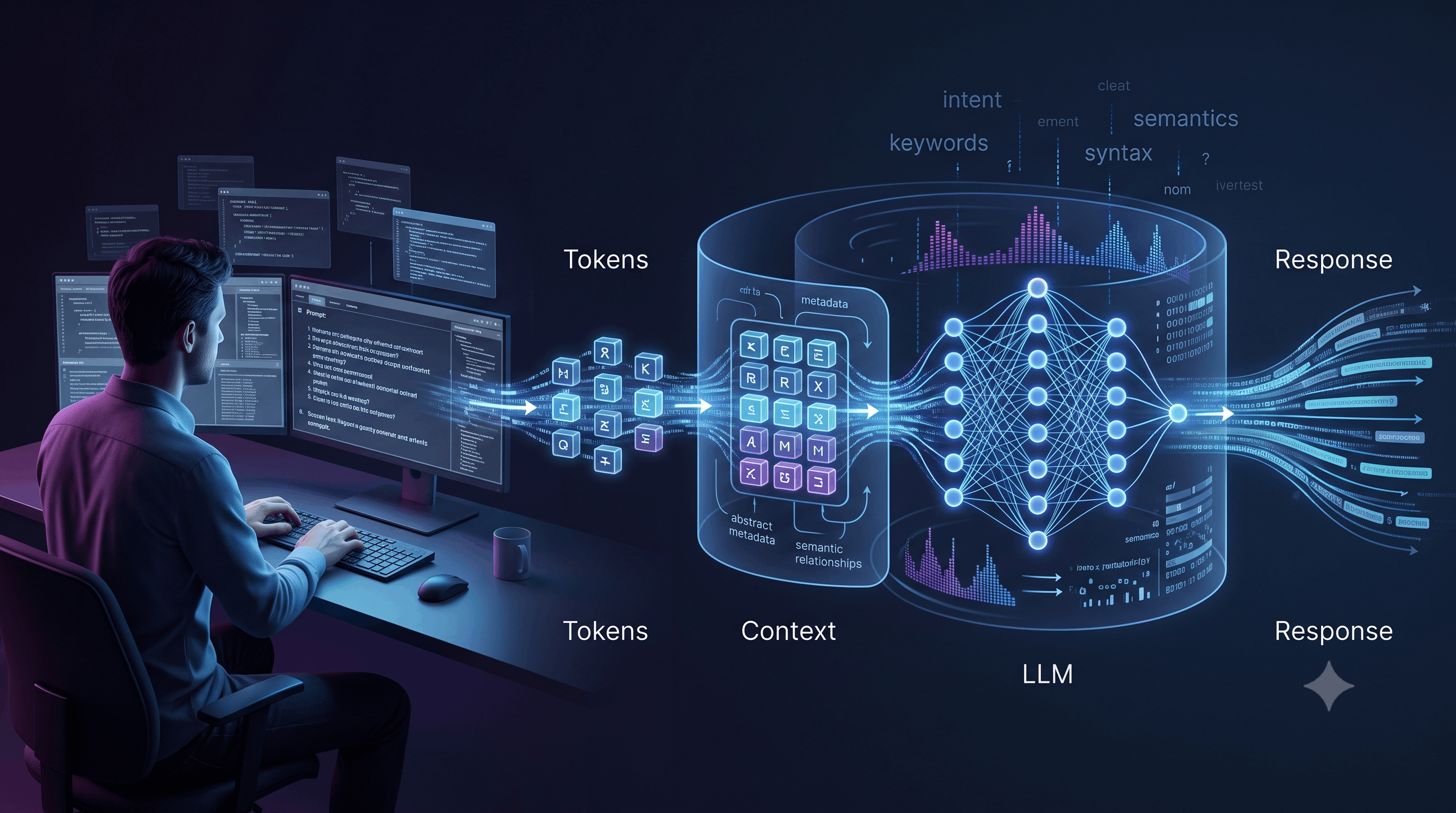
Rahul
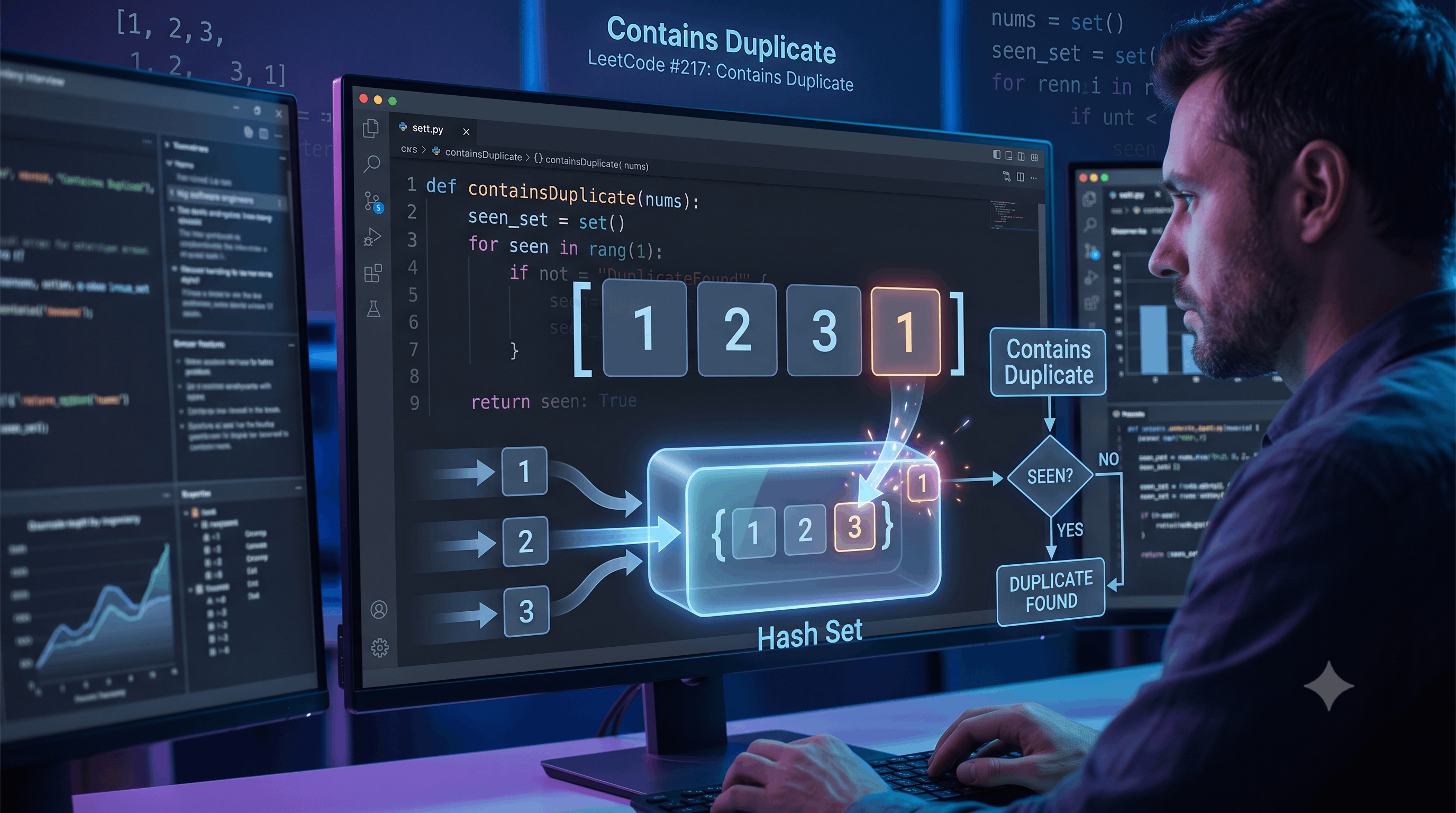 LeetCode #217: Contains Duplicate — Master Hash Sets and Fast Lookup
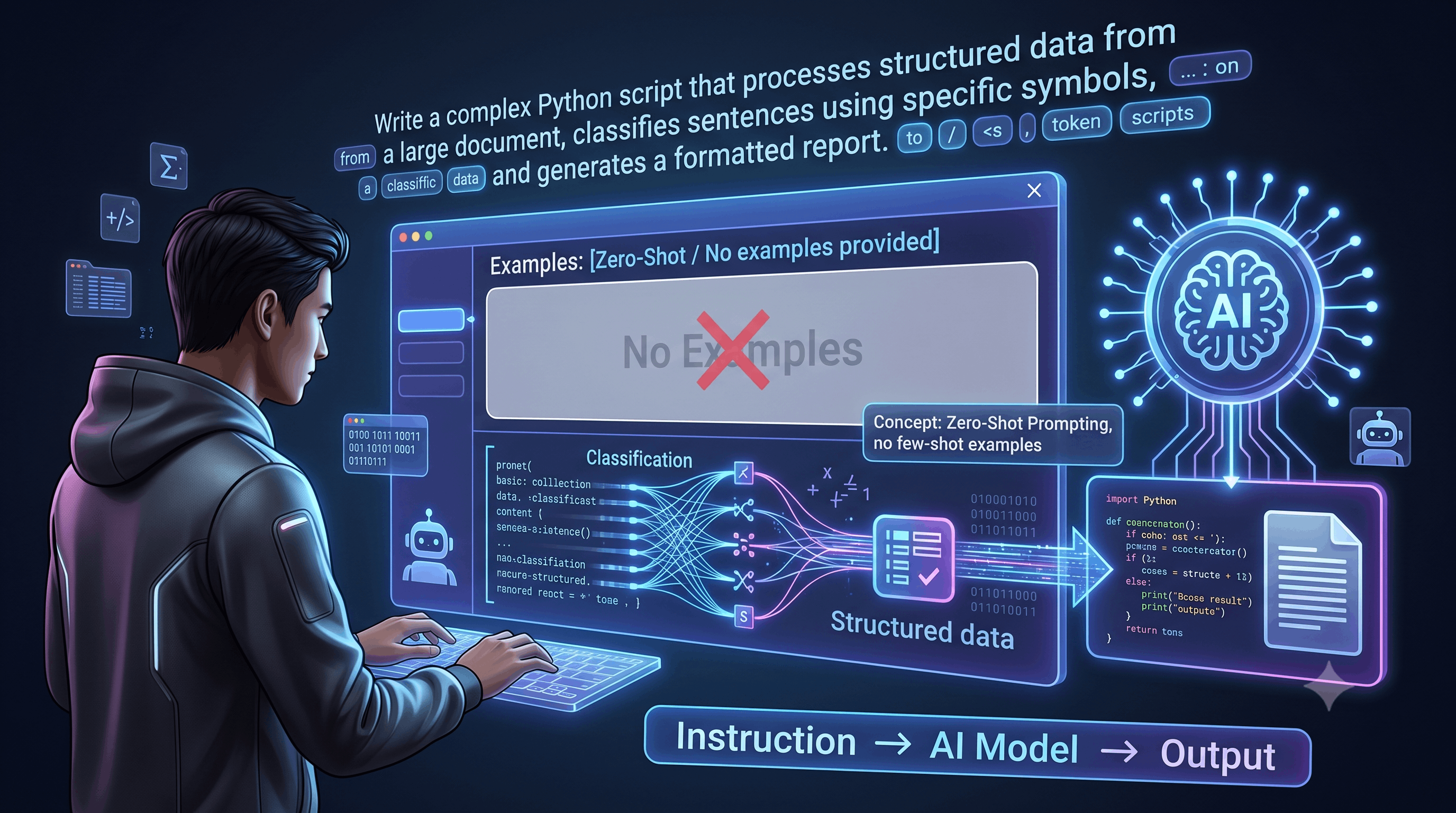 Zero-Shot Prompting Explained: How to Get AI to Perform Tasks Without Examples
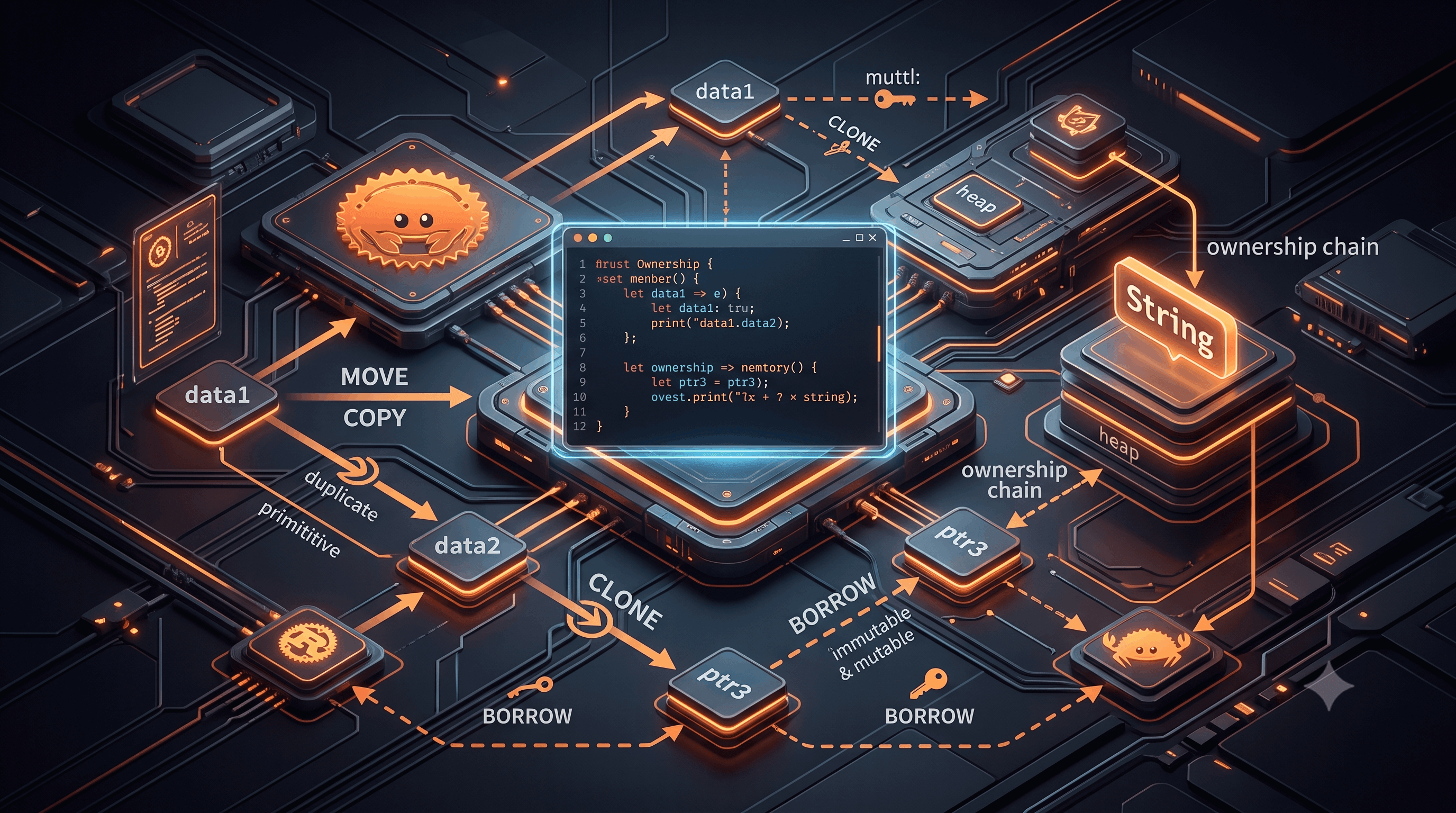 Rust Ownership: The Concept That Makes Rust Different
 How to Start a Laundry Business in India: Investment, Machines, Pricing, Profit & Technology — Building a Laundry Brand Beyond Washing Clothes
 Merge Sort Explained: Divide and Conquer from Scratch
 Dissecting the High-Level System Architecture of Booking.com
 Kanban vs. Scrum: Which Agile Methodology to Choose?
 The Scaling Journey of LinkedIn: From Startup to Professional Powerhouse
 Mastering Code Review: A Guide for Reviewers and PR Creators
 ChatGPT: Unveiling the Power of AI in Conversational Experiences with Kairos Coders

Kairos Coders are here to help
When you type:
"How do I build an AI application?"
you might imagine that an AI model receives the sentence exactly as you see it.
It doesn't.
Before a modern language model can process your text, the text usually passes through a process called:
Tokenization converts text into smaller units called tokens.
Those tokens are then mapped to numerical IDs, which can be converted into vectors and processed by a neural network.
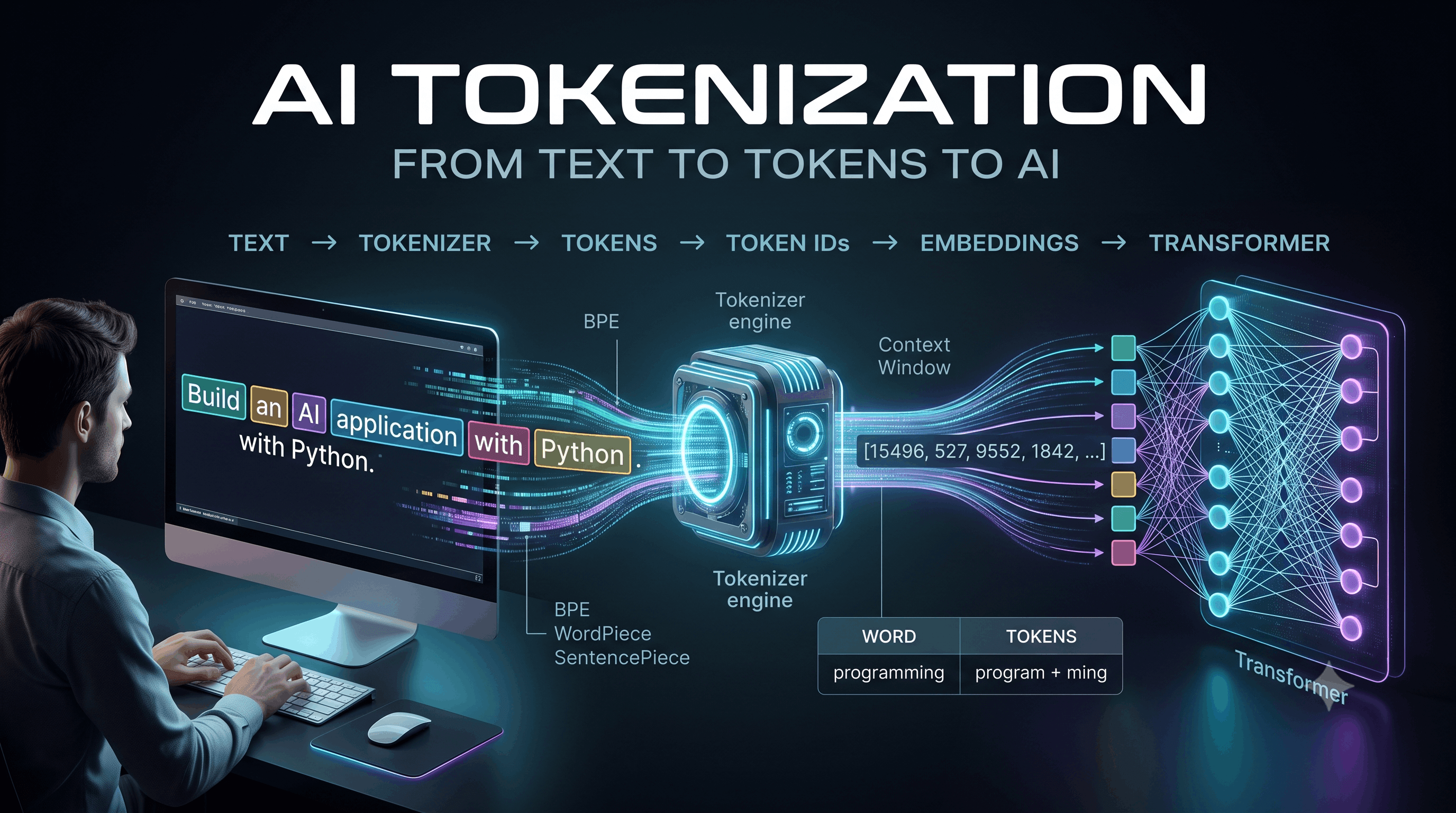
The simplified pipeline is:
Human Text
    ↓
Tokenizer
    ↓
Tokens
    ↓
Token IDs
    ↓
Embeddings
    ↓
Transformer
    ↓
Prediction
This seemingly simple step is fundamental to how modern Large Language Models process language.
And understanding tokenization will make many AI concepts much easier to understand.
Tokenization is the process of converting text into smaller units called tokens so that a language model can process the text numerically.
For example:
"Hello world"
might conceptually become:
["Hello", "world"]
But modern LLM tokenizers often use subword or byte-level units, so the actual result may look different.
For example:
"unbelievable"
could potentially be represented as multiple pieces rather than one whole word.
The exact tokenization depends on the tokenizer.
Computers work with numbers.
A neural network cannot directly perform matrix operations on:
"Hello"
Instead, the text needs to become numerical data.
The process looks approximately like:
"Hello"
   ↓
Token
   ↓
Token ID
   ↓
Embedding Vector
   ↓
Neural Network
This connects natural language to mathematical computation.
There are several possible ways to split text.
Consider:
"I love programming."
I
(space)
l
o
v
e
...
This can create extremely long sequences.
I
love
programming
.
This is simpler but has limitations.
A tokenizer can divide words into reusable pieces.
For example, conceptually:
program + ming
or:
program + ing
The exact split depends on the tokenizer.
Modern language models commonly use tokenization strategies that operate at the subword or byte level.
A token is a unit produced by a tokenizer.
A token can represent:
For example:
Hello, world!
could be represented by a tokenizer using pieces corresponding to:
Hello
,
 world
!
The exact tokens vary by tokenizer.
This is important:
There is no universal tokenization of text.
Different models can tokenize the same sentence differently.
Consider:
I love Python.
A conceptual tokenizer might produce:
["I", " love", " Python", "."]
Notice something interesting.
The space can sometimes be incorporated into a token representation.
That's because modern tokenizers aren't necessarily simply:
split(" ")
They can use learned vocabularies and byte-level rules.
Tokens themselves are still not what the neural network directly manipulates.
Each token corresponds to an integer ID in the tokenizer's vocabulary.
For example, conceptually:
"I"       → 42
" love"   → 381
" Python" → 9271
"."       → 13
These numbers are illustrative only.
A real tokenizer has its own vocabulary and IDs.
So:
Text
 ↓
Tokens
 ↓
Token IDs
A tokenizer has a vocabulary containing the token units it knows how to represent.
Imagine a tiny vocabulary:
0 → <PAD>
1 → <UNK>
2 → I
3 → love
4 → Python
5 → .
Then:
"I love Python."
could become:
[2, 3, 4, 5]
Real LLM vocabularies are far larger and often contain many subword or byte-level tokens.
At first glance, a word-based vocabulary seems attractive.
Suppose we build a vocabulary containing:
cat
dog
computer
programming
developer
...
But language contains enormous numbers of possible words, names, spellings, and variations.
Consider:
program
programming
programmer
programmers
programmed
programmable
If every variation were treated as an entirely separate vocabulary item, the vocabulary could become unnecessarily large.
Subword tokenization provides a useful compromise.
Subword tokenization breaks uncommon words into smaller reusable pieces.
Imagine:
"programming"
becoming:
"program" + "ming"
Then the same pieces can potentially help represent:
program
programming
programmer
programmed
The actual segmentation depends on the tokenizer.
This approach gives models a balance between:
Word-level representation
and:
Character-level representation
Consider an unusual word:
"microservice"
A tokenizer may have a token for:
micro
and another for:
service
Instead of requiring:
"microservice"
to exist as a single vocabulary item.
This allows the tokenizer to handle many previously unseen or uncommon combinations.
Older word-level tokenization approaches often faced the out-of-vocabulary problem.
Suppose the vocabulary contains:
cat
dog
computer
Then the model encounters:
QuantumCryptography
If the whole word isn't in the vocabulary, a simple word tokenizer may need an unknown token:
<UNK>
Subword approaches reduce this problem because unfamiliar words can often be decomposed into smaller known pieces.
One important tokenization approach is:
BPE originated as a compression technique and was later adapted for tokenization.
The basic intuition is:
Frequently occurring sequences can be merged into reusable units.
Imagine starting with small units:
a
b
c
d
...
and discovering that:
t + h
frequently occurs.
You can merge them:
th
Then perhaps:
th + e
becomes:
the
Through repeated merging, a vocabulary of useful pieces emerges.
Modern implementations can operate at different levels, including byte-level variants.
Imagine training data contains:
play
player
playing
played
The tokenizer may discover reusable pieces.
Conceptually:
play
play + er
play + ing
play + ed
Now the same pieces can represent many words.
Again, the exact behavior depends on the tokenizer and training process.
WordPiece is another subword tokenization approach.
It became particularly associated with Transformer-based NLP systems such as BERT.
Instead of simply applying the exact same merging procedure as BPE, WordPiece uses a vocabulary-learning strategy designed around useful subword units and likelihood objectives.
The practical result is similar in spirit:
Words
 ↓
Subword pieces
 ↓
Token IDs
SentencePiece is a tokenizer framework that treats text as a sequence of symbols and can train tokenization models without requiring traditional whitespace-based word boundaries.
This is particularly useful for multilingual systems and languages where whitespace does not naturally separate words in the same way as English.
SentencePiece has been used with approaches such as:
Language models often use special tokens that aren't ordinary words.
Examples can include conceptual tokens such as:
<BOS>
Beginning of sequence.
<EOS>
End of sequence.
<PAD>
Padding.
<UNK>
Unknown token.
Modern chat models can also use special control structures to distinguish different message roles or formatting.
The exact special-token vocabulary depends on the model.
Now connect this article with the previous one.
We learned:
Text
 ↓
Embedding
But there's an important intermediate step.
A simplified LLM pipeline looks like:
Text
 ↓
Tokenizer
 ↓
Token IDs
 ↓
Embedding Lookup
 ↓
Vectors
 ↓
Transformer
For example:
"Hello AI"
      ↓
["Hello", " AI"]
      ↓
[15496, 9552]
      ↓
Embedding vectors
      ↓
Transformer
The numbers here are only illustrative.
Suppose the model has a token vocabulary of 50,000 tokens.
Each token has an associated vector.
Conceptually:
Token ID 0  → Vector 0
Token ID 1  → Vector 1
Token ID 2  → Vector 2
...
Token ID 49,999 → Vector 49,999
When a token ID arrives, the model retrieves its corresponding vector.
This is essentially an embedding-table lookup.
Once tokens have become vectors, the Transformer can process them.
A simplified view:
Text
 ↓
Tokenizer
 ↓
Token IDs
 ↓
Embeddings
 ↓
Positional / position-related information
 ↓
Transformer Layers
 ↓
Output Logits
 ↓
Next Token
This is the bridge from raw text to neural computation.
Every language model has a limit on how many tokens it can process within a particular context.
This is commonly called the:
For example, a hypothetical model might support:
128,000 tokens
Another model might support a different context length.
The important point is:
Context limits are generally measured in tokens, not words.
Consider:
"I am learning machine learning."
That's only a few words.
But tokenization may produce a different number of tokens depending on the tokenizer.
Therefore:
Words ≠ Tokens
This matters when working with:
Many AI services price usage based partly on tokens.
A simplified pricing model might look like:
Input Tokens × Input Price
+
Output Tokens × Output Price
Therefore, token efficiency can matter when building production AI applications.
For example:
Huge Prompt
 ↓
100,000 tokens
 ↓
Higher cost
versus:
Optimized Prompt
 ↓
20,000 tokens
 ↓
Lower cost
Exact pricing varies by provider and model, so token economics should always be checked against the specific service being used.
Suppose your prompt contains:
"Build a scalable microservices architecture."
You might count:
6 words
But the tokenizer could produce a different number of tokens.
This is why developers working with LLMs should think in terms of tokens, not just words or characters.
Tokenization efficiency can vary dramatically between languages.
For example, a tokenizer trained heavily on English data may represent English text relatively efficiently.
Other languages may require more tokens for the same amount of semantic content.
This can affect:
Multilingual tokenizer design therefore matters enormously for global AI systems.
Tokenizers can process code too.
Consider:
def hello():
    print("Hello World")
The tokenizer doesn't necessarily see:
def
hello
(
)
:
as simple words.
It may divide the code into a mixture of programming-language pieces, symbols, whitespace patterns, and other tokens.
This allows LLMs to process:
and many other forms of code.
Imagine:
getUserById()
A tokenizer might represent parts of this identifier using reusable pieces.
Likewise:
HTTP
GET
/api/users
contains punctuation and symbols that need to be represented.
Good tokenization helps language models handle programming syntax efficiently.
Numbers can be interesting.
Consider:
123456789
A tokenizer might represent the number as one token or several tokens depending on its vocabulary and tokenization scheme.
Similarly:
3.1415926535
may be divided into multiple pieces.
This is one reason LLMs can sometimes struggle with precise arithmetic: tokenization and neural representation are not equivalent to having a dedicated mathematical calculator.
Consider:
🔥 🚀 ❤️
These aren't necessarily one token each.
Depending on the tokenizer, Unicode characters and emoji sequences may be represented by multiple token pieces.
This can affect token counts.
Let's follow a real conceptual pipeline.
You type:
Explain recursion in Python.
"Explain recursion in Python."
The tokenizer converts it into token pieces.
Conceptually:
["Explain", " recursion", " in", " Python", "."]
The exact output depends on the tokenizer.
[ID₁, ID₂, ID₃, ID₄, ID₅]
Each token ID maps to a vector.
ID
 ↓
Embedding Vector
The vectors pass through Transformer layers.
Vectors
 ↓
Attention
 ↓
Feed-Forward Networks
 ↓
More Transformer Layers
The model produces scores for possible next tokens.
"Recursion"
0.42

"is"
0.18

"can"
0.11

...
The model then selects or samples a next token according to its decoding strategy.
The generated token becomes part of the growing sequence.
Prompt
 ↓
Next Token
 ↓
Next Token
 ↓
Next Token
 ↓
...
Eventually, the generated tokens are decoded back into text.
During training, huge collections of text are processed.
The pipeline looks like:
Training Corpus
      ↓
Tokenizer
      ↓
Token IDs
      ↓
Model
      ↓
Prediction
      ↓
Loss
      ↓
Backpropagation
      ↓
Parameter Updates
The tokenizer itself is usually established as part of the model's design and training pipeline rather than being dynamically relearned from scratch during every inference request.
When you use a trained LLM:
Your Prompt
    ↓
Same tokenizer family / configured tokenizer
    ↓
Token IDs
    ↓
Model
    ↓
Generated Tokens
    ↓
Decoded Text
The tokenizer is an essential part of the model ecosystem.
You generally shouldn't assume that a tokenizer from one model will produce identical IDs or token boundaries for another model.
This is important for developers.
You might see:
"hello" → 15339
and assume:
hello = 15339
forever.
That's incorrect.
Token IDs depend on the tokenizer's vocabulary.
Another tokenizer could assign a completely different ID.
So:
Tokenizer A:
hello → 15339

Tokenizer B:
hello → 9821
could both be perfectly valid.
These are two different components.
Converts:
Text
 ↓
Tokens
 ↓
Token IDs
Converts information into:
Vector Representation
In a language model:
Text
 ↓
Tokenizer
 ↓
Token IDs
 ↓
Embedding Layer
 ↓
Transformer
In a dedicated semantic-search system:
Text
 ↓
Embedding Model
 ↓
Embedding Vector
The second setup doesn't necessarily expose the same tokenization/embedding process as an LLM's internal architecture.
Remember our previous article?
RAG systems often perform:
Document
 ↓
Chunking
 ↓
Embedding
 ↓
Vector Database
Tokenization matters because the LLM ultimately has a token-based context limit.
Suppose you retrieve:
100 huge chunks
You may exceed the model's context capacity.
A better pipeline considers:
Document
 ↓
Chunk
 ↓
Token Count
 ↓
Embedding
 ↓
Retrieval
 ↓
Context Selection
 ↓
LLM
Token awareness is therefore an important part of production RAG design.
False.
A word can become:
1 token
or:
2 tokens
or:
many tokens
depending on the tokenizer.
Also false.
Tokenizers can represent multiple characters as one token or split characters into multiple pieces.
A token can be:
part of a word
punctuation
whitespace-related text
symbol
byte-level unit
Tokens aren't necessarily semantic concepts.
If you're building an LLM application, you need to understand the model's context capacity.
Token IDs and token boundaries are tokenizer-specific.
Use the tokenizer associated with the model or service you're working with.
Tokenization also matters when writing prompts.
Suppose you're building an AI application that sends:
50,000 tokens
of instructions and documents for every request.
That's potentially inefficient.
You may improve the architecture by:
Large Context
     ↓
Retrieval
     ↓
Relevant Information
     ↓
Smaller Prompt
     ↓
LLM
This is one reason RAG can be more practical than simply putting an entire knowledge base into every prompt.
Modern models support increasingly large context windows, but larger context doesn't eliminate the need for good information management.
If your application has:
1 million tokens of data
you may still not want to send all of it for every question.
Instead:
1M tokens
   ↓
Search / Retrieval
   ↓
Relevant 10K tokens
   ↓
LLM
This reduces unnecessary computation and can improve relevance.
At this point, we can connect the previous three articles.
We learned:
Neural Networks
We learned:
Embeddings
We learned:
Tokenization
Together:
Human Language
      ↓
Tokenization
      ↓
Token IDs
      ↓
Embeddings
      ↓
Neural Network
      ↓
Transformer
      ↓
Prediction
      ↓
Generated Token
      ↓
Text
This is the foundation for understanding how modern LLMs process language.
A token is a unit produced by a tokenizer from text. It can represent a word, part of a word, punctuation, whitespace-related content, or other symbols.
No. A word can be represented by one or multiple tokens depending on the tokenizer.
Tokenization converts text into token units that can subsequently be mapped to numerical IDs.
A token ID is an integer identifying a particular token in a tokenizer's vocabulary.
Byte Pair Encoding is a tokenization approach based on creating reusable units through frequent pair merging; modern implementations may use byte-level variants.
WordPiece is a subword tokenization method strongly associated with models such as BERT.
SentencePiece is a tokenization framework that can learn subword segmentation directly from text without requiring conventional whitespace tokenization.
Tokens provide a practical balance between vocabulary size, sequence length, and the ability to represent unfamiliar words and symbols.
Not necessarily. A token can be a semantic word, a subword, punctuation, whitespace-related pattern, or other unit.
Token counts can affect context usage, latency, and—in many services—cost.
No. Token IDs are specific to a tokenizer vocabulary.
Typically:
Token IDs
 ↓
Embeddings
 ↓
Transformer
for a language model.
When you type:
"Build an AI application."
the model doesn't simply receive those words as humans perceive them.
Instead, the journey looks roughly like:
"Build an AI application."
             ↓
         Tokenizer
             ↓
     Token Pieces
             ↓
         Token IDs
             ↓
        Embeddings
             ↓
       Transformer
             ↓
      Neural Network
             ↓
     Next-Token Scores
             ↓
       Generated Token
             ↓
            Text
And that explains something fundamental about Large Language Models:
LLMs operate on numerical representations of token sequences, not directly on human-readable words.
Once you understand this pipeline, the architecture of modern AI starts becoming much less mysterious.
But we've reached an even more interesting question.
We know that:
Text
 ↓
Tokens
 ↓
Vectors
But how does the model understand which tokens are related to which other tokens?
How does it know that in:
"The developer opened the laptop because it was slow."
the word "it" is related to something earlier in the sentence?
How can a model connect information separated by dozens, hundreds, or thousands of tokens?
The answer is one of the most revolutionary ideas in modern AI:
Pixels to Perfection Design that Impresses