Rahul
 LeetCode #155: Min Stack — Design a Stack with O(1) Minimum Retrieval
 LeetCode #20: Valid Parentheses — Master the Stack Pattern
 LeetCode #15: 3Sum — Master Sorting, Two Pointers and Duplicate Handling
 Instruction vs Context in AI Prompts: How to Tell AI What to Do and What Information to Use
 Rust Structs and Enums: Building Powerful Data Models
 Dissecting the High-Level System Architecture of Booking.com
 Kanban vs. Scrum: Which Agile Methodology to Choose?
 The Scaling Journey of LinkedIn: From Startup to Professional Powerhouse
 Mastering Code Review: A Guide for Reviewers and PR Creators
 ChatGPT: Unveiling the Power of AI in Conversational Experiences with Kairos Coders

Kairos Coders are here to help

Rust has become one of the most exciting programming languages for developers who care about performance, reliability, security, and modern software development.
From operating systems and command-line tools to web servers, cloud infrastructure, game engines, embedded systems, and WebAssembly, Rust is being used in areas where speed and correctness matter.
But what makes Rust different from languages such as C++, Java, Python, or JavaScript?
The answer comes down to one powerful idea:
Rust gives developers low-level control without forcing them to give up modern safety.
In this first article of our Rust Programming: Beginner to Expert series, we'll understand what Rust is, why it was created, where it is used, how it compares with other languages, and what you can expect to learn throughout this series.
Rust is a systems programming language designed to provide:
Rust was originally created by Graydon Hoare and was later sponsored and developed by Mozilla. Today, Rust is developed through the Rust project and its global community.
Rust is a compiled language, meaning your source code is transformed into machine code before execution.
A very simple Rust program looks like this:
fn main() {
    println!("Hello, Rust!");
}
Although this program is tiny, it introduces several fundamental ideas we'll explore throughout this series.
To understand Rust, it helps to understand the problems developers have historically faced with systems programming.
Languages such as C and C++ provide extremely high performance and direct control over memory and hardware.
However, that control comes with significant responsibility.
Developers can accidentally introduce bugs involving:
Some of these bugs can cause crashes.
Others can create serious security vulnerabilities.
Rust was designed to address many of these problems at compile time.
Instead of discovering certain classes of bugs after the application crashes, Rust's compiler attempts to prevent them before the program is allowed to run.
This philosophy is one of Rust's biggest strengths.
Rust can be summarized through three major goals:
Rust is designed to produce highly efficient native machine code.
It does not require a traditional garbage collector.
This makes Rust suitable for performance-sensitive applications.
Rust's ownership and borrowing system prevents many memory-related problems at compile time.
Rust provides modern features such as:
The goal is to combine the control of a systems language with abstractions expected from a modern programming language.
Rust is compiled into native machine code.
For example:
fn main() {
    let numbers = [10, 20, 30, 40, 50];

    for number in numbers {
        println!("{}", number);
    }
}
A Rust compiler can optimize this program into highly efficient machine instructions.
Rust also avoids the runtime garbage collection pauses associated with some languages.
This doesn't mean every Rust program is automatically faster than every program written in another language.
Performance depends on:
However, Rust provides the tools necessary to build extremely high-performance software.
Memory management is one of the most important concepts in Rust.
Languages such as Python and JavaScript use garbage collection to automatically manage memory.
C and C++ generally give developers much more direct responsibility for memory.
Rust takes a different approach.
It uses a system called:
Ownership
Ownership is enforced by the compiler.
Consider:
fn main() {
    let name = String::from("Rust");

    println!("{}", name);
}
The variable name owns the String.
When name goes out of scope, Rust automatically knows that the memory associated with the string can be released.
No garbage collector is required.
Later in this series, we'll explore ownership in much greater depth because it is one of the most important concepts you must understand to become proficient in Rust.
Ownership is based on a few fundamental rules.
At a high level:
For example:
fn main() {
    let message = String::from("Hello Rust");

    println!("{}", message);
}
Here, message owns the string.
Rust automatically handles the cleanup when message leaves its scope.
This provides memory safety without requiring a garbage collector.
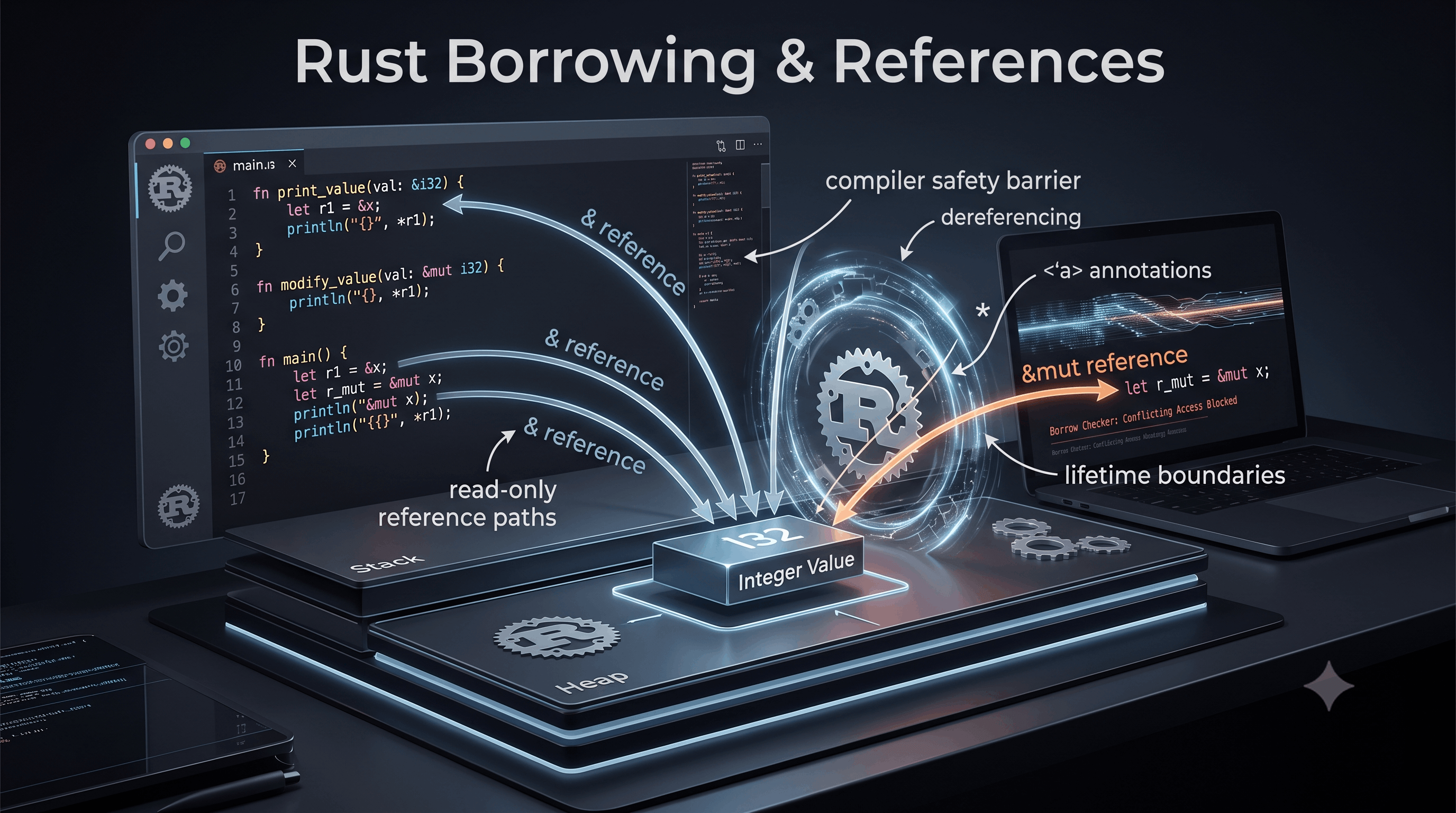
Sometimes you don't want to transfer ownership.
You simply want another part of your program to temporarily use a value.
Rust allows this through borrowing.
fn print_message(message: &String) {
    println!("{}", message);
}

fn main() {
    let message = String::from("Hello Rust");

    print_message(&message);

    println!("{}", message);
}
The & means that the function is borrowing the value rather than taking ownership of it.
This concept becomes extremely important as Rust programs become larger.
One of the most interesting things about Rust is that many incorrect programs simply won't compile.
For example:
fn main() {
    let number = 10;

    number = 20;
}
This produces a compilation error because variables are immutable by default.
If you want a variable to be changed, you explicitly declare it as mutable:
fn main() {
    let mut number = 10;

    number = 20;

    println!("{}", number);
}
This explicit behavior is part of Rust's design philosophy.
The language encourages developers to make important decisions visible in the code.
Rust is often compared with C++ because both are suitable for systems programming.
C++ provides:
But C++ also gives developers considerable responsibility for memory management and safety.
Rust provides:
A simplified comparison looks like this:
| Feature | Rust | C++ |
|---|---|---|
| Native performance | Excellent | Excellent |
| Garbage collector | No | No |
| Memory safety | Strong compile-time guarantees | Developer responsibility |
| Ownership system | Yes | No equivalent |
| Package manager | Cargo | Multiple ecosystems |
| Compile-time checks | Very strong | Strong |
| Learning curve | Moderate/High | High |
| Systems programming | Excellent | Excellent |
Rust isn't necessarily a replacement for C++ in every situation.
However, it offers a compelling alternative for developers who want systems-level performance with stronger safety guarantees.
Python and Rust are very different languages.
Python prioritizes developer productivity and simplicity.
Rust prioritizes performance, safety, and control.
For example, Python allows you to write:
print("Hello Python")Rust requires a little more structure:
fn main() {
    println!("Hello Rust!");
}
Python is generally easier for beginners.
Rust has a steeper learning curve.
However, Rust gives you significantly more control over memory and performance.
The two languages can also work together.
Rust can be used to implement performance-critical components while Python handles higher-level application logic.
JavaScript dominates web development, particularly in frontend development.
Rust is more commonly used for:
Rust can also compile to WebAssembly, allowing Rust code to run in web browsers.
This opens interesting possibilities for applications where JavaScript performance isn't sufficient for a particular workload.
Rust isn't limited to one type of application.
You can build many different types of software.
Rust is excellent for CLI tools.
For example:
mytool --input data.txtYou can build utilities for:
Rust can be used to create high-performance backend services.
Popular frameworks and libraries include:
For example, a Rust backend could provide:
GET /users
POST /users
GET /products
POST /orders
Later in this series, we'll build complete APIs.
Rust can be used for low-level systems development.
It provides enough control to interact closely with:
Rust is increasingly being explored and adopted for systems-level components.
Rust can also be used for embedded programming.
This includes software running on:
Rust's safety guarantees can be particularly valuable in systems where reliability matters.
Rust has become one of the important languages in the WebAssembly ecosystem.
You can compile Rust into WebAssembly and run it inside environments such as web browsers.
This makes it possible to use Rust for computationally intensive browser applications.
Rust can also be used for game development.
One popular ecosystem is:
Bevy
Bevy is a Rust-based game engine focused on modern game development.
Rust can also be useful for building:
Rust is widely used in parts of the blockchain ecosystem because of its:
It can be used for implementing protocols, nodes, smart-contract environments, and supporting infrastructure.
Rust isn't simply an experimental programming language.
It is used across the technology industry.
Rust has been adopted or used by organizations and projects including:
Its adoption has grown particularly in areas where reliability and performance are important.
Rust has consistently attracted attention from developers because of the combination of:
Performance + Safety + Modern Tooling
Its compiler is also famous for providing detailed error messages.
For beginners, compiler errors can initially feel intimidating.
For example, Rust might tell you:
error[E0382]: borrow of moved valueAt first, this may seem complicated.
But Rust's compiler generally provides additional information explaining what happened and often points toward possible solutions.
Over time, the compiler becomes less of an obstacle and more like a programming teacher.
One of the most important mindset changes when learning Rust is understanding that the compiler is actively checking your assumptions.
Imagine writing:
let data = String::from("Hello");

let a = data;
let b = data;
Rust will reject this because ownership has been moved.
Instead of allowing potentially unsafe behavior, the compiler forces you to understand what should happen with the value.
This can make Rust feel difficult initially.
But that difficulty is intentional.
Once you understand ownership, borrowing, lifetimes, and traits, many Rust concepts begin to fit together.
Rust comes with an extremely useful tool called Cargo.
Cargo handles tasks such as:
You can create a new project with:
cargo new hello_rustThen enter the project:
cd hello_rustRun it:
cargo runCargo will compile and execute your program.
This makes Rust development much easier to manage as projects grow.
We'll explore Cargo in detail in a future article.
Rust's ecosystem is organized around crates.
A crate is essentially a Rust package or compilation unit.
Developers can publish libraries that other developers can use.
For example, you might add a dependency to your Cargo.toml file:
[dependencies]
serde = "1"
Then use it in your project.
This ecosystem allows developers to reuse existing libraries instead of implementing everything from scratch.
Yes — initially.
But difficult doesn't mean impossible.
Rust has concepts that beginners may not encounter in languages such as Python or JavaScript.
The biggest challenges are usually:
The good news is that these concepts aren't random.
They form a coherent system.
Once ownership and borrowing become intuitive, many other Rust concepts become easier.
There is no universal timeline.
But a practical progression might look like:
Learn:
Learn:
Learn:
Learn:
That's exactly the journey we'll follow in this series.
Rust is especially valuable if you're interested in:
You don't need to become a systems programmer to benefit from learning Rust.
Even web developers can gain a deeper understanding of:
Rust isn't necessarily the best first choice for every project.
If you want to quickly build:
Python may be more productive.
If you're building a typical frontend web application, JavaScript or TypeScript may be the natural choice.
The right language depends on the problem.
Rust becomes particularly attractive when performance, reliability, concurrency, and control are important.
The biggest mistake beginners make is trying to memorize Rust syntax.
Don't.
Instead, understand the concepts behind the language.
For example, don't simply memorize:
let mut value = 10;Understand:
mut mean?These questions will gradually turn you from someone who can write Rust syntax into someone who actually understands Rust.
This won't be a series where we only write tiny examples.
As we progress, we'll build increasingly realistic projects.
You'll eventually work with:
The objective is not simply to say:
"I know Rust."
The objective is to be able to design, build, debug, optimize, and deploy real Rust software.
Before finishing this article, let's look at our first complete Rust program again:
fn main() {
    println!("Hello, Rust!");
}
There are two important pieces here.
fn main()This defines the main function.
The main function is where a standard Rust executable begins execution.
println!This is a Rust macro used to print text.
The ! is important.
It tells us that println! is a macro rather than an ordinary function.
We'll explore macros much later in the series.
For now, remember:
fn main() {
    println!("Hello, Rust!");
}
is your first step into Rust programming.
Rust is more than another programming language.
It represents a different approach to software development.
Instead of choosing between:
Performance
and
Safety
Rust attempts to provide both.
Its learning curve can be steep, particularly when you encounter ownership and borrowing.
But those concepts are precisely what make Rust powerful.
If you learn Rust properly, you won't just learn another syntax.
You'll develop a deeper understanding of:
And that's why Rust is worth learning.
In the next article, we'll move from theory to practice and set up your complete Rust development environment.
Pixels to Perfection Design that Impresses