
Rahul
 LeetCode #155: Min Stack — Design a Stack with O(1) Minimum Retrieval
 LeetCode #20: Valid Parentheses — Master the Stack Pattern
 LeetCode #15: 3Sum — Master Sorting, Two Pointers and Duplicate Handling
 Instruction vs Context in AI Prompts: How to Tell AI What to Do and What Information to Use
 Rust Structs and Enums: Building Powerful Data Models
 Dissecting the High-Level System Architecture of Booking.com
 Kanban vs. Scrum: Which Agile Methodology to Choose?
 The Scaling Journey of LinkedIn: From Startup to Professional Powerhouse
 Mastering Code Review: A Guide for Reviewers and PR Creators
 ChatGPT: Unveiling the Power of AI in Conversational Experiences with Kairos Coders

Kairos Coders are here to help
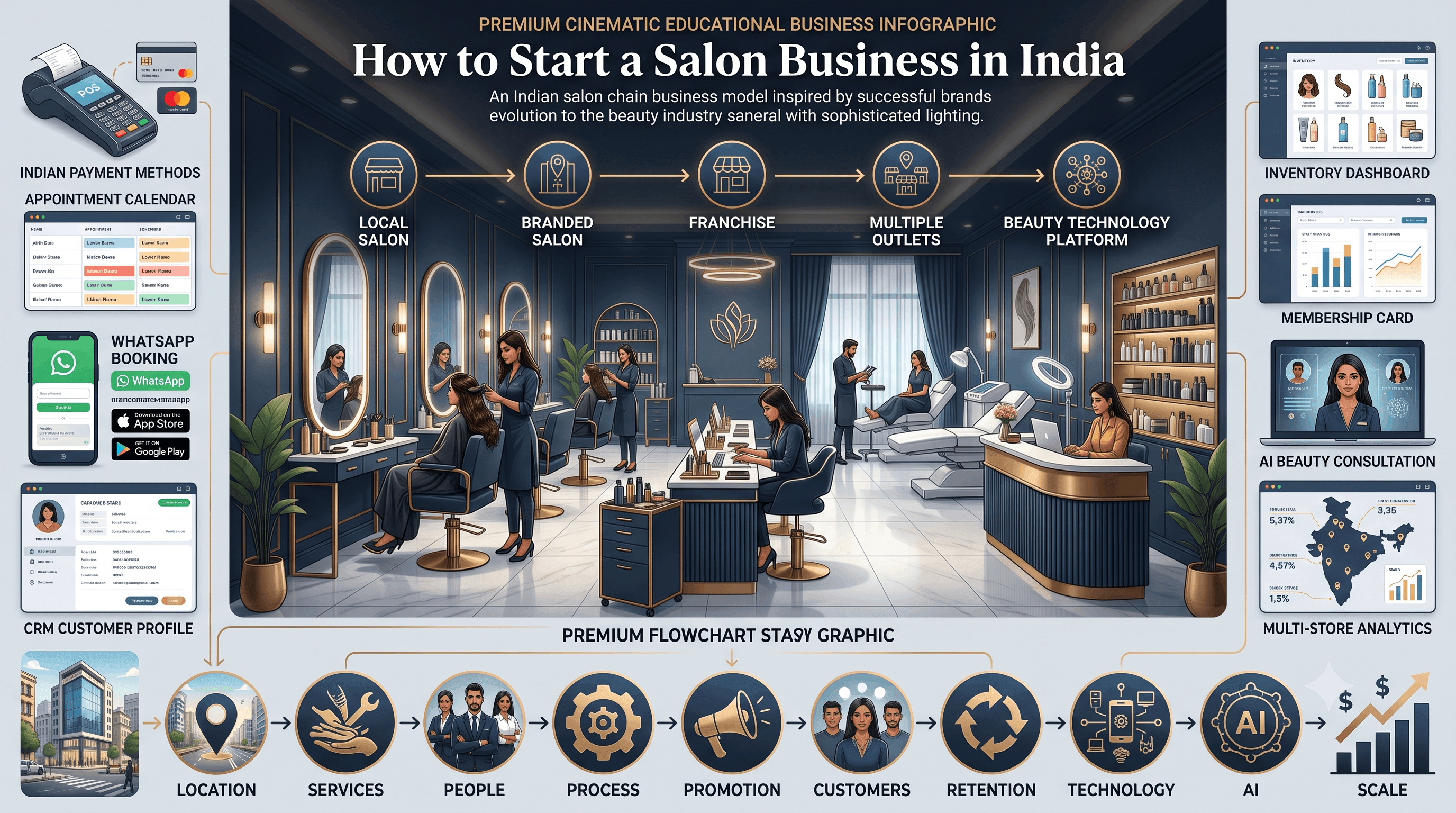
A salon looks simple from the outside.
A customer walks in.
Gets a haircut.
Pays.
Leaves.
But behind that haircut is a surprisingly complex business involving people, appointments, inventory, training, customer retention, pricing, memberships, technology and location economics.
And if you want to understand how a small Indian salon can become a large chain, two real businesses are particularly useful case studies:
Naturals says it has grown from its early Chennai beginnings to 750+ salons, while its current franchise material highlights more than 400 women entrepreneurs in its network.
Lakmé Salon says it has 450+ salons across 160+ cities, with more than 300 entrepreneurs operating franchise salons.
The fascinating part isn't simply the number of outlets.
It's how they built systems that allow one salon to resemble another salon hundreds of kilometres away.
Let's start with a simple comparison.
The owner manages:
Often, much of the business knowledge exists inside the owner's head.
If the owner isn't there, operations can become difficult.
The business is systemized.
Brand
↓
Services
↓
Pricing
↓
Training
↓
Standard Operating Procedures
↓
Appointments
↓
POS
↓
CRM
↓
Inventory
↓
Marketing
↓
Analytics
↓
Expansion
That's the fundamental difference.
Naturals was conceived around 2000 and opened its first salon in Chennai in the early 2000s. The company says its first franchise salon opened in 2006. Its current website states that it has 750+ salons and aims for 3,000 salons by 2029.
That's a remarkable transformation:
One salon
→ Franchise system
→ Hundreds of entrepreneurs
→ Hundreds of locations
The important lesson:
The scalable product isn't the haircut. It's the operating system behind the haircut.
Naturals explicitly promotes:
Its current franchise material also describes financing support through partner banks and says its franchise model targets a 36–48 month ROI period. These are the company's stated claims, not guaranteed returns.
This tells us something important.
A franchisee doesn't simply buy a logo.
They're buying access to a business system.
Lakmé provides another excellent example.
Lakmé Salon says its journey began in 1980, with franchise expansion becoming an important milestone in its growth. It currently reports 450+ salons across 160+ cities and more than 300 franchise entrepreneurs.
And its franchise model is especially interesting because it describes six major components:
Place
Portfolio
Process
People
Promotion
Personality
Lakmé calls this its 6P entrepreneurial model.
That's an excellent framework for anyone building an independent salon.
Let's translate Lakmé's framework into entrepreneur language.
Where is your salon?
What services do you offer?
How consistently are those services delivered?
Who performs the services?
How do customers discover you?
Why should customers remember your salon?
This framework can be used even if you never purchase a franchise.
There isn't one universal answer.
A small neighborhood salon and a premium branded salon can have completely different economics.
For example, Lakmé's current franchise enquiry asks prospective partners whether they have a 900 sq. ft. space and a ₹60 lakh budget.
That should immediately demonstrate something:
A branded salon can require dramatically more capital than a small independent salon.
For an independent salon, an illustrative model could look like:
| Expense | Example |
|---|---|
| Security deposit | ₹1,00,000 |
| Interior | ₹2,00,000 |
| Salon chairs | ₹60,000 |
| Mirrors/stations | ₹50,000 |
| Shampoo stations | ₹50,000 |
| Hair equipment | ₹50,000 |
| Facial/beauty equipment | ₹40,000 |
| Reception/POS | ₹30,000 |
| AC/electrical work | ₹75,000 |
| Branding/signage | ₹40,000 |
| Initial inventory | ₹50,000 |
| Licenses/misc. | ₹30,000 |
| Working capital | ₹1,50,000 |
| Illustrative Total | ₹9,25,000 |
This is only an example model.
Location, size, interior quality, equipment and service mix can move the number substantially.
This is one of the biggest mistakes new salon entrepreneurs make.
They spend:
₹5 lakh on beautiful interiors
before understanding:
Who will actually visit?
Instead, work backwards.
Identify your customer.
Identify the location.
Identify expected footfall.
Design the service mix.
Calculate revenue potential.
Then design the salon.
Beautiful interiors don't fix bad economics.
You can create several formats.
Target:
Focus:
Affordable + convenient
Services for:
Focus:
Household customers
Focus:
Higher ticket sizes.
Examples:
Specialization can make branding easier.
A salon doesn't have one product.
It has a service portfolio.
For example:
Now the business has multiple revenue streams.
Sell packages.
For example:
Haircut + Wash + Styling
Haircut + Beard + Facial
Makeup + Hair + Skin + Nails
Multiple services for a fixed amount.
This increases:
Average customer value
and potentially:
Customer retention.
Suppose someone visits once.
Revenue:
₹800
Done.
But suppose that person returns every month for three years.
Even a modest:
₹800 × 12 × 3
= ₹28,800
That's before considering additional services.
Now imagine having:
500 recurring customers.
The economics become very different.
That's why salon businesses should obsess over:
Retention, not just acquisition.
Every customer can have a profile:
CUSTOMER

Name:
Aman

Last Visit:
18 Aug

Haircut:
Classic Fade

Preferred Stylist:
Rahul

Average Spend:
₹1,250

Next Recommended Visit:
15 Sep
Now the salon isn't relying entirely on memory.
Instead of waiting for customers to remember:
"It's time for my haircut."
Your system can send:
"Hi Aman, it's been 4 weeks since your last visit. Would you like to book your usual appointment?"
That's a tiny automation.
But multiply it across:
1,000 customers
and it becomes a powerful retention mechanism.
Imagine:
Customer
↓
↓
"Book haircut tomorrow at 5 PM"
↓
System checks availability
↓
Confirms appointment
↓
Sends reminder
↓
Customer arrives
↓
Staff completes service
↓
Payment recorded
↓
Feedback request sent
This can be far more useful than building an expensive mobile app too early.
A salon's inventory isn't only shampoo.
It also has:
TIME.
Suppose a stylist has:
8 working hours
But only:
4 hours of booked appointments.
You have unused capacity.
That's lost revenue.
Your software should therefore track:
Available hours
vs
Booked hours
vs
Revenue generated
Imagine:
STYLIST PERFORMANCE

Stylist: Rahul

Available: 180 hrs
Booked:   142 hrs

Utilization: 78.9%

Revenue: ₹1,85,000

Avg Ticket: ₹1,303
Now management can understand:
Who is busy?
Who has spare capacity?
Which services generate the most revenue?
A good salon dashboard should consider:
A stylist generating ₹2 lakh but producing unhappy customers may create a long-term problem.
A salon may use:
If inventory isn't tracked, money disappears quietly.
Food businesses use recipes.
Salons can use service consumption models.
For example:
Expected consumption:
Colour: 40g
Developer: 40ml
If a stylist consistently uses:
70g
the system should flag the difference.
Not automatically accuse anyone.
Just investigate.
Maybe:
Data creates visibility.
A salon doesn't have to make money only from services.
It can sell:
The salon becomes:
Service business + retail business.
Lakmé currently offers membership schemes where customers pay predefined amounts and receive higher-value redeemable benefits. Its published terms currently list slabs ranging from ₹5,000 to ₹1,00,000, with corresponding benefit values.
This is a fascinating model.
Instead of:
Customer pays every time.
You create:
Customer commits money upfront and receives benefits over time.
That can improve retention and create more predictable customer relationships.
The exact economics must be carefully designed to avoid creating excessive discount liabilities.
For example:
₹5,000
Benefits:
₹5,800
₹10,000
Benefits:
₹12,000
₹25,000
Benefits:
₹31,000
These are merely illustrative figures.
The actual benefit structure should be calculated based on:
Suppose you have:
300 members
and average membership value:
₹10,000
That's:
₹30 lakh
in customer commitments.
But don't treat that entire amount as immediate profit.
You have future services to deliver.
So membership accounting must be handled carefully.
Now let's add the Kairos Coders layer.
A modern salon platform could look like:
                    CUSTOMER
                       │
          ┌────────────┼────────────┐
          ↓            ↓            ↓
       WEBSITE      WHATSAPP      WALK-IN
          │            │            │
          └────────────┼────────────┘
                       ↓
                  APPOINTMENT
                       ↓
                      CRM
                       ↓
             ┌─────────┼─────────┐
             ↓         ↓         ↓
            POS      STAFF    INVENTORY
             │         │         │
             └─────────┼─────────┘
                       ↓
                   ANALYTICS
                       ↓
                       AI
That's a salon operating system.
This is where Naturals' current technology vision becomes particularly interesting.
Naturals says its Naturals 3.0 strategy includes AI-powered personalized beauty solutions, virtual consultations and technology-driven salon operations.
Now imagine your own salon system.
Customer:
Priya
History:
AI detects:
"Priya is likely due for a hair spa."
The system can automatically generate a personalized reminder.
Imagine a customer uploads a photo.
AI could assist with:
The customer then discusses the options with a professional stylist.
AI shouldn't replace the stylist.
It should make the consultation better.
Suppose your data shows:
Saturday
→ 40% higher appointments
Wedding season
→ Makeup demand increases
Festival period
→ Hair/beauty services increase
AI can help forecast:
This means:
Don't schedule staff based only on intuition.
Suppose Tuesday afternoon has:
Low bookings
The system could automatically identify the empty capacity.
Instead of offering discounts to everyone:
Tuesday 2–5 PM Haircut Offer
Only customers likely to respond receive the campaign.
This is much smarter than:
20% OFF EVERYTHING!
Before opening another branch, collect:
Then score potential locations.
LOCATION SCORE

Footfall          87
Competition       61
Rent Economics    73
Customer Demand   91
Parking            82

TOTAL              79
This is exactly where software can improve traditional business decisions.
A modern salon should have multiple acquisition channels.
People search:
"Salon near me."
Before/after transformations.
Offers and appointment reminders.
Existing customers bring new customers.
Target:
Salon in [City/Area]
Local creators can generate awareness.
Beauty is extremely visual.
Create:
Before
↓
Transformation
↓
After
This can become excellent social media content.
But obtain appropriate customer consent before publishing photos.
A common salon marketing strategy is:
50% OFF
But constant discounting can train customers to wait for discounts.
Instead, create targeted offers.
First-visit package.
Rebooking reward.
Exclusive service.
Time-specific offer.
Both customers receive a benefit.
Let's build a simplified example.
Suppose:
Average bill = ₹1,000
Daily customers:
20
Daily revenue:
₹20,000
Monthly revenue at 26 operating days:
₹5,20,000
Now subtract:
The remaining amount is your operating profit—not the ₹5.2 lakh revenue.
Suppose monthly fixed costs are:
₹3,00,000
Average contribution per customer:
₹600
Break-even customers:
₹3,00,000 ÷ ₹600
= 500 customers/month
At 26 operating days:
≈ 19 customers/day
Now you have a measurable business target.
Imagine your salon has:
8 styling stations
Monthly revenue:
₹8,00,000
Revenue per station:
₹1,00,000/month
Now compare that against another branch:
8 stations
Revenue:
₹4,80,000
Revenue per station:
₹60,000
You immediately know which branch is utilizing its physical capacity better.
The challenge changes completely.
At one salon:
Owner manages business.
At ten:
Management system required.
At fifty:
Regional management required.
At 100+:
Centralized technology becomes essential.
You need:
Lakmé's franchise process explicitly describes support across:
Site selection
→ Salon design
→ IT
→ Operations
→ HR
→ Training
→ Marketing
The company also says its support begins with catchment analysis and continues through launch, with a 90-day launch marketing plan.
This is the important insight:
A franchise system reduces the amount the entrepreneur has to invent from scratch.
The franchise business model can be thought of as:
Brand
Systems
Training
Marketing
Technology
Entrepreneur's Capital
=
New Outlet
But there is another side:
Fees
Royalties
Brand restrictions
Operating standards
Less independence
So franchise isn't automatically better.
It's a trade-off.
| Factor | Independent | Franchise |
|---|---|---|
| Brand | Build yourself | Existing |
| Investment | Flexible | Usually higher |
| Menu | Full freedom | Controlled |
| Technology | Choose yourself | Brand system |
| Marketing | Your responsibility | Support available |
| Training | Build yourself | Provided |
| Expansion | Your system | Proven framework |
| Control | High | Lower |
The right choice depends on your goals and capital.
Naturals demonstrates the power of:
Franchise entrepreneurship
Training
Standardization
Brand building
Technology
Local entrepreneurs
Its current vision is particularly ambitious: 3,000 salons and 1,000+ women entrepreneurs by 2029, alongside its stated AI/technology initiatives.
Lakmé demonstrates:
Strong brand
Professional training
Site selection
Marketing
IT
Operational audits
Franchise support
The brand says its franchise network includes more than 300 entrepreneurs, while its current salon footprint exceeds 450 outlets across 160+ cities.
The biggest lesson from these companies isn't:
"Open a salon."
It's:
"Build a system that can reproduce a great salon experience."
That's a completely different mindset.
Don't immediately think:
100 salons.
Think:
Prove:
Then document everything.
Document:
Once documented, the business becomes less dependent on individual memory.
The progression is:
Person-dependent business
↓
Process-dependent business
↓
Technology-supported business
↓
Scalable business
This is one of the most important principles in entrepreneurship.
A salon isn't merely a place where people get haircuts.
It's a combination of:
Real estate
Human talent
Customer relationships
Inventory
Services
Brand
Technology
The strongest salon chains understand this.
Naturals built a large franchise network around standardized support, training and entrepreneurship.
Lakmé built a structured franchise system around Place, Portfolio, Process, People, Promotion and Personality.
And now the next frontier is:
AI + personalization + automation + data.
That's where a traditional salon can become a modern beauty-tech business.
Here's the technology opportunity:
Salon POS
→ Appointment Management
→ CRM
→ Memberships
→ Inventory
→ Staff Analytics
→ WhatsApp Automation
→ Digital Marketing
→ AI Consultation
→ Demand Forecasting
→ Personalized Offers
→ Multi-Branch Dashboard
Imagine owning 20 salons and opening one dashboard every morning:
KAIROS BEAUTY OS

20 STORES
₹42.6L REVENUE
8,421 APPOINTMENTS

TOP SERVICE
Hair Colour

BEST STORE
Delhi #04

LOWEST UTILIZATION
Store #13

INVENTORY ALERT
Hair Colour — 3 days

AI ALERT
Saturday bookings expected +23%

CUSTOMERS DUE
1,284

REBOOKING RATE
67%
Now technology isn't decoration added to the business.
Technology is the operating system of the business.
Pixels to Perfection Design that Impresses