
Rahul
 LeetCode #155: Min Stack — Design a Stack with O(1) Minimum Retrieval
 LeetCode #20: Valid Parentheses — Master the Stack Pattern
 LeetCode #15: 3Sum — Master Sorting, Two Pointers and Duplicate Handling
 Instruction vs Context in AI Prompts: How to Tell AI What to Do and What Information to Use
 Rust Structs and Enums: Building Powerful Data Models
 Dissecting the High-Level System Architecture of Booking.com
 Kanban vs. Scrum: Which Agile Methodology to Choose?
 The Scaling Journey of LinkedIn: From Startup to Professional Powerhouse
 Mastering Code Review: A Guide for Reviewers and PR Creators
 ChatGPT: Unveiling the Power of AI in Conversational Experiences with Kairos Coders

Kairos Coders are here to help
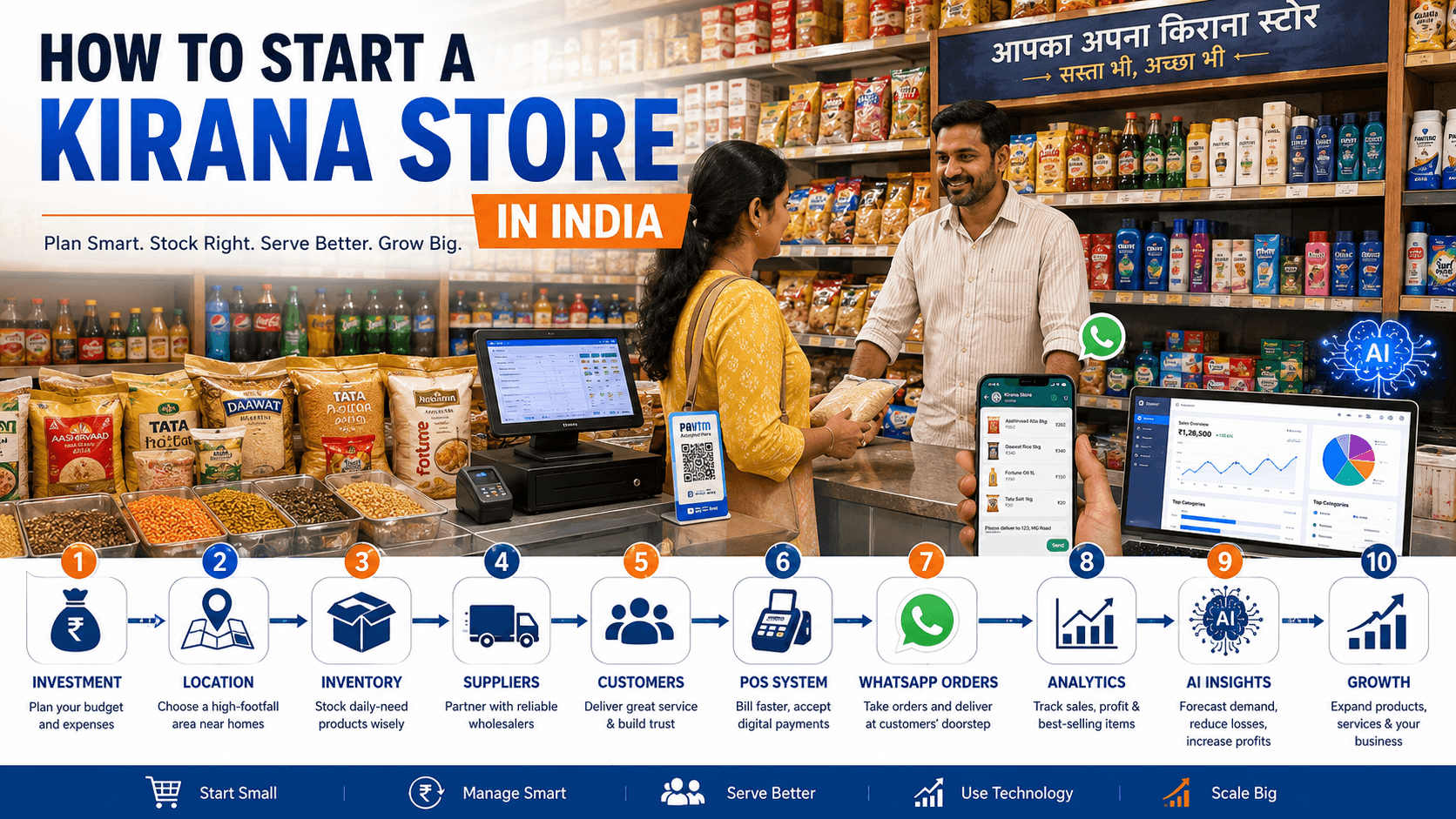
A kirana store may look like one of the simplest businesses in India.
A small shop, some shelves, a refrigerator, groceries, a billing machine, and customers from the neighborhood.
But behind every successful kirana store is a surprisingly complex business involving inventory management, pricing, customer retention, cash flow, supplier relationships, and increasingly, technology.
The good news?
You don't necessarily need a huge investment to start one.
With the right location, product mix, pricing strategy, and a little technology, a small kirana store can become a profitable neighborhood business — and potentially grow into multiple outlets or even an online grocery operation.
In this guide, we'll break down:
A kirana store is essentially a neighborhood retail grocery business.
Depending on its size, it may sell:
A small store might focus on 200–500 products, while a larger neighborhood supermarket can carry thousands of SKUs.
The important point is that you don't need to sell everything on day one.
Start with products people regularly purchase.
The investment depends heavily on your location, shop size, inventory, and whether you already own the premises.
A small store could potentially start with a relatively modest setup, while a larger supermarket-style operation can require several lakhs or more.
Here's an illustrative example:
| Expense | Approx. Budget |
|---|---|
| Shop deposit/advance | ₹50,000 |
| Shelves & racks | ₹60,000 |
| Counter | ₹20,000 |
| Refrigerator | ₹30,000 |
| Weighing machine | ₹5,000 |
| POS/billing setup | ₹15,000 |
| Initial inventory | ₹1,50,000 |
| Signboard/branding | ₹15,000 |
| Licenses/miscellaneous | ₹10,000 |
| Working capital | ₹50,000 |
| Total | ₹4,05,000 |
These are illustrative figures, not fixed market prices.
You could build a smaller setup for less, particularly if you already have a shop, shelves, equipment, or supplier relationships.
The biggest mistake is spending almost all your capital on inventory and leaving nothing for working capital.
For a kirana store, location can make or break the business.
You want customers who can easily walk to your shop.
Look for areas with:
A shop inside a residential colony can sometimes outperform a more expensive shop on a busy road because customers repeatedly need everyday products.
Spend several hours there.
Count:
People → Shops → Competitors → Vehicles → Potential customers
Don't simply choose a location because the rent looks cheap.
A ₹10,000/month shop with very few customers can be more expensive than a ₹25,000/month shop with strong sales potential.
Don't stock products based entirely on what you think people need.
Stock based on what your neighborhood actually buys.
For example:
You may need more:
You may sell more:
You may see higher demand for:
The neighborhood determines the product mix.
One of the biggest mistakes new retailers make is purchasing too much inventory.
Imagine buying ₹2 lakh worth of products.
But ₹50,000 worth of those products barely sell.
Your money is now sitting on shelves.
Instead, identify fast-moving products.
These are products customers purchase repeatedly.
For example:
Your goal isn't to have the biggest inventory.
Your goal is to have the right inventory.
Revenue isn't profit.
This is one of the most important concepts for a new business owner.
Suppose you purchase a product for ₹80 and sell it for ₹100.
Your gross profit is:
₹100 − ₹80 = ₹20
Your gross margin is:
₹20 / ₹100 × 100 = 20%
But that ₹20 isn't your final profit.
You still have to pay:
That's why you should always calculate net profit, not just markup.
A kirana store can have thousands of products.
That creates a major problem:
Doing this manually becomes difficult as the store grows.
This is where technology starts becoming useful.
Instead of writing every transaction in a notebook, use a billing/POS system.
A basic POS can help you track:
Now imagine your store sells 300 products per day.
At the end of the day, instead of asking:
"How much did we sell?"
You can see:
Today's Sales: ₹18,450
And potentially:
Gross Margin: ₹3,800
Top Product: Milk
Slowest Product: Brand X Cookies
That's a completely different way of running a business.
UPI has fundamentally changed Indian retail.
Customers increasingly expect to pay using:
Put a clearly visible QR code at the counter.
But don't stop there.
Your billing system should ideally reconcile digital payments with sales so that you can understand:
Cash + UPI + Cards = Total Sales
This makes accounting much easier.
You don't necessarily need a sophisticated mobile app.
For a neighborhood kirana store, WhatsApp can be surprisingly powerful.
A customer could send:
"2 kg atta
1 litre oil
1 packet Maggi
2 soaps"
Your store receives the order.
You prepare it.
The customer picks it up or gets it delivered.
That's essentially local e-commerce without building a complicated app.
Later, you can build:
Customer → WhatsApp → Order System → Inventory → Billing → Delivery
Now your traditional kirana store has become a small digital commerce business.
Suppose 500 families regularly purchase from your shop.
You could potentially know:
Now you can create useful offers.
For example:
"Your usual monthly grocery items are available. Need anything delivered?"
That's much more powerful than randomly sending advertisements.
Here's where things get interesting.
Imagine your system notices:
Every month between the 1st and 5th:
Your system can identify the pattern.
Instead of manually guessing how much inventory to order, software can recommend:
Recommended purchase: 20 bags of rice
This is the beginning of data-driven retail.
And eventually, AI can help predict:
Expired inventory is one of the silent profit killers in grocery retail.
Suppose you have:
50 packets of a product
and 15 expire before they are sold.
You didn't just lose the expected profit.
You potentially lost the money invested in those products as well.
A good inventory system should help identify:
Products approaching expiry
so you can:
The biggest question for many new kirana owners is:
"How can a small shop compete with 10-minute delivery?"
The answer isn't necessarily to copy them.
Your advantage is local relationships.
A neighborhood store can compete through:
Customers know the shopkeeper.
Some local customers may value trusted payment arrangements, where appropriate.
You know what the neighborhood buys.
Customers can call or WhatsApp.
A customer doesn't need to meet a minimum order value.
The customer can simply walk in.
You can deliver within a small radius.
A recommendation from a shopkeeper can be more valuable than an algorithm.
Technology shouldn't replace these advantages.
It should amplify them.
Let's imagine a small kirana store generates:
Daily sales: ₹15,000
Assuming 30 days:
Monthly revenue = ₹4,50,000
Now suppose the average gross margin across products is approximately 15%.
Gross profit = ₹67,500
Illustrative monthly expenses:
| Expense | Amount |
| Rent | ₹15,000 |
| Electricity | ₹5,000 |
| Staff | ₹15,000 |
| Delivery | ₹4,000 |
| Internet/software | ₹1,500 |
| Miscellaneous | ₹5,000 |
| Total | ₹45,500 |
Estimated operating profit:
₹67,500 − ₹45,500 = ₹22,000/month
This is only an example.
Actual margins, sales, rent, wastage, taxes, staff costs and supplier pricing can change the result substantially.
The important lesson is:
Don't estimate profit from revenue alone.
Calculate:
Revenue → Gross Profit → Operating Expenses → Net Profit
Suppose your monthly fixed expenses are:
₹40,000
And your average gross margin is:
15%
Then approximately:
Break-even sales = ₹40,000 ÷ 15%
= ₹2,66,667/month
So you need roughly:
₹8,900/day
in sales to cover those fixed expenses, assuming the 15% gross margin holds consistently.
This is why understanding your numbers before opening the shop is so important.
You don't need to build a supermarket immediately.
A better strategy can be:
Small neighborhood store.
Improve inventory and billing.
Add WhatsApp ordering.
Offer local delivery.
Build customer loyalty.
Create an online ordering system.
Open another store.
Centralize purchasing.
Create your own private-label products.
Build a recognizable local grocery brand.
Now you aren't simply running a shop.
You're building a retail business.
A technology-enabled kirana store could eventually look like this:
                 CUSTOMER
                    │
          ┌─────────┴─────────┐
          │                   │
       Walk-in             WhatsApp
          │                   │
          └─────────┬─────────┘
                    ↓
                POS SYSTEM
                    ↓
              INVENTORY DB
                    ↓
        ┌───────────┼───────────┐
        ↓           ↓           ↓
      Sales      Purchases    Customers
        │           │           │
        └───────────┼───────────┘
                    ↓
                ANALYTICS
                    ↓
                   AI
                    ↓
        Demand & Reorder Insights
This is where a traditional business starts becoming a technology-enabled business.
You don't need to hire a software development team on day one.
Start with simple tools.
The idea is simple:
Don't digitize everything at once. Digitize the bottleneck first.
Your money gets locked into slow-moving products.
Low rent doesn't compensate for low customer traffic.
Uncontrolled credit can destroy cash flow.
Dead stock quietly eats your profit.
Revenue can look impressive while the business loses money.
You don't want customers to choose you only because you're ₹1 cheaper.
Manual processes become increasingly difficult as the store grows.
You should know your:
Daily sales → Gross margin → Expenses → Net profit → Inventory value
Absolutely.
The first store is only the starting point.
A successful model can evolve into:
1 Store
↓
Multiple Stores
↓
Central Purchasing
↓
Warehouse
↓
Private Label
↓
Online Grocery
↓
Local Delivery Network
↓
Franchise / Partner Stores
Technology can connect the entire operation.
You could eventually have a dashboard showing:
STORE 01   ₹18,500/day
STORE 02   ₹22,300/day
STORE 03   ₹16,700/day

TOTAL      ₹57,500/day
Then monitor:
That's when data becomes a competitive advantage.
A kirana store may be a traditional Indian business, but there is nothing traditional about the opportunity ahead.
The winning model may not be:
Kirana vs Technology
It could be:
Kirana + Technology
The shop still needs:
Good products + good prices + good location + good service.
But technology can add:
Better inventory + better customer retention + better decisions + better forecasting + easier operations.
You don't need to build the next Amazon.
Start with one neighborhood.
Understand your customers.
Track every rupee.
Control your inventory.
Use technology where it saves time or increases sales.
Then scale.
A business doesn't become a tech business because it has an app.
It becomes technology-enabled when technology helps you:
Sell more → Waste less → Understand customers → Reduce manual work → Make better decisions → Scale faster.
And that's exactly where the future of the humble Indian kirana store could become very interesting.
Pixels to Perfection Design that Impresses