
Rahul
 LeetCode #155: Min Stack — Design a Stack with O(1) Minimum Retrieval
 LeetCode #20: Valid Parentheses — Master the Stack Pattern
 LeetCode #15: 3Sum — Master Sorting, Two Pointers and Duplicate Handling
 Instruction vs Context in AI Prompts: How to Tell AI What to Do and What Information to Use
 Rust Structs and Enums: Building Powerful Data Models
 Dissecting the High-Level System Architecture of Booking.com
 Kanban vs. Scrum: Which Agile Methodology to Choose?
 The Scaling Journey of LinkedIn: From Startup to Professional Powerhouse
 Mastering Code Review: A Guide for Reviewers and PR Creators
 ChatGPT: Unveiling the Power of AI in Conversational Experiences with Kairos Coders

Kairos Coders are here to help
A juice shop is one of the oldest food businesses in India.
But the modern juice business is something very different.
A traditional juice shop might sell:
Mosambi → ₹60
Orange → ₹80
Mango Shake → ₹100
A modern beverage brand asks a completely different question:
Can we turn fresh fruit into a recognizable, repeatable, scalable consumer brand?
That's exactly why businesses such as Juice Lounge and Drunken Monkey are interesting case studies.
Juice Lounge entered the Indian market in 2005 and later expanded through franchising, while Drunken Monkey started in Hyderabad in 2016 and built a smoothie-focused chain around a much broader product and lifestyle proposition.
The lesson isn't to copy either brand.
The lesson is to understand how a simple beverage becomes a business system.
Let's start with the difference.
Usually focuses on:
The owner often personally controls:
Purchasing → Preparation → Billing → Customer service
The model becomes:
Brand
→ Standardized recipes
→ Menu engineering
→ Supply chain
→ Store design
→ Packaging
→ POS
→ Customer data
→ Marketing
→ Franchise/expansion
The product may still be a glass of fruit.
But the business architecture is completely different.
Juice Lounge is one of the older organized juice-bar concepts in India.
Its own history says the brand started in 2005, later moved into franchising in 2009, and developed multiple food-and-beverage concepts.
Its proposition wasn't limited to ordinary juices.
The brand positioned itself around:
That is an important business lesson.
Instead of:
"I sell juice."
the business can become:
"I operate a healthy beverage and quick-service food concept."
Historical reporting on Juice Lounge described multiple formats:
A 2018 Restaurant India article reported the brand operating in 30+ cities in India and abroad at that time and discussed its use of kiosk, OTC and lounge formats.
This is strategically important.
Different locations require different store economics.
Small footprint.
High footfall.
Fast transactions.
Order at counter.
Limited seating.
Larger space.
Longer customer visits.
Higher potential average ticket.
The entrepreneur should choose the format after choosing the customer and location, not before.
Now we have a very different example.
Drunken Monkey was founded by Samrat Reddy in 2016 in Hyderabad. The company focused heavily on smoothies and positioned them as a lifestyle/health-oriented product rather than simply another juice.
The company's current website says it offers 200+ smoothie and smoothie-bowl combinations and operates across 30+ cities.
Earlier reporting described its rapid expansion to more than 100 stores across 43 Indian cities.
That's an important case study.
The company didn't try to compete with every local juice seller on:
"Who can sell orange juice cheapest?"
Instead, it created a specialized smoothie category.
There's an especially interesting quote from the founder.
Samrat Reddy described his ambition as wanting to do for smoothies what Starbucks did for coffee.
That statement reveals the strategy.
The goal wasn't simply:
Sell beverage
It was:
Create a beverage category + experience + brand.
That's a much bigger opportunity.
This is one of the biggest strategic lessons.
Imagine:
Orange Juice:
₹70
Signature smoothie:
₹199
They are technically both selling fruit-based beverages.
But they're not necessarily selling the same product experience.
The premium business may be selling:
Therefore, the goal isn't necessarily to beat the ₹70 juice shop.
It's to create a reason for the customer to spend ₹199.
Investment varies dramatically by format.
Historical franchise-industry data has reported Juice Lounge investment figures in different ranges depending on the format, while more recent franchise listings have placed Juice Lounge and Drunken Monkey at different investment levels. These figures should be treated as reference points, not current quotations or guaranteed returns.
For an independent business, you could build an illustrative model such as:
| Expense | Example Budget |
|---|---|
| Security deposit | ₹75,000 |
| Interior/setup | ₹1,00,000 |
| Commercial juicers/blenders | ₹75,000 |
| Refrigeration | ₹50,000 |
| Prep equipment | ₹30,000 |
| Counter/display | ₹50,000 |
| POS | ₹20,000 |
| Signage/branding | ₹30,000 |
| Initial inventory | ₹40,000 |
| Packaging | ₹20,000 |
| Licenses/misc. | ₹25,000 |
| Working capital | ₹1,00,000 |
| Illustrative Total | ₹6,15,000 |
A kiosk could be cheaper.
A premium smoothie lounge could cost substantially more.
A franchise can involve additional fees, royalties and brand-specific requirements.
Never use a franchise-directory number as your final investment plan.
Get the latest commercial terms directly from the brand before investing.
A small juice/smoothie outlet may require:
For:
For:
You may need:
For:
This is what makes a juice business interesting.
You don't simply store boxes of finished products.
You store:
Fruits
And fruits have:
Shelf life.
If you buy too much:
→ Wastage.
If you buy too little:
→ Stockout.
So the business is effectively solving:
How much fresh inventory should I buy today?
Suppose you sell:
100 smoothies/day
and each requires a certain combination of fruits.
Your purchasing system can estimate:
Tomorrow's fruit requirement.
Instead of:
"Let's buy 20 kg mangoes."
You can calculate:
Expected sales × recipe requirement + safety stock
This is basic demand forecasting.
Mango demand in summer may be completely different from winter.
Watermelon demand may behave differently from citrus.
Some fruits become expensive or unavailable at certain times.
Therefore your menu should adapt.
A smart menu follows supply + demand + margin.
Don't start with 200 products.
Even if a brand such as Drunken Monkey has built a very broad smoothie menu, a new entrepreneur should begin much smaller. The current brand site itself highlights 200+ smoothie/smoothie-bowl combinations.
Start with:
Then identify winners.
After three months, don't ask:
"Which item sounds coolest?"
Ask:
Which products sell?
Which products make money?
Which products create repeat customers?
For every item track:
Then classify products.
High sales + high contribution.
High sales + moderate contribution.
Low sales + high contribution.
Low sales + low contribution.
This is menu engineering.
Suppose your signature smoothie requires:
Every employee should follow the same recipe.
Not:
"Thoda aur banana daal do."
Because at scale:
10g extra × 100 orders = 1kg extra ingredient consumption.
Multiply that across hundreds of days.
Small operational mistakes become large financial problems.
Your POS/restaurant system can maintain:
PRODUCT
Signature Mango Smoothie

SIZE
Regular

RECIPE
Mango      100g
Banana      50g
Milk       150ml
Seeds        5g

FOOD COST
₹62

SELLING PRICE
₹179

CONTRIBUTION
₹117
Now pricing decisions become data-driven.
Suppose:
Selling Price = ₹199
Direct ingredients + packaging:
₹70
Then:
₹129
is your simplified contribution before other operating expenses.
But don't confuse that with net profit.
You still have:
This distinction is critical.
Imagine:
Daily fruit purchases:
₹5,000
Fruit actually used:
₹4,300
Wastage:
₹700
That's:
₹700 × 30 = ₹21,000/month
You might think:
"It's only some spoiled fruit."
But the business is losing:
₹21,000/month
just from that example.
Technology can make this visible.
Imagine:
WASTAGE REPORT

Mango        ₹4,200
Watermelon   ₹2,100
Banana       ₹1,200
Strawberry   ₹3,500

Total        ₹11,000
Then ask:
Why is strawberry wastage so high?
Maybe you're buying too much.
Maybe the product isn't selling.
Maybe storage is poor.
Maybe the forecast is wrong.
Data tells you where to investigate.
Every sale can update expected ingredient consumption.
For example:
100 Mango Smoothies
↓
Expected mango consumption:
10 kg
The system can compare this against actual inventory.
This helps identify:
Technology becomes a margin-control mechanism.
Your customer could order through:
QR Code
→ Digital Menu
→ Select Smoothie
→ Customize
→ Pay
→ Order Number
→ Kitchen/Counter
→ Pickup
This reduces manual order entry.
For a neighborhood juice bar, WhatsApp can be surprisingly powerful.
Customer:
"2 protein smoothies and one mango shake."
Store:
Confirm → Prepare → Deliver
You don't need to build a complex app before proving demand.
This is one of the most interesting opportunities.
Imagine:
20 smoothies/month
or:
5 smoothies/week
or:
Protein smoothie after workout
This changes the model from:
Transaction
to:
Recurring revenue.
A juice/smoothie business can create B2B partnerships with:
For example:
Corporate Smoothie Subscription
50 employees
× 20 working days
= 1,000 beverages/month
Now you have predictable demand.
Look at the difference between:
Rahul Fresh Juice
and:
A recognizable lifestyle beverage brand
The second can potentially command a premium because customers are buying a brand experience.
Drunken Monkey's branding is intentionally playful and lifestyle-oriented, while its messaging centers around its "Naturally High" positioning.
Your brand needs its own identity.
Don't imitate theirs.
Your cup should communicate:
Brand
Product
Social handle
QR code
Ordering channel
Imagine a customer walking through a mall holding your smoothie.
Your packaging becomes a moving advertisement.
There are two fundamentally different approaches.
Examples:
Advantage:
Visibility
Disadvantage:
Rent
Examples:
Advantage:
Repeat customers
Disadvantage:
Smaller customer pool
The ideal location depends on your concept.
Drunken Monkey's early positioning wasn't simply:
"We sell fruit."
The company wanted smoothies to become a social/lifestyle experience, including café-like spaces and non-beverage elements. Contemporary reporting described features such as Wi-Fi, board games and comic books in its bars.
That's an important lesson.
You can sell:
Product
or
Product + Experience
The second can create a much stronger brand.
Juice Lounge expanded its proposition beyond juice into smoothies, milkshakes and food products. Its own site describes a broad menu extending into sandwiches, pasta, pizza, burgers and fries.
This teaches another lesson:
Once you have customer traffic, increase the value of each visit.
Someone coming for a juice could also buy:
Sandwich + Juice
or:
Smoothie + Snack
But don't add products simply to make the menu huge.
Every additional product creates:
Expand intelligently.
Suppose:
Smoothie = ₹179
Add:
Protein upgrade = ₹40
Customer chooses:
₹219
Or:
Smoothie + healthy snack = ₹249
You haven't necessarily acquired another customer.
You've increased the value of an existing transaction.
This is where Kairos Coders can bring a genuine technology angle.
Imagine your system has six months of data.
It knows:
AI can potentially predict:
Tomorrow's expected watermelon smoothie demand: 84 units.
Then calculate:
Required watermelon → Required ingredients → Required procurement
This can reduce both:
Stockouts + Wastage
Suppose AI discovers:
Mango Smoothie
Sales: High
Contribution: High
Repeat rate: High
Recommendation:
Promote heavily.
Meanwhile:
Kiwi Detox
Sales: Low
Food cost: High
Wastage: High
Recommendation:
Reprice, reformulate or remove.
That's much better than managing the menu based on intuition.
                    CUSTOMER
                       │
        ┌──────────────┼──────────────┐
        ↓              ↓              ↓
      STORE         WEBSITE        WHATSAPP
        │              │              │
        └──────────────┼──────────────┘
                       ↓
                      POS
                       ↓
             ┌─────────┼─────────┐
             ↓         ↓         ↓
        INVENTORY     CRM      ORDERS
             │         │         │
             └─────────┼─────────┘
                       ↓
                  ANALYTICS
                       ↓
                       AI
                       ↓
        ┌──────────────┼──────────────┐
        ↓              ↓              ↓
    FORECAST       WASTAGE        MARKETING
This is where a juice shop becomes a food-tech operation.
Let's create a simple independent-store example.
Suppose monthly fixed expenses are:
₹1,50,000
Average contribution per order:
₹120
Break-even orders:
₹1,50,000 ÷ ₹120
= 1,250 orders/month
Approximately:
42 orders/day
This is a simplified model.
Your real number will depend on:
Never use an online franchise ROI claim as your own financial forecast.
This is where real businesses provide another useful lesson.
Juice Lounge expanded through franchising, and its official franchise FAQ currently states a franchise fee and ongoing royalty structure.
Third-party industry listings also report investment and royalty figures for brands such as Juice Lounge and Drunken Monkey, but these should always be independently verified with the franchisor before making any investment decision.
You get:
But you give up some:
You control:
But you must build everything yourself.
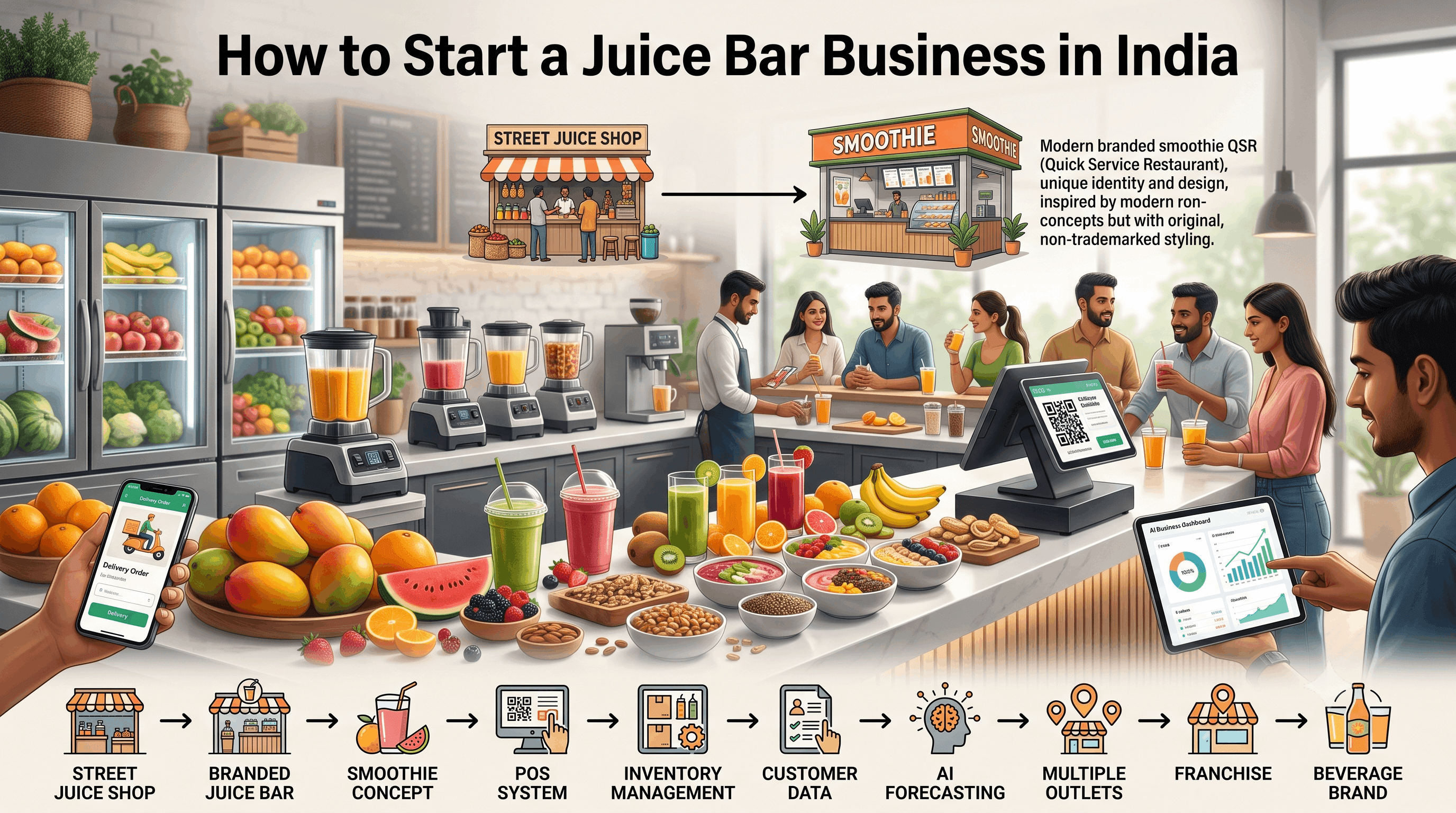
The journey could be:
Local Juice Shop
↓
Signature Product
↓
Strong Branding
↓
POS + Inventory
↓
Online Ordering
↓
Customer Loyalty
↓
Second Store
↓
Central Procurement
↓
Central Kitchen / Prep System
↓
Multiple Stores
↓
Franchise
↓
National Beverage Brand
This is exactly the kind of journey entrepreneurs should study.
A simple product can become a category.
Multiple formats allow different locations to work.
Franchising can accelerate expansion.
A beverage concept can expand into complementary food.
Standardization matters before scaling.
These are lessons from the business model—not instructions to copy the brand.
Don't necessarily compete in an existing category.
Create a differentiated one.
Branding can change how customers perceive an ordinary product.
A beverage can become a lifestyle product.
Menu innovation can increase customer interest.
A standardized product system can support rapid expansion.
Drunken Monkey's founder spent significant time researching and refining smoothie recipes before launching the business, according to the company's own founder profile.
That's a particularly valuable lesson:
Don't rush from idea to outlet.
Now let's turn the entire business into a software problem.
Imagine a SaaS platform specifically for beverage businesses.
Sales
Inventory
Wastage
Suppliers
Recipes
Customers
Orders
Profitability
Demand Forecasting
Procurement Recommendations
Wastage Prediction
Menu Optimization
Customer Recommendations
Low-stock alerts
Supplier purchase orders
Customer campaigns
Subscription reminders
Daily business reports
Now you're not simply running a juice business.
You're running a data-driven beverage company.
More products don't automatically mean more revenue.
Fresh inventory has a cost even when it doesn't sell.
Margins become unpredictable.
Someone will always be cheaper.
High footfall doesn't guarantee profitability.
"Healthy" doesn't automatically mean "high-selling."
Start with simple digital tools.
One profitable store isn't automatically a scalable business.
The juice industry demonstrates something fascinating.
The raw materials are simple:
Fruit + Water + Milk + Nuts + Seeds
But the business can become:
Brand + Product + Experience + Data + Technology + Distribution
That's the difference between a juice shop and a beverage brand.
If you're starting with ₹5–10 lakh, don't think:
"How do I open a juice shop?"
Think:
"How do I build a juice concept that could eventually operate without me standing behind the counter?"
That question changes everything.
You start thinking about:
Recipes
→ Training
→ Inventory
→ Technology
→ Brand
→ Customer retention
→ Data
→ Scalability
Juice Lounge demonstrated how a juice-bar concept could expand through multiple formats and franchising. Drunken Monkey demonstrated how a smoothie-focused concept could build an entirely new lifestyle proposition around beverages.
The takeaway for a new entrepreneur isn't:
Copy Juice Lounge.
or:
Copy Drunken Monkey.
It's:
Study what they systemized—and build your own version.
A juice business can be surprisingly technical.
POS → Know what customers buy.
Recipe Management → Know what every product costs.
Inventory → Know how much fruit you have.
Wastage Analytics → Know where money is disappearing.
CRM → Know who your repeat customers are.
Online Ordering → Create another sales channel.
AI Forecasting → Predict demand.
Automation → Reduce operational work.
The glass of smoothie is the visible product.
The data and systems behind that glass can become the real competitive advantage.
Pixels to Perfection Design that Impresses