
Rahul
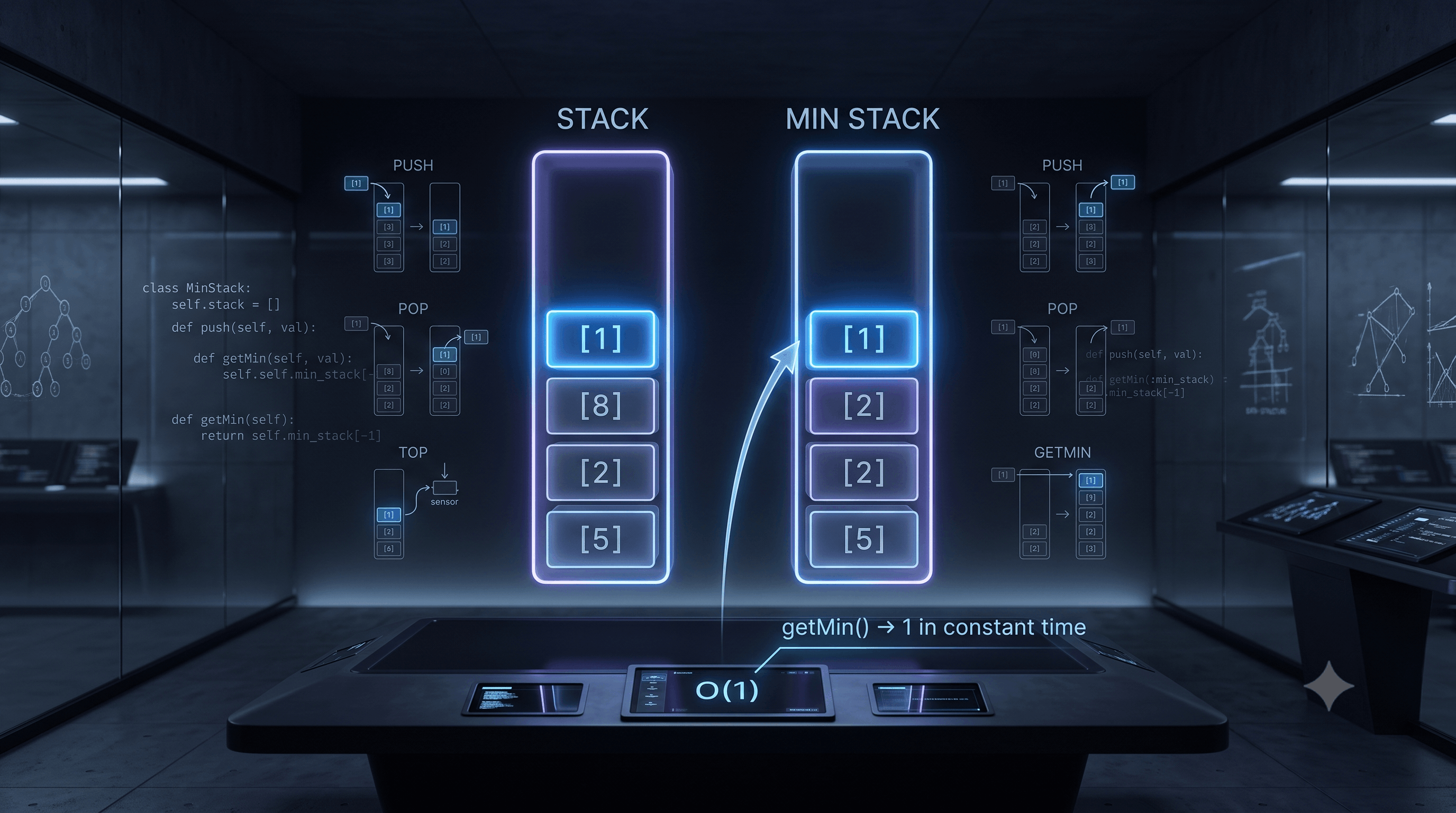 LeetCode #155: Min Stack — Design a Stack with O(1) Minimum Retrieval
 LeetCode #20: Valid Parentheses — Master the Stack Pattern
 LeetCode #15: 3Sum — Master Sorting, Two Pointers and Duplicate Handling
 Instruction vs Context in AI Prompts: How to Tell AI What to Do and What Information to Use
 Rust Structs and Enums: Building Powerful Data Models
 Dissecting the High-Level System Architecture of Booking.com
 Kanban vs. Scrum: Which Agile Methodology to Choose?
 The Scaling Journey of LinkedIn: From Startup to Professional Powerhouse
 Mastering Code Review: A Guide for Reviewers and PR Creators
 ChatGPT: Unveiling the Power of AI in Conversational Experiences with Kairos Coders

Kairos Coders are here to help
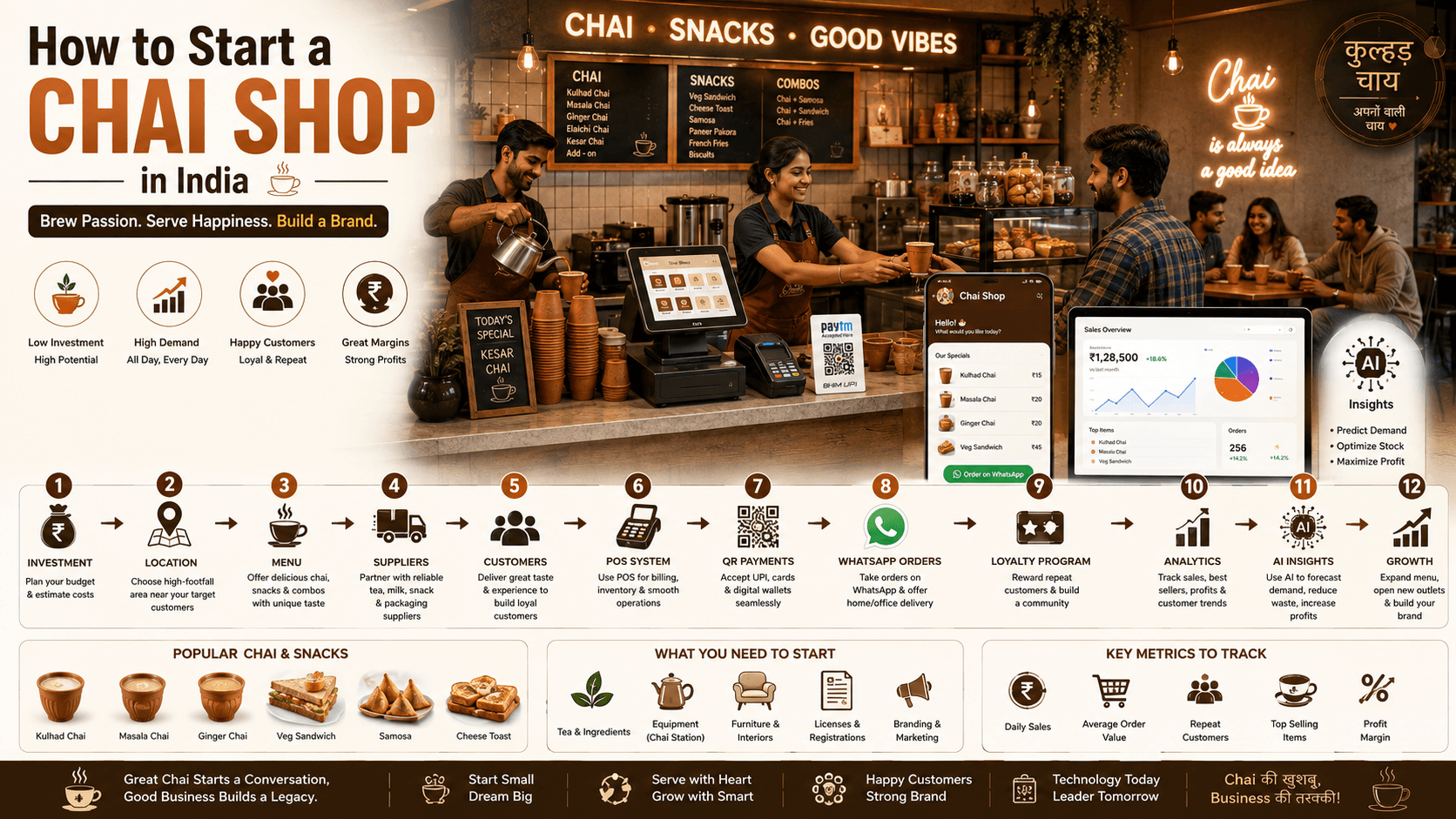
India doesn't just drink tea.
India runs on chai. ☕
From roadside tea stalls and kulhad chai counters to premium cafés and modern tea franchises, the chai business exists at almost every price point.
And that's what makes it interesting.
A chai shop can start as a relatively small business, but with the right location, pricing, menu, branding and technology, it can evolve into a recognizable local brand — or even a scalable franchise.
In this guide, we'll explore how to start a chai shop in India, how much you may need to invest, what to sell, how to calculate profit, how to choose a location, and how technology can turn a traditional chai shop into a modern food business.
Tea has several advantages as a business product.
Customers don't necessarily buy chai once a month.
They may buy it:
This creates the possibility of repeat customers.
The basic product is relatively straightforward:
Tea + Milk + Water + Sugar + Tea Leaves
The complexity comes from consistency, presentation, location, service and menu expansion.
You can operate a:
₹10 roadside chai stall
or
₹20–₹40 branded chai counter
or
₹100+ premium tea café
The business model changes depending on your target customer.
Before spending money, decide your format.
Small setup.
Low investment.
High volume.
Usually focused on:
The goal is volume and speed.
A more modern setup.
Possible menu:
The focus becomes:
Product + Branding + Experience
This is a completely different business.
You may have:
Now customers aren't only buying tea.
They're buying time and experience.
Investment varies enormously depending on the format.
An illustrative small branded chai counter might look like:
| Expense | Approx. Budget |
|---|---|
| Security deposit/advance | ₹50,000 |
| Interior/setup | ₹75,000 |
| Counter | ₹30,000 |
| Tea equipment | ₹25,000 |
| Refrigerator | ₹25,000 |
| Utensils & kitchen equipment | ₹20,000 |
| Signboard/branding | ₹20,000 |
| POS/QR setup | ₹10,000 |
| Initial inventory | ₹25,000 |
| Licenses/miscellaneous | ₹15,000 |
| Working capital | ₹50,000 |
| Illustrative Total | ₹3,45,000 |
These figures are only an example. Actual costs vary substantially based on city, rent, shop size, equipment and business model.
A simple tea stall can require considerably less.
A premium café can require several lakhs or significantly more.
You can make excellent chai and still struggle if nobody walks past your shop.
Look for locations with:
But don't only count people.
Count potential customers.
For example:
If 2,000 people pass your location every day, that doesn't mean 2,000 people are going to buy chai.
Ask:
How many are likely to stop?
Then estimate:
Footfall × Conversion Rate × Average Order Value
A simple model:
Customers/day × Average Order Value × Days/month
Suppose:
150 customers/day
and:
Average order = ₹35
Then:
150 × ₹35 = ₹5,250/day
For 30 days:
₹5,250 × 30 = ₹1,57,500/month
That's revenue.
Not profit.
The next step is understanding your costs.
Suppose one cup of chai sells for:
₹20
Your approximate ingredient cost might include:
Imagine the direct cost comes to approximately:
₹7
Then:
Selling Price = ₹20
Direct Cost = ₹7
Gross Contribution = ₹13
But you still have:
Therefore:
High gross margin does not automatically mean high net profit.
Don't create a menu with 50 items just because you can.
Every additional item creates:
Instead, build a focused menu.
Tea
Coffee
Food
Combos
Now you have a manageable menu.
Your cheapest item gets customers through the door.
Your premium items improve average order value.
Imagine:
| Product | Price |
| Regular Chai | ₹15 |
| Masala Chai | ₹25 |
| Kulhad Chai | ₹30 |
| Premium Chai | ₹40 |
| Chai + Snack Combo | ₹59 |
| Premium Combo | ₹99 |
A customer who originally planned to spend ₹15 may choose a ₹59 combo.
This is called upselling.
Your objective isn't necessarily:
Sell the most expensive product.
It's:
Increase the average order value without making the customer feel pressured.
Instead of selling:
Chai = ₹20
you can create:
Chai + Biscuit = ₹29
or:
Chai + Sandwich = ₹69
or:
2 Chai + Fries = ₹99
The customer perceives additional value.
Meanwhile, you increase:
Average Order Value (AOV).
A small increase in AOV can have a major impact when multiplied by hundreds of customers.
Suppose:
Monthly fixed costs = ₹60,000
And your average contribution after direct food costs is:
₹20 per order
Then:
₹60,000 ÷ ₹20 = 3,000 orders/month
For 30 days:
3,000 ÷ 30 = 100 orders/day
So approximately:
100 orders per day
would be required to cover those fixed costs under this simplified assumption.
Anything above that contributes toward operating profit.
This is why calculating break-even before opening is extremely useful.
A smart chai business should monitor:
How much did we sell?
How many transactions?
How much does each customer spend?
What are people buying?
Which products actually make money?
How much inventory is being thrown away?
When are customers coming?
These numbers tell you how to run the shop.
A POS system isn't just a billing machine.
It can become the central nervous system of your shop.
For example:
Customer
   ↓
Order
   ↓
POS
   ↓
Payment
   ↓
Inventory
   ↓
Sales Data
   ↓
Analytics
At the end of the day you can see:
Revenue: ₹7,850
Orders: 213
Average Order: ₹36.85
Top Product: Masala Chai
Top Combo: Chai + Sandwich
Now you're managing the business using data rather than guesses.
Instead of customers standing in a queue, put a QR code on tables or counters.
Customer scans:
QR → Digital Menu → Select Items → Order
The order reaches the counter.
For a small shop this may not be necessary on day one.
But as customer volume increases, it can reduce ordering friction.
Imagine someone visits your chai shop every evening.
Instead of losing the customer after they leave, you can build an opt-in customer relationship through WhatsApp Business.
You could potentially send:
Today's Special: Masala Kulhad Chai + Sandwich ₹69
or:
Rainy Evening Combo ☕
Chai + Pakora ₹59
The important part is permission and moderation.
Nobody wants ten promotional messages every day.
Use messaging to provide useful offers, not spam.
Your regular customers are your most valuable customers.
Imagine:
Buy 9 Chais → Get 1 Free
Or:
₹500 spent → ₹50 reward
Or a digital points system.
Now instead of asking:
"How do I find another customer?"
you can ask:
"How do I get existing customers to visit one more time this week?"
Retention can be more valuable than constantly chasing new customers.
Suppose your POS data shows:
8–10 AM → High demand
11 AM–1 PM → Low demand
4–7 PM → Very high demand
You can optimize staff accordingly.
During peak hours:
Technology helps you see these patterns.
You don't need a futuristic robot making tea.
AI can be useful behind the scenes.
Predict tomorrow's likely demand.
Recommend how much milk, tea, sugar or bread to purchase.
Identify:
Generate:
Ask:
"Why was Saturday's revenue lower?"
An AI-powered dashboard could analyze the sales data and identify possible patterns.
A future-ready chai business could look like:
                CUSTOMER
                    ↓
        ┌───────────┴───────────┐
        ↓                       ↓
      WALK-IN                QR/WHATSAPP
        ↓                       ↓
        └───────────┬───────────┘
                    ↓
                  POS
                    ↓
          ┌─────────┴─────────┐
          ↓                   ↓
      INVENTORY            CUSTOMER DB
          ↓                   ↓
          └─────────┬─────────┘
                    ↓
                ANALYTICS
                    ↓
                    AI
                    ↓
       ┌────────────┼────────────┐
       ↓            ↓            ↓
    Demand       Marketing    Business
  Forecasting    Insights     Insights
This is where a traditional chai shop starts becoming a data-driven business.
Technology should solve problems.
It shouldn't become the problem.
A small chai stall doesn't necessarily need:
Start simple.
UPI + basic billing
POS + inventory
WhatsApp + digital menu
Customer loyalty
Analytics
AI forecasting
Technology should grow with the business.
A cup of tea is a commodity.
A brand can turn it into an experience.
Think about:
Instead of:
"Let's go get tea."
Customers eventually say:
"Let's go to [Your Brand]."
That's the beginning of brand equity.
Chai is extremely visual.
You can create content around:
Short-form video can potentially bring local awareness without a huge advertising budget.
And your customers can become your marketing team.
Cheap rent doesn't guarantee customers.
Complexity increases costs.
Customers should receive the same taste repeatedly.
Low price doesn't automatically mean high profit.
Milk, bread, vegetables and other perishables can quietly eat your margins.
Staff costs should match business volume.
Your regular customers can become your biggest asset.
A beautiful shop with weak economics is still a bad business.
The long-term opportunity isn't necessarily one shop.
It could be:
One Shop
↓
Profitable Store
↓
Standardized Recipes
↓
Standardized Operations
↓
Second Store
↓
Central Procurement
↓
Brand
↓
Multiple Outlets
↓
Franchise
Technology becomes increasingly important at every step.
With multiple stores, you can monitor:
STORE 01 → ₹8,500/day
STORE 02 → ₹11,200/day
STORE 03 → ₹7,900/day
STORE 04 → ₹13,100/day
Then ask:
Why is Store 04 outperforming Store 01?
That's where analytics becomes a business advantage.
A successful chai shop isn't simply:
Good Chai = Good Business
It's closer to:
Location
Product
Pricing
Speed
Customer Experience
Marketing
Cost Control
Technology
=
Scalable Business
Technology doesn't replace the fundamentals.
It makes the fundamentals easier to measure and improve.
Starting a chai shop can look deceptively simple.
Put up a counter.
Make tea.
Sell it.
But building a profitable and scalable chai brand requires much more.
You need to understand:
Customers.
Costs.
Margins.
Location.
Inventory.
Pricing.
Retention.
Marketing.
And increasingly:
Technology.
The future isn't necessarily about replacing the traditional chai shop with technology.
It's about taking something as simple as a cup of chai and building a smarter business around it.
Start with one shop.
Get the economics right.
Build repeat customers.
Track your numbers.
Use technology where it actually helps.
Then scale.
Don't use technology because it looks cool.
Use it because it answers a business question.
What are customers buying?
When are they buying?
Which products make money?
How much inventory should we purchase?
Which customers are returning?
Where are we losing money?
How can we increase average order value?
Once technology starts answering these questions, your chai shop stops being just a tea counter.
It becomes a data-driven business.
Pixels to Perfection Design that Impresses